Friday, May 24, 2013

Article: A new iOS game looks to kickstart neuroscience education


Automatic v controlled cognitive brain clock timing systems: A link with working memory?


[Double click on image to enlarge]

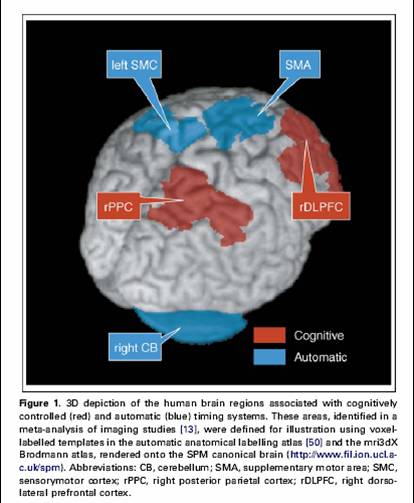
Contemporary research (Buhusi & Meck, 2005; Lewis & Miall, 2006) supports the idea that there are two mental timing circuits that can be dissociated: (1) an automatic timing system that works in the millisecond range, which is used in discrete-event (discontinuous) timing, and involves the cerebellum; and (2) a continuous-event, cognitively controlled timing system that requires attention and involves the basal ganglia and related cortical structures.

The above figure, which is based on a meta-analysis of studies (see Lewis & Miall, 2006), provides neurological evidence for two such systems via the localization of each system in different parts of the brain. What I (as a cognitive psychologist with a primary interest in psychological testing and theories of intelligence-see IQs Corner) find particularly intriguing is the conclusion (as reported in the Lewis & Miall, 2006 article as well as many other articles I've read) that the primary brain region associated with the cognitively controlled timing system is that also primarily associated with working memory--the dorsolateral prefrontal cortex (DLPFC).

  • Buhusi, W. & Meck, C. (Oct, 2005). What makes us tick: Functional and neural mechanism of interval timing. Nature Reviews: Neuroscience, 6, 755-765
  • Lewis, P. & Miall, C (2006). Remembering the time: a continuous clock. Trends in Cognitive Sciences, 10(9), 401-406.


Technorati Tags: , , , , , , , , , , , , , ,,,,,,

Wednesday, May 22, 2013

Article alert: Distinguishing How From Why the Mind Wanders: A Process-Occurrence Framework for Self-Generated Mental Activity

More on mind wandering.

PT J
AU Smallwood, J
AF Smallwood, Jonathan
TI Distinguishing How From Why the Mind Wanders: A Process-Occurrence
Framework for Self-Generated Mental Activity
SO PSYCHOLOGICAL BULLETIN
AB Cognition can unfold with little regard to the events taking place in
the environment, and such self-generated mental activity poses a
specific set of challenges for its scientific analysis in both cognitive
science and neuroscience. One problem is that the spontaneous onset of
self-generated mental activity makes it hard to distinguish the events
that control the occurrence of the experience from those processes that
ensure the continuity of an internal train of thought once initiated.
This review demonstrates that a distinction between process and
occurrence (a) provides theoretical clarity that has been absent from
current discussions of self-generated mental activity, (b) affords
conceptual leverage on seemingly disparate results associating the state
with both domain-general processes and task error, and (c) draws
attention to important questions for understanding unconstrained thought
in contexts such as psychopathology and education. It is suggested that
identifying the moment that self-generated mental events begin is a
necessary next step in moving toward a testable account of why the mind
has evolved to neglect the present in favor of ruminations on the past
or imaginary musings of what may yet come to pass.
PD MAY
PY 2013
VL 139
IS 3
BP 519
EP 535
ER

Article: Does brain training work? Yes, if it meets these 5 conditions


Article: Frontiers | Distraction and Mind-Wandering Under Load


Frontiers | Distraction and Mind-Wandering Under Load
http://www.frontiersin.org/Cognition/10.3389/fpsyg.2013.00283/abstract

Sent via Flipboard


Monday, May 20, 2013

Article: Alvaro Fernandez: Founder of SharpBrains talks about brain health


Alvaro Fernandez: Founder of SharpBrains talks about brain health
http://saludify.com/alvaro-fernandez-sharpbrains-health/

Sent via Flipboard


Attentional control (Posner, 2007 review): Executive attention may be trainable


A recent Annual Review of Psychology had a nice overview article (by Posner and Rothbart..click here to view) dealing with research on the cognitive construct of attention. I found Figure 2 and Table 1 (above) particularly informative. Below are some key quotes from the article. Given my prior reading and posts regarding the importance of executive attention, I was particularly interested in Posner and Rothbart's suggestion that executive attention may be a domain general learning mechanism that may be trainable. The italics and/or underlining below were added by this blogmaster.
  • In recent years, attention has been one of the fastest growing of all fields within cognitive psychology and cognitive neuroscience.
  • Certainly many, perhaps even most, imaging studies have been concerned with anatomical issues. As Figure 2 illustrates, several functions of attention have been shown to involve specific anatomical areas that carry out important functions.
  • Imaging data have supported the presence of three networks related to different aspects of attention (Fan et al. 2005). These networks carry out the functions of alerting, orienting, and executive attention (Posner & Fan 2007). A summary of the anatomy and chemical modulators involved in the three networks is shown in Table 1. Alerting is defined as achieving and maintaining a state of high sensitivity to incoming stimuli; orienting is the selection of information from sensory input; and executive attention involves mechanisms for monitoring and resolving conflict among thoughts, feelings, and responses.
  • ..we have argued that the executive attention network is involved in self-regulation of positive and negative affect as well as a wide variety of cognitive tasks underlying intelligence (Duncan et al. 2000). This idea suggests an important role for attention in moderating the activity of sensory, cognitive, and emotional systems.
  • There is considerable evidence that the executive attention network is of great importance in the acquisition of school subjects such as literacy (McCandliss et al. 2003) and in a wide variety of other subjects that draw upon general intelligence (Duncan et al.2000).
  • It has been widely believed by psychologists that training involves only specific domains, and that more general training of the mind, for example, by formal disciplines like mathematics or Latin, does not generalize beyond the specific domain trained (Thorndike 1903, Simon 1969). However, attention may be an exception to this idea. Attention involves specific brain mechanisms, as we have seen, but its function is to influence the operation of other brain networks (Posner & Rothbart 2007). Anatomically, the network involving resolution of conflict overlaps with brain areas related to general intelligence (Duncan et al. 2000). Training of attention either explicitly or implicitly is sometimes a part of the school curriculum (Posner&Rothbart 2007), but additional studies are needed to determine exactly how and when attention training can best be accomplished and its long-lasting importance.
  • Executive attention represents a neurodevelopmental process in children and adolescents, the alteration which could affect the propensity for the development of a number of disorders.

Technorati Tags: , , , , , , , , , , , ,

powered by performancing firefox

Article: Fit Brains Trainer for iPad and iPhone


Fit Brains Trainer for iPad and iPhone
http://trainer.fitbrains.com/

Sent via Flipboard