
Understanding the human brain clock & related neuroscience
Showing posts with label Mental Timing Scholars. Show all posts
Showing posts with label Mental Timing Scholars. Show all posts
Monday, November 21, 2011
The Auditory Neuroscience Lab.
Very interesting lab that is producing large volumes of publications related to music, rhythm and brain timing and rhythm. The Auditory Neuroscience Lab.


Monday, April 27, 2009
Mental Time Keeping Scholar: Dr. Jessica Grahn
Dr. Jessica Grahn, a Postdoctoral researcher at the University of Cambridge (MRC Cognition and Brain Sciences Unit), has been a prolific researcher (click here for list of related publications) re: how the brain processes rhythms and beats, cognitive functions clearly that involve the IQ Brain Clock.
I've just added Dr. Grahn to the IQs Corner Mental Timing Scholars list. I look forward to catching up on her publications, both past and future.
Technorati Tags: psychology, school psychology, educational psychology, cognitition, intelligence, IQ, neuropsychology, mental timing, interval timing, temporal processing, rhythm perception, beat production, music perception, Parkinsons, Mental Timing Scholar, IQ Brain Clock

Sunday, February 01, 2009
Mental time-keeping scholar: Katya Rubia

Technorati Tags: psychology, educational psychology, cognition, intelligence, school psychology, neuropsychology, neuroscience, IQ Brain Clock, brain clock, mental timing, temporal processing, mental time-keeping, metal time-keeping scholar
Wednesday, January 14, 2009
The IQ brain clock: Role of basal ganglia and cerebellum

[double click on image to enlarge}
In a prior post I drooled over the means by which he explained possible different neural models of temporal processing (the IQ Brain Clock) via visual-graphic diagrams. As a result of his most recent article (see prior post link above), I went and found an earlier 2004 publication (with Spencer) that again presents an excellent visual-graphic explanation of hypothesized different neural timing models (see figure above), but more importantly, presents a very nice visual-graphic explanation of the hypothesized role of the basal ganglia (and dopamaine), which have been repeatedly implicated in mental timing and such clinical disorders as Parkinson's (see figure below). I've always known that the basal ganglia play a prominent role in mental timing, but have never been able to grasp (probably reflecting my limitations) the possible "why" or underlying mechanism. They offer an interesting and understandable hypothesis.

[double click on image to enlarge]
In the Ivry and Spencer (2004) article in Current Opinion in Neurobiology, the authors suggest that the basal ganglia works like a gating mechanism....which I have compared to the switch operator function in a railway system (see PPT slide show). According to the authors, who also prominently feature the cerebellum in brain clock timing system models:
- The current evidence does not preclude distributed models or hypotheses that assign a central role for timing to another specialized system, such as the basal ganglia. As reviewed here, the results of imaging and lesion studies are ambiguous with respect to the role of the basal ganglia in timing short intervals. A clear dissociation between the cerebellar and the basal ganglia contributions on temporal processing tasks remains elusive, primarily because similar deficits have been observed in patients with lesions of either structure ..... The cerebellar hypothesis offers a parsimonious account over a broad set of tasks, and neurobiologically feasible models have been developed. Nonetheless, a specialized system hypothesis must be able to account for similar patterns of performance following damage to distinct systems.
- As a starting point, we propose that the basal ganglia are an integral part of decision processes, operating as a threshold mechanism (Figure 2). Activations into the basal ganglia are gated such that only those reaching threshold are implemented [69]. The activation functions for different decisions can reflect multiple factors, such as goals, sensory inputs, and contextual information. These representations engage in a competitive process for control. According to this view, the basal ganglia ensure that response implementation or working memory updating does not occur until a criterion level of activation is reached. Dopamine inputs to the striatum modulate threshold settings, providing one mechanism by which the competition can be biased. Thresholds for reinforced actions are lowered, increasing the likelihood of implementation, even if the input patterns are unchanged.
Technorati Tags: psychology, educational psychology, school psychology, biological psychology, neuropsychology, neuroscience, brain clock, IQ Brain Clock, mental timing, cerebellum, basal ganglia, dopamine, Parkinsons, temporal processing
Friday, December 19, 2008
IQ Brain Clock blog "tweaks": Research, interventions and scholars
I did a little blog maintenance today. Under "key research articles" you will now find two different IM (Interactive Metronome) "research packets." One deals with mental timing research in general, the other is IM-specific.
I've also fixed some dead links in the "Mental Timing Scholars" section. In the process, I visited each listed scholars web page in search of new publications. If found some new publications as well as some slightly older publications that I previously had not read. I've downloaded them and hope to read and post (if relevant) whatever I find.
Finally, given the increasing number of RAS effectiveness studies I've been running across (see yesterday's post), I added the CBRM (Center for Biomedical Research in Music) at Colorado State to the timing-related interventions section.
Happy holidays from the IQ Brain ClockTechnorati Tags: psychology, educational psychology, school psychology, neuropsychology, neuroscience, neurotechnology, cognition, intelligence, auditory processing, Ga, RAS, CBRM, mental timing scholars, Interactive Metronome, IQ Brain Clock, brain clock, temporal processing
I've also fixed some dead links in the "Mental Timing Scholars" section. In the process, I visited each listed scholars web page in search of new publications. If found some new publications as well as some slightly older publications that I previously had not read. I've downloaded them and hope to read and post (if relevant) whatever I find.
Finally, given the increasing number of RAS effectiveness studies I've been running across (see yesterday's post), I added the CBRM (Center for Biomedical Research in Music) at Colorado State to the timing-related interventions section.
Happy holidays from the IQ Brain ClockTechnorati Tags: psychology, educational psychology, school psychology, neuropsychology, neuroscience, neurotechnology, cognition, intelligence, auditory processing, Ga, RAS, CBRM, mental timing scholars, Interactive Metronome, IQ Brain Clock, brain clock, temporal processing
Wednesday, December 17, 2008
Mental timing scholar - Dr. Hedderik van Rijn

Technorati Tags: psychology, educational psychology, biological psychology, school psychology, neuropsychology, neuroscience, time perception, brain clock, interval timing, pacemaker accumulator model
Friday, October 31, 2008
Mental time keeping scholar - Dr. Richard Ivry

Another researcher has been added to the mental time keeping scholar blog roll. Below is information taken directly from Dr. Richard Ivry's web page.
Director Institute of Cognitive and Brain Sciences
Member, Executive Committee Helen Wills Neuroscience Institute
My research explores the neural basis of sensorimotor control and learning. Our experiments involve neurologically healthy and impaired individuals, use behavioral and neuroimaging methods to characterize the functional role of different parts of the motor pathways. For example, we have hypothesized that a primary role for the cerebellum is to regulate the temporal aspects of movement. Moreover, the cerebellum also appears to be involved in perceptual tasks that require precise timing. We are currently exploring how the brain may represent temporal information at a mechanistic level. We hypothesize that the cerebellum may be conceptualized as a network of interval-based timing elements, with these elements tuned to specific intervals that are task-specific.
This decade has seen a great deal of interest in higher-level functions of the cerebellum, inspired by various results in the neuroimaging literature as well as intriguing findings that this structure is abnormal in autistic individuals. Functional hypotheses include the idea that this structure is essential for attention shifting, internal speech, and/or preparation of response alternatives. We are testing these hypotheses in our patient population.
Another primary area of research involves the study of motor learning. We have conducted behavioral and neuroimaging studies comparing explicit and implicit motor sequence learning. This work suggests separable psychological and neural systems associated with these two forms of motor learning. Our current work is designed to clarify differences between the systems in terms of how they represent learned association.
Technorati Tags: psychology, neuropsychology, neuroscience, mental time keeping scholar, IQ Brain Clock, temporal processing
Director Institute of Cognitive and Brain Sciences
Member, Executive Committee Helen Wills Neuroscience Institute
My research explores the neural basis of sensorimotor control and learning. Our experiments involve neurologically healthy and impaired individuals, use behavioral and neuroimaging methods to characterize the functional role of different parts of the motor pathways. For example, we have hypothesized that a primary role for the cerebellum is to regulate the temporal aspects of movement. Moreover, the cerebellum also appears to be involved in perceptual tasks that require precise timing. We are currently exploring how the brain may represent temporal information at a mechanistic level. We hypothesize that the cerebellum may be conceptualized as a network of interval-based timing elements, with these elements tuned to specific intervals that are task-specific.
This decade has seen a great deal of interest in higher-level functions of the cerebellum, inspired by various results in the neuroimaging literature as well as intriguing findings that this structure is abnormal in autistic individuals. Functional hypotheses include the idea that this structure is essential for attention shifting, internal speech, and/or preparation of response alternatives. We are testing these hypotheses in our patient population.
Another primary area of research involves the study of motor learning. We have conducted behavioral and neuroimaging studies comparing explicit and implicit motor sequence learning. This work suggests separable psychological and neural systems associated with these two forms of motor learning. Our current work is designed to clarify differences between the systems in terms of how they represent learned association.
Technorati Tags: psychology, neuropsychology, neuroscience, mental time keeping scholar, IQ Brain Clock, temporal processing
Understanding the IQ brain clock: Excellent overview article

[double click on image to enlarge]
Damn I love the journal Trends in Cognitive Science. It routinely publishes concise articles that circumscribe the state of the knowledge in important areas of human cognition/intelligence. I just finished reading yet another outstanding article ("Dedicated and intrinsic models of time perception") by Ivry and Schlerf (2008) (click to review)
Throughout the past year I've posted material regarding different neural models that have been advanced to explain the IQ brain clock (temporal processing). I've never felt I've done a good job in pulling all of this together. These authors do an exceptional job in describing the four primary hypothesized models that have been advanced to explain the neural mechanisms underlying the human brain clock. More importantly they do so which the aid of great visual-graphics (see the one above). I liked the article so much that I've added it to the "key research articles" section of this blog and have also added Dr. Ivry to the "mental timing scholars" link section.
Technorati Tags: psychology, educational psychology, school psychology, neuropsychology, neurotechnology, neuroscience, mental time keeping, interval timing, temporal processing, temporal g, pacemaker accumulator, IQ Brain Clock
Throughout the past year I've posted material regarding different neural models that have been advanced to explain the IQ brain clock (temporal processing). I've never felt I've done a good job in pulling all of this together. These authors do an exceptional job in describing the four primary hypothesized models that have been advanced to explain the neural mechanisms underlying the human brain clock. More importantly they do so which the aid of great visual-graphics (see the one above). I liked the article so much that I've added it to the "key research articles" section of this blog and have also added Dr. Ivry to the "mental timing scholars" link section.
- Abstract: Two general frameworks have been articulated to describe how the passage of time is perceived. One emphasizes that the judgment of the duration of a stimulus depends on the operation of dedicated neural mechanisms specialized for representing the temporal relationships between events. Alternatively, the representation of duration could be ubiquitous, arising from the intrinsic dynamics of nondedicated neural mechanisms. In such models, duration might be encoded directly through the amount of activation of sensory processes or as spatial patterns of activity in a network of neurons. Although intrinsic models are neurally plausible, we highlight several issues that must be addressed before we dispense with models of duration perception that are based on dedicated processes.
- we focus on a fundamental question that has defined much of the recent discussion: is our perception of the passage of time the consequence of dedicated, clock-like neural mechanisms? Or is duration coded in an accessible manner as an intrinsic and ubiquitous property of neural activity?
- The facile manner with which we compare time across different modalities suggests some sort of internal clock.
- Dedicated models of time perception are, at their core, modular. As vision scientists speak of dedicated mechanisms for color or motion perception, modular models of time perception entail some sort of specialized mechanism that represents the temporal relationship between events. The pacemaker-counter model is one example of a modular system .
- Intrinsic models offer a radically different perspective on the perception of time. These models assume that there is no specialized brain system for representing temporal information, asserting that time is inherent in neural dynamics.
- the cerebellar timing hypothesis is based on the assumption that the cerebellum has a unique representational capability and is accessed whenever a particular task requires precise timing.
- Similar arguments have been developed for other neural regions that might serve as dedicated timing systems [25]. These include the basal ganglia [26,27], supplementary motor area [28,29] and prefrontal cortex, especially in the right hemisphere [30,31]. For the most part, converging evidence has been offered in support of all of these candidate regions.
- considerable debate continues on the question of whether temporal-processing deficits are uniquely associated with damage to a particular neural structure.
- Other dedicated models avoid localization issues by postulating that the representation of time results from activity across a network of regions
- The role of nontemporal factors on perceived duration Performance on time-perception tasks entails several component processes, many of which are not specific to time. These include attention, working memory and long-term or reference memor
Technorati Tags: psychology, educational psychology, school psychology, neuropsychology, neurotechnology, neuroscience, mental time keeping, interval timing, temporal processing, temporal g, pacemaker accumulator, IQ Brain Clock
Thursday, October 30, 2008
Cognitive and Action Lab & Richard Ivry: Mental timing scholar
 Only time for a quick note. I just discovered a great new research lab that conducts research related to topics covered by the IQ Brain Clock. It is the Cognitive and Action Lab run by Dr. Richard Ivry. I'm in the middle of reading a great overview article by Dr. Ivry....and will be making a post in the next few days. I've already added Dr. Ivry to the "mental timing scholars" list at this blog. I'll make a separate mental timing scholars post regarding Dr. Ivry soon.
More later. Some exciting and great work.
Tuesday, May 13, 2008
Genetics study links brain clock and autism
 This press release was sent to me by a friend of the Brain Clock blog. It is a press release from Corporate Communications and Marketing Athrolys College Road Bangor. The hyperlinks and additional reference information (including link to original research article and other Autism-related timing article) at the end of this post have been added by the Time Doc blogmaster.
Whenever I can find the time, I'll be adding autism to the "Group differences and clinical disorders" branch of the IQ Brain Clock EWOK. The complete list of possible clinical disorders research has suggested may involve aspects of mental timing (although not reflected at the current EWOK) are listed in my 2007 brain clock keynote address PPT show. This working list includes Parkinson's, Huntington's, Schizophrenia, ADHD, reading development and disorders (dyslexia), certain speech and language development related disorders, motor timing disorders, Aspergers, and now Autism.
I'm also soon be adding Dr. Wimpory to the Mental Timing Scholars blogroll of the IQ Brain Clock blog.
Publication date: 7/03/2007
Research by scientists in Wales reported in Molecular Psychiatry (advance online issue 30th Jan 07) has identified that Autistic Disorder is associated with two genes involved in timing and biological clocks: per1 and npas2. Cross species research shows that these two clock genes regulate timing mechanisms that control such things as sleep cycle, memory and communicative timing, a less familiar concept. The work, identifying a link between autism and these clock genes, was led by Dr. Dawn Wimpory, Lecturer-Practitioner/Consultant Clinical Psychologist for Autism, practising with the NWWales NHS Trust and Bangor University. She collaborated with Bangor University colleagues in both the School of Psychology and the North West Cancer Research Fund Institute (NWCRFI), together with Professor Michael J Owen’s team from Cardiff University’s Department of Psychological Medicine.Dr. Wimpory’s clinical work and observations of the lack of social/communicative timing in Autistic Disorder was complemented by colleague Brad Nicholas of The NWCRFI suggesting that clock genes may be involved. This idea waited many years to be tested but new information from the human genome project, developments in the field of biological clocks and the construction of
autism gene banks has recently allowed the experiment to be carried out.
“Timing is quintessential to normal infant development. In Autistic Disorder, malfunction of adaptive timing may lead to a cascade of other developmental problems. In the first few months an unaffected infant can take part in social exchanges, sharing eye contact and babbling in what we’d recognise as ‘natural’ communication patterns. This facility for preverbal communication appears lacking or diminished in Autistic Disorder,” explains Dr. Wimpory.
It is through such preverbal communication that an unaffected infant anticipates and predicts others’ behaviour, progressing to increasingly sophisticated social participation, for example, in teasing exchanges. Mutually enjoyable preverbal teasing games (e.g. ‘peep-bo!’) are timing-dependent. They appear as an early stage in the development of empathy and social pretence. Empathy and pretending are among the life-long difficulties for individuals with Autistic Disorder. These may be developmentally linked to early difficulties in synchronising with the inbuilt rhythms of communication including eye-contact.The study analyzed genetic markers in 11 clock related genes from 110 individuals with Autistic Disorder and each of their parents (avoiding the more varied ASD subjects and those with additional substantial learning/intellectual impairments often included in autism genetic studies). The results showed that markers in two of the genes, npas2 and per1, had significant association with Autistic Disorder. These two genes had already been identified as regulating complex emotional memory, communicative timing and sleep patterns in the mouse and the fruit fly; organisms that are used by scientists to study the role of clock genes. Problems in sleep, memory and timing are all characteristic of Autistic Disorder; each may play an important role in its development.
“Autism is a disorder of complex inheritance where several interacting genes may be involved. This is the first autism study to identify interacting genes, it is also the first to identify genes that regulate behaviour recognised as affected in autism: timing and memory. It adds further evidence for the role of the biological clock in autism”.The research was funded by the Baily Thomas Charitable Fund with additional support from Autism Cymru; the researchers now intend to replicate their study with a larger sample.
Time Doc blogmaster comments: I pulled the following two mental timing publications from Dr. Wimpory's web page:- Nicholas B, Rudrasingham V, Nash, S., Kirov G, Owen MJ, Wimpory, D. (2007). Association of Per1 and Npas2 with Autistic Disorder:Support for the Clock Genes/Social Timing Hypothesis Molecular Psychiatry,12,(6) 581-592 (click here to view)
- Wimpory, D., Nicholas, B., Nash, S. (2002). Social Timing, Clock Genes and Autism: A New Hypothesis Journal of Intellectual Disability Research, 46,(4) 352-358. (click here to view; note that date is listed incorrectly as 2005 on Dr. Wimpory's web page)
Friday, February 29, 2008
Research Byte: Wearden's "slowing down the brain clock" article published
A previous post listed an "in press" article (by Wearden) on slowing down the brain clock. The article is now officially published (click here to view)
Technorati Tags: psychology, educational psychology, neuroscience, neuropsychology, brain clock, temporal processing, IQ brain clock
Technorati Tags: psychology, educational psychology, neuroscience, neuropsychology, brain clock, temporal processing, IQ brain clock
Thursday, February 21, 2008
Alan Burdick on the human brain clock: The mind in overdrive
 As I continue to traverse the various disciplines studying various aspects of temporal processing or mental timing, I often get confused and drown in the conceptual, empirical and theoretical depth of the empirical articles from such a diverse array of disciplines. Trying to put together an understandable explanation of the human brain clock is difficult....I often doubt my abilities to distill this information. I often wonder if my brain clock speed is insufficient to understand this complex and rich array of diverse research.
I find hope when I run across professional writers who have attempted to understand and explain these phenomena to the general public. Hope was renewed the other day when I ran across a brief article (The mind in overdrive: Can we increase productivity by revving up the neural pacemakers in the brain?) in Discover magazine by the well-known NY free-lance author, Alan Burdick, where he attempted to tackle the difficult issue of understanding the human brain clock. Kudos to Burdick for working on bringing this knowledge to the awareness of the general public. I hope that Burdick continues to work on translating the complex literature of mental timing for general consumption. I wish I had such skills and could write similar articles, book chapters, or books about this important topic.
His 2006 Discover publication can be found by clicking here. I'm going to add a link to his web page to the IQ Brain Clock blog roll.
Technorati Tags: psychology, educational psychology, neuroscience, neuropsychology, mental timing, brain clock, temporal processing, Discover Magazine, Alan Burdick
Monday, October 01, 2007
Time Doc Byte #2: Importance of the brain clock
 Here is my second Time Doc Byte. Category - "importance" of the human brain clock and mental time-keeping. This time quotes from Lewis and Walsh (2005; see "Components of the brain's clock" in the Key Research Articles section.) Emphasis added by the Time Doc blogmaster.
Clearly Dr. Lewis et al believe that some kind of internal brain clock exists, but our understanding how it works, the brain mechanisms involved, etc., is still in a stage of formative development.
- We know the human brain contains some kind of clock, but determining its neural underpinnings and teasing apart its components have proven difficult.
- The holy grail of timing research is to understand the ‘time-dependent process’: a mechanism equivalent to a piezoelectric crystal in a man-made clock or the movement of a shadow on a sundial. This has proven an elusive goal, to the extent that ideas about how this mechanism might work remain near the level of conjecture. Researchers have had great difficulty in pinning timing-related activity in the brain to any specific type of function. This is largely because most time measurement tasks draw upon more than one process, making it difficult to tease the various components apart.
Technorati Tags: psychology, educational psychology, neuropsychology, neuroscience, cognition, intelligence, brain clock, mental timing, mental time keeping
Powered by ScribeFire.
Thursday, February 22, 2007
Mental time keeping scholar - Dr. Buonomano

In a prior post I announced the IQ Brain Clock blog "Mental Timing Scholars" link section (see side panel of this blog). Today I added a fifth researcher to this scholar honor role. This post is to highlight Dr. Dean Buonomano's research.
Below is a brief listing of his mental timing/temporal processing research interests (lifted from his lab web page). Although difficult for me to read (I'm still reading and rereading it), I've found his recent article with Dr. Karmarkar (Timing in the Absence of Clocks: Encoding Time in Neural Network States) particularly interesting since it suggests an alternative to the dominant internal mental clock theoretical/conceptual explanation for mental timing (a link to the article is provided in "key research articles" section of this blog).
NEURAL BASIS OF TEMPORAL PROCESSING
- Sensory stimuli, such as speech, are rich in temporal information on the time scale of tens to hundreds of milliseconds. The primary goal of my laboratory is to understand the neural basis of temporal information processing. Specifically, how do neurons develop selective responses to temporal characteristics such as the order, duration and intervals of different stimulus features' To answer this question the main approaches in my laboratory involve: (1) studying how cortical neural networks respond to temporal stimuli; (2) the characterization of time-dependent neuronal properties, and (3) studying short- and long-term synaptic plasticity. In parallel with these studies my laboratory also relies on computer simulations of artificial neural networks, and behavioral experiments aimed at characterizing temporal processing. Together these different approaches will be used to attempt to generate a theory of how the nervous system recognizes and categorizes complex sensory stimuli.
Mental time keeping scholar - Dr. Rammsayer

In a prior post I announced the IQ Brain Clock blog "Mental Timing Scholars" link section (see side panel of this blog). Today I added a fourth researcher to this scholar honor role. This post is to highlight Dr. Thomas Rammsayer's research.
Below is a brief listing of his mental timing/temporal processing research interests (lifted from his faculty web page). I have found his Intelligence article on "temporal g" particularly exciting (link to article is provided in "key research articles" section of this blog). In fact, a post re: this article was the first official post to the IQ Brain Clock blog.
- Temporal information processing in humans:
- Neurobiological approaches to timing systems in humans
- Perceptual and cognitive mechanisms in human timing and time perception
- Time psychophysics
Technorati Tags: psychology, educational psychology, cognition, school psychology, neuropsychology, neuroscience, neurology, intelligence, IQ, interval timing, mental timing, brain timing, master clock, brain clock, IQ Brain Clock.temporal tracking, temporal processing,Interactive Metronome,scalar timing
Monday, February 05, 2007
More on UCLA mental time keeping theory
More press coverage (Scientific American.com) (see post the other day) highlighting the new UCLA research suggesting an alternative to the traditional pacemaker-accumulator model of mental or interval time-keeping in the brain.
According to Warren Meck, one of the prominent mental time researchers previously featured at this blog:
Technorati Tags: psychology, educational psychology, neuroscience, neuropsychology, time, time perception, mental time keeping, brain, brain clock, interval timing, UCLA
According to Warren Meck, one of the prominent mental time researchers previously featured at this blog:
- "This paper has important implications for our every day perception of the temporal relationships among all of the sights and sounds that we process." He adds that the study complements his research focusing on internal clock mechanisms—which he has localized to the basal ganglia at the brain's center—at durations of seconds to hours involving cognitive and memory processes.
Technorati Tags: psychology, educational psychology, neuroscience, neuropsychology, time, time perception, mental time keeping, brain, brain clock, interval timing, UCLA
powered by performancing firefox
Thursday, November 09, 2006
Mental time keeping scholar - Dr. John Wearden

In a prior post I announced the IQ Brain Clock blog "Mental Timing Scholars" link section. I've now expanded this scholar honor roll to three reseachers (Meck, Lewis, and now Wearden). This post is to highlight Dr. John Wearden's program of research.
Below is a statement (lifted from his faculty web page) re: his mental interval time-keeping program of research. He is a scholar whose research this blog will monitor and summarize at it becomes available. What I very much appreciate, and readers of this blog should "check out"...is his list of publications...which includes links to pdf copies of all articles (so you can read and view everything he has done). Kudos to Dr. Wearden.
- For the last 15-20 years I have worked more or less exclusively on the perception of time. A specific area of interest has been the application of scalar timing theory (SET), originally developed as an explanation of timing in animals, to studies of time perception in humans. SET is an internal-clock-based model of timing, but in addition involves short- and long-term memory components, and decision processes. My research has investigated all these areas: studies of “speeding up” and “slowing down” the pacemaker of the clock (both with adults and children), studies of working memory and “reference” memory for duration, and manipulation of decision processes involved in timing. The most recent research involves attempts to control the operation of the putative internal clock, work on all sorts of memory for duration, and attempts to manipulate the “references” that people use when making time judgements. I have been involved in studies of timing in children, elderly people, patients with Parkinson's disease and, most recently, schizophrenia. An additional area of interest is animal timing. Although I do not carry out experiments on animals, I am engaged in computer and mathematical models of animal timing, as well as other theoretical issues. In general, a substantial proportion of my output is theoretical, mainly using computer modelling to test theories derived from SET, but also other areas such as modelling the process of chronometric counting. I have long-standing collaborations with researchers at the University of Liège in Belgium , and the University Blaise-Pascal in Clermont-Ferrand , France , and have recently begun a collaboration with researchers at the Hopital St. Anne in Paris .
- I hope to begin an extensive research programme on timing in the elderly, in particular the question of why distortions of subjective time in everyday life are so frequently mentioned by old people, and what these reports mean. Conventional laboratory studies of timing in the elderly find fairly consistent, albeit small, changes in time perception with age, albeit changes which seem far too slight to account for the subjective reports of older people. In a recent article, I have argued that much previous research on timing in old people (including my own) is “barking up the wrong tree”, and that novel methodologies are needed if old people's time experiences are to be properly understood. Some work in this area can be done with student participants, and preliminary data on some potentially relevant variables has already been collected.
Technorati Tags: psychology, educational psychology, cognition, school psychology, neuropsychology, neuroscience, neurology, intelligence, IQ, interval timing, mental timing, brain timing, master clock, brain clock, IQ Brain Clock.temporal tracking, temporal processing,Interactive Metronome,scalar timing
Sunday, November 05, 2006
Mental timing scholar feature: Dr. Penny Lewis
 In a prior post I announced the IQ Brain Clock blog "Mental Timing Scholars" link section. One of the two (I'm sure there are more...this "honor roll" will be updated) researchers is Dr. Penny Lewis, at the University of Manchester.
Below is a statement (lifted from her faculty web page) re: her mental interval time-keeping program of research. She is a scholar whose research this blog will monitor and summarize at it becomes available.
- "Time measurement is fundamental to almost everything we do: music and speech, for instance, are just time-coded variations in sound, and movements are carefully timed contractions of muscles. We perceive our lives as a flow of events in time, and plan our futures in the same way. If our timing system gets damaged, as it does in patients with Parkinson’s Disease, Schizophrenia, and certain types of brain injury, all of these abilities can be impaired. A fundamental question about time measurement is whether we have just one mental clock or a number of different clocks for timing in this range. I am using fMRI and temporary brain lesions induced using Transcranial Magnetic Stimulation (TMS) to address this question. To date, my findings support the existence of two quite distinct systems for automatic and cognitively controlled timing. Future work will clarify this picture and provide more information about how each system works."
Technorati Tags: psychology, educational psychology, cognition, school psychology, neuropsychology, neuroscience, neurology, intelligence, IQ, interval timing, mental timing, brain timing, master clock, brain clock, IQ Brain Clock.temporal tracking, temporal processing,Interactive Metronome,scalar timing
Saturday, November 04, 2006
New IQ Brain Clock blog features: Blogroll and "scholars"
This evening I've added two new features to the Tick Tock Talk: IQ Brain Clock blog. On the right-hand side of the blog you will find the "blogroll" and "mental timing scholars."
I simply lifted the neuroscience-related links I include at my mother-ship blog (IQs Corner) and placed them here. The "scholars" section simply reflects those researchers I've found via my reading in this area..and they appear to be top-notch researchers in mental time keeping.
At this time I'm asking for help. I'd like folks to send me (either via the blog "comment" feature of this blog; or via my email [iap@earthlink.net]) other blogs to consider adding to the blogroll and nominations (with URL's to web pages if possible) of researchers/scholars who are doing important research in this area.
Thanks.
Technorati Tags: psychology, educational psychology, cognition, school psychology, neuropsychology, neuroscience, neurology, intelligence, IQ, interval timing, mental timing, brain timing, master clock, brain clock, IQ Brain Clock.temporal tracking, temporal processing,Interactive Metronome,scalar timing
I simply lifted the neuroscience-related links I include at my mother-ship blog (IQs Corner) and placed them here. The "scholars" section simply reflects those researchers I've found via my reading in this area..and they appear to be top-notch researchers in mental time keeping.
At this time I'm asking for help. I'd like folks to send me (either via the blog "comment" feature of this blog; or via my email [iap@earthlink.net]) other blogs to consider adding to the blogroll and nominations (with URL's to web pages if possible) of researchers/scholars who are doing important research in this area.
Thanks.
Technorati Tags: psychology, educational psychology, cognition, school psychology, neuropsychology, neuroscience, neurology, intelligence, IQ, interval timing, mental timing, brain timing, master clock, brain clock, IQ Brain Clock.temporal tracking, temporal processing,Interactive Metronome,scalar timing
Wednesday, October 25, 2006
Automatic vs cognitively controlled cognitive timing: Plus working memory link
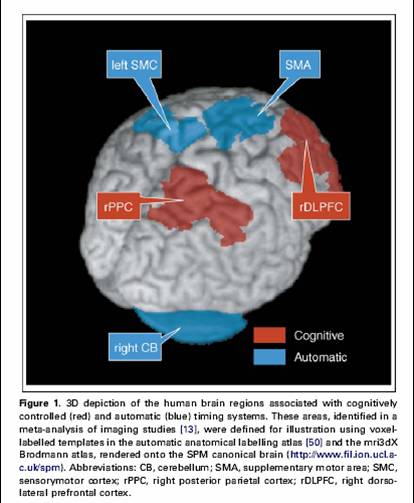
[Double click on image to enlarge]
Contemporary research (Buhusi & Meck, 2005; Lewis & Miall, 2006) supports the idea that there are two mental timing circuits that can be dissociated: (1) an automatic timing system that works in the millisecond range, which is used in discrete-event (discontinuous) timing, and involves the cerebellum; and (2) a continuous-event, cognitively controlled timing system that requires attention and involves the basal ganglia and related cortical structures.The above figure, which is based on a meta-analysis of studies (see Lewis & Miall, 2006), provides neurological evidence for two such systems via the localization of each system in different parts of the brain. What I (as a cognitive psychologist with a primary interest in psychological testing and theories of intelligence-see IQs Corner) find particularly intriguing is the conclusion (as reported in the Lewis & Miall, 2006 article as well as many other articles I've read) that the primary brain region associated with the cognitively controlled timing system is that also primarily associated with working memory--the dorsolateral prefrontal cortex (DLPFC).
More on this potentially important relationship in future posts.
- Buhusi, W. & Meck, C. (Oct, 2005). What makes us tick: Functional and neural mechanism of interval timing. Nature Reviews: Neuroscience, 6, 755-765
- Lewis, P. & Miall, C (2006). Remembering the time: a continuous clock. Trends in Cognitive Sciences, 10(9), 401-406.
Technorati Tags: psychology, educational psychology, cognition, school psychology, neuropsychology, neuroscience, neurology, intelligence, IQ, interval timing, mental timing, brain timing, master clock, brain clock,temporal processing,Interactive Metronome,scalar timing,working memory,prefrontal cortex,Gsm
Subscribe to:
Posts (Atom)