
Understanding the human brain clock & related neuroscience
Showing posts with label scalar theory. Show all posts
Showing posts with label scalar theory. Show all posts
Tuesday, November 15, 2011
Tic toc: Where's your brain's clock?
I stumbled across a nice general media article that highlights some of the major concepts OD the human master brain clock. The article was in the Conversation.


Wednesday, October 24, 2007
The brain clock in children: How early?
 Again, more from my reading of Meck's edited text on the brain clock and interval timing. This time from Sylvie Droit-Volet's chapter on "Temporal experience and timing in children." Dr. Droit-Volet has published extensively on the developmental aspects of the brain clock in children. [I've got at least a half dozen of her articles in my "to read" folder....I just don't have enough time]
Below are some select quotes/conclusions. The bottom line (from my reading) is that the human temporal processing unit (aka. the brain block) is present in young children and research suggests it functions, in most respects, similar to the adult brain clock. One similarity is that auditory information appears to be processed more efficiently by the human brain clock. Also, attention is a critical ability in temporal processing. Below are some tidbits from the chapter (emphasis added by the Time Doc blogmaster).
- These findings suggest that the clock-based system underlying time perception in animals and human adults is functional at an early age.
- Our study was then a clear demonstration that the pacemaker-accumulator system is functional at an early age
- There is ample evidence that auditory stimuli are judged longer than equivalent visual stimuli, and visual stimuli shorter than auditory ones....Thus, for the same the same objective duration, more pulses are accumulated for auditory signals than for visual signals, and the subjective time seems longer.
- However, it has been argued that differences in pacemaker speed are not the main source of variability in a timing system...In fact, according to scalar timing theory, the main source of variance is in the memory-encoding process.
- The greater sensitivity to duration for auditory than for visual stimuli in younger children suggests a sort of primacy of audition over vision in the processing off temporal information. This is an old idea, already put forward by studies in infants perception of temporal characteristics of speech sound and rhythms.
- The most critical process in children's abilities to time events is probably the encoding of duration.
- Difficulties in the encoding of duration can also account for the high variability in the memory representation of the standard duration in young children. Indeed, the memory representation is the result of how it has been encoded. Among the cognitive processes involved in the encoding of duration, we have specifically investigated the of attention. 202
- Psychologists agree that the amount of attentional resources increases with age durring early development.
Technorati Tags: psychology, educational psychology, school psychology, neuropsychology, developmental, intelligence, cognition, brain clock, pacemaker accumulator, scalar timing theory, children, auditory, visual, Ga, Gv, memory encoding
Powered by ScribeFire.
Wednesday, July 11, 2007
Research bytes - Wearden mental timing scholar pubs again, and again, and...
 John Weardon, one of the listed "mental timing scholars" at the IQ Brain Clock (see right hand column of blog), together with some of his colleagues, has been busy pumping out more theoretical mental timing research. Be forewarned, these are not-so-easy to read research articles. Check out the following recent "in press" pubs. Emphasis and/or any links below provided by blogmaster.
- "In press" Journal of Experimental Child Psychology article that concludes that "judgments of the similarity of two successive durations separated by a retention interval, the retention of the first duration in short-term memory reduces temporal accuracy."
- "In press" Quarterly Journal of Experimental Psychology (QJEP) that supports the major characteristics/assumptions of Scalar Expectancy Timing Theory (SET), which is the primary theoretical foundation of the pacemaker-accumulator model of mental timing.
- Another "in press" article in QJEP that demonstrates that it is possible to experimentally "slow down" the internal brain clock. Why would one want to slow down the clock, when speeding up the mental brain clock is associated with better cognitive functioning? According to the authors, demonstrating that it is possible to slow down the internal clock can help with our understanding how people maintain time via their internal clock. That is...it can help us better understand the phenomena of mental timing.
Technorati Tags: psychology, educational psychology, neuropsychology, neuroscience, mental timing, time perception, scalar theory, pacemaker accumulator, brain clock, temporal processing, temporal awareness, brain clock
Powered by ScribeFire.
Friday, June 01, 2007
Mental timing research buzz--4 Acta Psychologica articles

The journal Acta Psychologica recently published (or has "in press") a number of articles dealing with different aspects of mental/interval timing. Check out the following. The next revision of the IQ Brain Clock EWOK will includes these articles.
Warning....these are not lite reading.
Fortin et al (in press). Temporal order in memory and interval timing: An interference analysis (click here).
Technorati Tags: psychology, educational psychology, neuroscience, neuropsychology, time perception, interval timing, mental time keeping, IQ brain clock, brain clock, temporal processing, intelligence, brain structures
Powered by ScribeFire.
Warning....these are not lite reading.
Fortin et al (in press). Temporal order in memory and interval timing: An interference analysis (click here).
- Topics covered include (but are not limited to) the interference effect in time perception, the attention allocation model (which accounts for numerous research findings in time estimation research),as well as good summaries of the brain structures/locations involved in different aspects of the mental time-keeper model (e.g., the accumulator of the pacemaker accumulator model residing in the striatal structures). I found the introduction a good overview of some established findings in the mental time-keeping research. The primary empirical results of this study suggest that timing is especially dependent on resources also used in processing temporal order in memory.
- The primary focus of this investigation is on the "unity assumption" which the authors describe as the following -- "whenever two or more sensory inputs are highly consistent (in one or more dimension(s); such as time, space, temporal patterning, number, and semantic content), observers will be more likely to treat them as referring to the same underlying multisensory event rather than as referring to separate unimodal events. Consequently, observers will be more likely to assume that the sensory inputs have a common spatiotemporal origin, and hence will be more likely to bind them into a single unified percept."
- If you have checked out the IQ Brain Clock EWOK, you will recognize the first author of this article....Droit-Volet, who has published consistently in this area of study. These investigators use the classic time bisection task. The bottom line conclusion--"the present study provides us with an insight into how children perform a temporal bisection task when compared with adults. It shows that, unlike in adults, the provision of referent durations improves children’s bisection performance by helping them to establish criterion duration. Indeed, our data suggest that children exhibit a variability both in the establishment of a criterion duration and in the encoding of time."
- In the mental time-keeping research it is often suggested that different mechanisms processing temporal intervals above and below 2-3 seconds (although the research results have been mixed). The results support the notion of two different processes. The authors concluded "our results are in accordance with the conceptual idea of Fraisse (1984) that differentiates between perception of duration (intervals up to 3s) and estimation of duration (intervals onger than 3 s). He suggests that shorter durations might be “perceived” as a unit.
Technorati Tags: psychology, educational psychology, neuroscience, neuropsychology, time perception, interval timing, mental time keeping, IQ brain clock, brain clock, temporal processing, intelligence, brain structures
Powered by ScribeFire.
Wednesday, February 14, 2007
New timing blog - circadian emphasis
Bingo.
This afternoon I discovered another blog that covers topics related to the IQ Brain Clock blog (the blog you are reading). The blog is called "A blog around the clock" with a specific focus on human timing at the level of circadian rhythms (see prior post for the placement of circadian rhythms in the hierarchy of scales of human time perception).
As soon as I'm done with this post I'll be adding this blog to the IQ Brain Clock blog roll. Keep on ticking.......
Technorati Tags: psychology, neuropsychology, educational psychology, school psychology, mental timing, time perception, temporal, brain clock, interval timing, circadian, intelligence, cognition
powered by performancing firefox
This afternoon I discovered another blog that covers topics related to the IQ Brain Clock blog (the blog you are reading). The blog is called "A blog around the clock" with a specific focus on human timing at the level of circadian rhythms (see prior post for the placement of circadian rhythms in the hierarchy of scales of human time perception).
As soon as I'm done with this post I'll be adding this blog to the IQ Brain Clock blog roll. Keep on ticking.......
Technorati Tags: psychology, neuropsychology, educational psychology, school psychology, mental timing, time perception, temporal, brain clock, interval timing, circadian, intelligence, cognition
powered by performancing firefox
What makes us tick? Nice research summary
Previously in this blog I've drawn attention to one of the key contemporary articles dealing with the neural mechanisms of mental/interval time keeping (by Buhusi and Meck). A copy of the complete article is listed under the "Key Research articles" portion of this blog ("What Makes Us Tick?).
Today I ran across a nice bulleted Neuroscience ummary of the article. It can be found by clicking here.
Technorati Tags: psychology, educational psychology, neuroscience, neuropsychology, mental timing, brain clock, interval timing, cognition, intelligence, temporal processing, internal clock model
powered by performancing firefox
Today I ran across a nice bulleted Neuroscience ummary of the article. It can be found by clicking here.
Technorati Tags: psychology, educational psychology, neuroscience, neuropsychology, mental timing, brain clock, interval timing, cognition, intelligence, temporal processing, internal clock model
powered by performancing firefox
Wednesday, November 15, 2006
Interactive Metronome keynote PPT slides posted: New blog feature
I've added a new feature to the IQ Brain Clock blog. You can see a new section on the right side, down a bit, called "On-line PPT slides." I plan to post any relevant PPT slides related to the purpose of this blog. Currently only one set has been posted..."Interactive Metronome: Whats happening under the hood?"
This was my keynote presentation as an external speaker at the October, 2006 IM conference in Austin, TX. See prior posts regarding my external consultant/evaluator potential "conflict of interest" with regard to IM.
Technorati Tags: psychology, educational psychology, school psychology, neuropsychology, neuroscience, mental time keeping, interval timing, brain clock, IQ Brain Clock, sychronized metronome tapping, Interactive Metronome, intelligence
This was my keynote presentation as an external speaker at the October, 2006 IM conference in Austin, TX. See prior posts regarding my external consultant/evaluator potential "conflict of interest" with regard to IM.
Technorati Tags: psychology, educational psychology, school psychology, neuropsychology, neuroscience, mental time keeping, interval timing, brain clock, IQ Brain Clock, sychronized metronome tapping, Interactive Metronome, intelligence
powered by performancing firefox
Wednesday, October 25, 2006
Introduction to pacemaker-accumulator mental time-keeping model
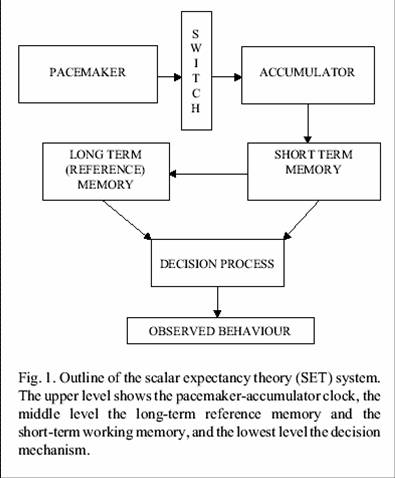 I previously made a couple of tease posts re: the predominant theoretical model of mental interval time-keeping (viz., the pacemaker-accumulator model). It is now time to "buck up" and provide my brief overview. Above is the best figure I've found to date (click here to see the original source article).
Human behavior based on the perception and timing in the range of seconds-to-minutes has traditionally been explained bythe pacemaker–accumulator model. The pacemaker-accumulator model (PAM), which is based on scalar expectancy or timing theory (Church, 1984; Gibbon et al., 1984; Meck, 1983), “is relatively straightforward, and provides powerful explanations of both behavioural and physiological data” (Buhusi & Meck, 2005; p. 755).
Briefly, the PAM model implicates the processing of temporal information via three synchronized modular information processing systems (see Buhusi & Mech, 2005.) The “clock” system consists of a dopaminergic pacemaker that regularly generates or emits neural ticks or pulses that are transferred (via a “gaiting” switch) to the accumulator, which accumulates ticks/pulses (neural counting) that correspond to a specific time interval. The raw representation of the stimulus duration in the accumulator is then transferred to working memory, a component of the PAM “memory” system. The contents of working memory are then compared against a “reference standard” in the long-term (reference) memory, the second component of the PAM memory system. Finally, the “decision” level of the PAM is conceptualized to consist of a comparator that determines an appropriate response based on a decision rule which involves a comparison between the interval duration value present in working memory and the corresponding duration value in reference memory. In other words, a comparison is made between the contents of reference memory (the standard) and working memory (viz., are they “close?”).
Considerable research evidence suggests that the PAM could be conceptualized as domain-general master internal clock central to many complex human behaviors (see Buhusi & Meck, 2005 and Lewis & Miall, 2006). Mental interval time-keeping and temporal processing research has suggested that a higher mental clock rate enables individuals to perform specific sequences of mental operations faster and reduces the probability of occurrence of interfering incidents (i.e., less disinhibition), two conditions that produce superior performance on cognitive tasks as well as more efficient basic information processing skills (Rammsayer & Brandler, in press).
Technorati Tags: psychology, educational psychology, cognition, school psychology, neuropsychology, neuroscience, neurology, intelligence, IQ, interval timing, mental timing, brain timing, master clock, brain clock, IQ Brain Clock.temporal tracking, temporal processing,Interactive Metronome,scalar timing
Subscribe to:
Posts (Atom)