Showing posts with label pacemaker accumulator. Show all posts

Monday, January 11, 2016

Your brain is a time machine: An oldie-but-goodie (OBG) post

This is an OBG (oldie-but-goodie) post I originally made on the IM-HOME blog

Time and space are the two fundamental dimensions of our lives. All forms of human behavior require us to process and understand information we receive from our environment in either spatial or temporal patterns. Even though mental timing (temporal processing) research is in a stage of infancy (when compared to spatial processing) important insights regarding the human brain clock have emerged.

Below is a list (albeit incomplete) of some of the major conclusions regarding the human brain clock. The sources for these statements come from my review of the temporal processing and brain clock literature during the past five years. Most of this information has been disseminated at the Brain Clock blog or the Brain Clock Evolving Web of Knowledge (EWOK). The goal of this post is to provide a Readers Digest summary of the major conclusions. This material can serve as a set of "talking points" at your next social event where you can impress your friends and family as you explain why you use the high-tech IM "clapper" (with a cowbell tone no less) either as a provider or as client.

Our brains measure time constantly. It's hard to find any complex human behavior where mental timing is not involved. Timing is required to walk, talk, perform complex movements and coordinate information flow across the brain for complex human thought. Think about moving your arm and hand to grasp a coffee cup. The messages to perform this task originate in your brain, which is not directly connected to your arm, hands and fingers. The ability to perform the necessary motor movements is possible only because the mind and extremities are connected via timing. Precisely timed neural messages connect your brain and extremities. You are a time machine.


Humans are remarkably proficient at internally perceiving and monitoring time to produce precisely timed behaviors and thinking. “We are aware of how long we have been doing a particular thing, how long it has been since we last slept, and how long it will be until lunch or dinner. We are ready, at any moment, to make complex movements requiring muscle coordination with microsecond accuracy, or to decode temporally complex auditory signals in the form of speech or music. Our timing abilities are impressive…” (Lewis & Walsh, 2005, p. 389).

To deal with time, humans have developed multiple timing systems that are active over more than 10 orders of magnitude with various degrees of precision (see figure below from Buhusi & Meck, 2005). These different timing systems can be classified into three general classes (viz., circadian, interval, and millisecond timing), each associated with different behaviors and brain structures and mechanisms. The fastest timing system (millisecond or interval timing) is involved in a numerous human behaviors such as speech and language, music perception and production, coordinated motor behaviors, attention, and thinking. This fast interval timing system is the most important timing system for understanding and diagnosing clinical disorders and for developing and evaluating effective treatment interventions for educational and rehabilitation settings. It is this timing system, and the relevant research, that is relevant to understanding Interactive Metronome. (Note.  See my conflict of interest statement at this blog.  I have an ongoing consulting relationship with IM).


Although there is consensus that the human brain contains some kind of clock, the jury is still out on the exact brain mechanisms and locations. It is also not clear whether there is one functional master clock or a series of clocks deployed in different brain areas. The areas of the brain most consistently associated with milli-second interval mental timing are the cerebellum, anterior cingulate, basal ganglia, the dorsolateral prefrontal cortex, right parietal cortex, motor cortex, and the frontal-striatal loop. That is a mouthful of technical brain terms. But, if you can memorize them and have them roll of your tongue with ease you will “shock and awe” your family and friends. Most of these areas of the brain are illustrated below. Now, if you really want to demonstrate your expertise, get your own illustrated “brain-in-a-pocket”. These images were generated by the free 3D Brain app available for your iPhone or iPad. Even cooler is the fact that you can rotate the images with your finger! You can give neuroanatomy lessons anytime…anywhere!


Research suggests that mental interval timing is controlled by two sub-systems. The automatic timing system processes discrete-event (discontinuous) timing in milliseconds. The cognitively-controlled timing system deals with continuous-event timing (in seconds) that requires controlled attention and working memory. Both systems are likely involved in IM. For example, the synchronized clapping requires motor planning and execution, functions most associated with the automatic timing system. However, the cognitive aspects of IM (focus, controlled attention, executive functions) invoke the cognitively controlled timing system. Aren’t these brain images awesome?


The dominant model in the brain clock research literature is that of a centralized internal clock that functions as per the pacemaker–accumulator model. Briefly, this is a model where an oscillator beating at a fixed frequency generates tics that are detected by a counter. For now I am just going to tease you with an image of this model. You can read more about this model at the Brain Clock blog.


Research suggests that the brain mechanisms underlying mental timing can be fine-tuned (modified) via experience and environmental manipulation. Modifiability of mental interval timing and subsequent transfer suggest a domain-general timing mechanism that, if harnessed via appropriately designed timing-based interventions, may improve human performance in a number of important cognitive and motor domains.

Friday, September 27, 2013

New review regarding human brain clock research and theory

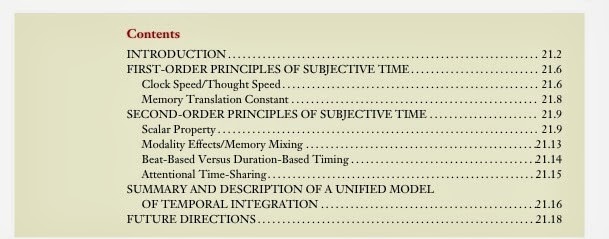
Hot off the press, in the prestigious Annual Review of Psychology has an excellent review (Allman et al., 2013) of contemporary research and theory regarding many aspects of the human brain clock (brain clock timing; temporal g).  I will be adding this to the Key Research Article blogroll section of this blog.

A few images from the article to give an advance peek.  [Click on images to enlarge]


Friday, March 23, 2012

Key Research Article: Timing and Time Perception Review

The following is a nice review of manly corners of the human timing research has been added to the Brain Clock Key Research Articles blogroll. Enjoy. Click on images to enlarge.


- Posted using BlogPress from Kevin McGrew's iPad

Tuesday, November 15, 2011

Tic toc: Where's your brain's clock?

I stumbled across a nice general media article that highlights some of the major concepts OD the human master brain clock. The article was in the Conversation.

Thursday, December 23, 2010

Research byte: Population clocks model of motor timing (Buonomano & Laje, 2010)


Double click on image to enlarge

Buonomano and Laje (2010) have presented an interesting description of a population clocks model to explain motor timing. The article is a hard read....and if it is too difficult, just do what I did....enjoy the lovely graphic figures. Seriously...this is an important contribution to understanding motor timing in motor performance. I will need to digest it more than once. Probably the most useful aspect of the article is the nice intro overview of the various theoretical models that have been advanced to explain the human brain clock.


The PDF article includes highlights and notes as per the IQs Reading blog feature.

The article will be added to the Key Research Articles section of this blog.


- iPost using BlogPress from my Kevin McGrew's iPad


Thursday, October 07, 2010

More research on possible brain centers of "IQ brain clock" and pacemaker-accummulator model of time-keeping

Wittmann, M., Simmons, A. N., Aron, J. L., & Paulus, M. P. (2010). Accumulation of neural activity in the posterior insula encodes the passage of time. Neuropsychologia, 48(10), 3110-3120.


Abstract
  • A number of studies have examined the perception of time with durations ranging from milliseconds to a few seconds, however the neural basis of these processes are still poorly understood and the neural substrates underlying the perception of multiple-second intervals are unknown. Here we present evidence of neural systems activity in circumscribed areas of the human brain involved in the encoding of intervals with durations of 9 and 18 s in a temporal reproduction task using event-related functional magnetic resonance imaging (fMRI). During the encoding there was greater activation in more posterior parts of the medial frontal and insular cortex whereas the reproduction phase involved more anterior parts of these brain structures. Intriguingly, activation curves over time show an accumulating pattern of neural activity, which peaks at the end of the interval within bilateral posterior insula and superior temporal cortex when individuals are presented with 9- and 18-s tone intervals. This is consistent with an accumulator-type activity, which encodes duration in the multiple seconds range. Given the close connection between the dorsal posterior insula and ascending internal body signals, we suggest that the accumulation of physiological changes in body states constitutes our experience of time. This is the first time that an accumulation function in the posterior insula is detected that might be correlated with the encoding of time intervals.
Select quotes from discussion [blog master comments in brackets.  Links inserted by blog master]

  • This study examined the neural substrates that underlie the processing of time in the seconds domain. In particular, activation was observed in brain regions related to the encoding and reproduction of time intervals which have been implicated as core neural substrates of time-keeping systems, notably the supplementary motor area, the striatum, cerebellum, the right frontal lobe, the inferior parietal gyrus, the posterior temporal cortex as well as the insula (Lewis & Miall, 2003a, 2003b; Rubia & Smith, 2004; Wiener et al., 2010; Wittmann, 1999).[Click here and here for prior posts related to possible underlying brain locations/structures of "brain clock"]
  • It seems as if the more posterior regions of the brain are instrumental in coding the duration of a presented interval and that many distributed (more anterior) regions of the brain are involved in keeping a representation of that interval for further processing (pressing the button at the right moment in time).
  • The main finding of this study is that the BOLD fMRI results support an integrator-like neuronal function over time involved in the representation of duration in humans. The pattern of activation for the 3-s interval differed from that observed for the longer intervals. This suggests that the perception of duration for shorter durations(up to 3 s) might rely on different brain areas (recruiting sensorimotor systems of the brain) than the estimation of duration in the multiple-second range (Fraisse, 1984; Morillon et al., 2009; Pöppel, 1997, 2009; Wittmann et al., 2007). The separation of the shorter from the two longer time intervals is also suggested by the high correlation in subjects’ behavioral performance between the 9- and 18-s temporal reproduction intervals and the lack of correlation between the 3 s and the two longer durations.
  • The finding that neural activity appears to accumulate in the posterior insula provides key evidence for piecing together a theory in which interoception might function as the prime source for our subjective experience of time. Our findings together with existing studies on the influence of emotions on the experience of time (Droit-Volet & Gil, 2009; Noulhiane, Mella, Samson, Ragot, & Pouthas, 2007; Wittmann, Vollmer, Schweiger, & Hiddemann, 2006) may lead the way for a comprehensive understanding of temporal processing in the brain. Our results concerning climbing neural activity in circumscribed regions of the brain and similar more unspecific findings of climbing activity as found in human EEG with shorter intervals are compatible with the pacemaker-accumulator model of time perception (Pfeuty et al., 2005). In line with this conceptualization is it is conceivable that the number and rate of body signals accumulated in the posterior insula over a given time span creates our sense of duration. Although this conclusion is speculative, we propose that the posterior insula, which processes physiological changes in body states, is strongly involved in our experience of time.

Thursday, November 20, 2008

How many internal brain clocks do we have?


Thanks to BPS for mentioning a research study ("How many clocks do we have") I apparently missed in my routine literature searches. The reference for the article, as well as the key figure, is presented above (double click on image to enlarge).

The research study was designed to investigate how humans can track multiple or different time intervals simultaneously. Three different type of hypothetical models were posited (see figure above). One is the classic pacemaker-accumulator model (which has spawned considerable research) with a single pacemaker and accumulator, the second is a model with a single pacemaker but multiple accumulators, the third is s multiple timing system (multiple sets of pacemakers and accumulators). You can read the detailed results, but the bottom line is that the authors concluded that their study favored the classic pacemaker-accumulator model (starred in figure above)

Technorati Tags: , , , , , , , , , ,

Friday, October 31, 2008

Understanding the IQ brain clock: Excellent overview article


[double click on image to enlarge]

Damn I love the journal Trends in Cognitive Science. It routinely publishes concise articles that circumscribe the state of the knowledge in important areas of human cognition/intelligence. I just finished reading yet another outstanding article ("Dedicated and intrinsic models of time perception") by Ivry and Schlerf (2008) (click to review)

Throughout the past year I've posted material regarding different neural models that have been advanced to explain the IQ brain clock (temporal processing). I've never felt I've done a good job in pulling all of this together. These authors do an exceptional job in describing the four primary hypothesized models that have been advanced to explain the neural mechanisms underlying the human brain clock. More importantly they do so which the aid of great visual-graphics (see the one above). I liked the article so much that I've added it to the "key research articles" section of this blog and have also added Dr. Ivry to the "mental timing scholars" link section.
  • Abstract: Two general frameworks have been articulated to describe how the passage of time is perceived. One emphasizes that the judgment of the duration of a stimulus depends on the operation of dedicated neural mechanisms specialized for representing the temporal relationships between events. Alternatively, the representation of duration could be ubiquitous, arising from the intrinsic dynamics of nondedicated neural mechanisms. In such models, duration might be encoded directly through the amount of activation of sensory processes or as spatial patterns of activity in a network of neurons. Although intrinsic models are neurally plausible, we highlight several issues that must be addressed before we dispense with models of duration perception that are based on dedicated processes.
A few tidbits extracted (directly) from the article, some that reinforce information posted at the IQ Brain Clock over the past few years---and some that is new. italics added by blogmaster:
  • we focus on a fundamental question that has defined much of the recent discussion: is our perception of the passage of time the consequence of dedicated, clock-like neural mechanisms? Or is duration coded in an accessible manner as an intrinsic and ubiquitous property of neural activity?
  • The facile manner with which we compare time across different modalities suggests some sort of internal clock.
  • Dedicated models of time perception are, at their core, modular. As vision scientists speak of dedicated mechanisms for color or motion perception, modular models of time perception entail some sort of specialized mechanism that represents the temporal relationship between events. The pacemaker-counter model is one example of a modular system .
  • Intrinsic models offer a radically different perspective on the perception of time. These models assume that there is no specialized brain system for representing temporal information, asserting that time is inherent in neural dynamics.
  • the cerebellar timing hypothesis is based on the assumption that the cerebellum has a unique representational capability and is accessed whenever a particular task requires precise timing.
  • Similar arguments have been developed for other neural regions that might serve as dedicated timing systems [25]. These include the basal ganglia [26,27], supplementary motor area [28,29] and prefrontal cortex, especially in the right hemisphere [30,31]. For the most part, converging evidence has been offered in support of all of these candidate regions.
  • considerable debate continues on the question of whether temporal-processing deficits are uniquely associated with damage to a particular neural structure.
  • Other dedicated models avoid localization issues by postulating that the representation of time results from activity across a network of regions
  • The role of nontemporal factors on perceived duration Performance on time-perception tasks entails several component processes, many of which are not specific to time. These include attention, working memory and long-term or reference memor

Technorati Tags: , , , , , , , , , , ,

Thursday, October 30, 2008

Cognitive and Action Lab & Richard Ivry: Mental timing scholar

Only time for a quick note. I just discovered a great new research lab that conducts research related to topics covered by the IQ Brain Clock. It is the Cognitive and Action Lab run by Dr. Richard Ivry. I'm in the middle of reading a great overview article by Dr. Ivry....and will be making a post in the next few days. I've already added Dr. Ivry to the "mental timing scholars" list at this blog. I'll make a separate mental timing scholars post regarding Dr. Ivry soon.

More later. Some exciting and great work.

Thursday, August 14, 2008

Brain Clock Research Byte # 2: Auditory temporal processing and Parkinson's

Internal brain clock timing mechanisms have been repeatedly identified as central to understanding Parkinson's disease. Yet another article, this time in Neuropsycholgia, by Guehl et al. (2008), implicates auditory temporal processing as a fundamental cognitive deficit.

Of significance is the hypothesis (which is contrary to the most popular hypothesis of a slowing of the internal clock or pacemaker) that deficient auditory temporal processing may be a function of memory or attention. The focus on attention is consistent with research that has speculated that controlled executive attention, which is primarily regulated by the prefrontal cortex, may play a key role in mental time-keeping.

Abstract
  • Previous research has suggested that Parkinson’s disease (PD) impairs perceptual acuity in the temporal domain. In the present study, psychophysical tests assessing several aspects of auditory temporal processing were administered to a group of PD patients treated with bilateral subthalamic nucleus (STN) stimulation and to a normal control group. Each patient was tested in three clinical conditions: without treatment, with levodopa therapy, and during STN stimulation. In all three conditions, the patients showed a significant deficit in the detection of very short temporal gaps within noise bursts and in the discrimination between the durations of two well-detectable time intervals (circa 50 ms) bounded by two temporally non-contiguous pairs of clicks. However, the patients showed no deficit in the detection of a temporal break produced by a local interval change in an otherwise isochronous sequence of 10 clicks spaced by 50-ms intervals. The latter result contradicts previous suggestions that PD slows down an internal clock or pacemaker involved in the perception of short durations. In this regard, we reinterpret previous evidence. Remarkably, the patients’ deficits were not diminished by levodopa therapy; in contrast, STN stimulation slightly improved performance, overall. We tentatively ascribe the deficit observed in the gap-detection test to a dysfunctioning of the auditory cortex, impairing its ability to track rapid fluctuations in sound intensity. We argue that the deficit in the duration-discrimination test is the consequence of an impairment in memory and/or attention rather than in the perception of time per se.

Saturday, January 05, 2008

Impulsivity and time perception


An interesting "in press" article (Trends in Cognitive Sciences; Willmann & Paulus) that links the pacemaker accumulator model (PAM) of mental time-keeping and impulsivity and decision making.

The bottom line is that individuals that focus more attentional resources on time ("watching the clock") and/or who may be in increased arousal states (due to emotional distress), experience time differently. Such individuals overestimate time durations, and thus have a harder time waiting for rewards or delaying gratification needs. According to the author's modification of the predominant PAM model (see addition of "mood states" oval in figure above), the pacemaker of impulsive individuals may run at a higher clock speed, due to increased arousal or attention.

Interesting hypothesis and expansion of the PAM.

Powered by ScribeFire.

Blogging on Peer-Reviewed ResearchTechnorati Tags: , , , , , , , , , ,

Friday, November 16, 2007

The brain clock temporal resolution (g) power hypothesis--more evidence


[Double click on image to enlarge]

My first post to the IQ Brain Clock was re: an article published in the journal Intelligence that suggested the human brain may have an underlying domain-general brain clock. I was very excited about the possibility of a "temporal g" (general intelligence) brain mechanism, a mechanism that may explain a diverse array of research findings regarding the importance of temporal processing and human performance in many domains. This first article (by Rammsayer and Brandler, 2007), in large part, was the impetus for me starting this humble specialized blog.

I am excited to report that Rammsayer and colleagues have followed up this original study with one based on a larger sample (including the sample in the 2007 publication). The new, and IMHO very important, article is:
  • Helmbold, N., Troche, S. & Rammsayer, T. (2007). Processing of temporal and nontemporal information as predictors of psychometric intelligence: A structural-equation-modeling approach. Journal of Personality, 75 (5), 985-1006. (click here to view)
Abstract
  • Recent research suggests a functional link between temporal acuity and general intelligence. To better understand this relation, the present study took advantage of a large sample (N5260) and structural equation modelling to examine relations among temporal acuity, measured by various tasks, speed of information processing as measured by the Hick reaction time task, and psychometric intelligence. Temporal acuity and the Hick task showed common variance in predicting psychometric intelligence. Furthermore, timing performance was a better predictor of psychometric intelligence and mediated the relation between Hick task performance and psychometric intelligence. These findings are consistent with the idea that temporal acuity reflects a basic property of neural functioning that is relevant to intelligence-related aspects of mental activity including speed of information processing.
A few comments (some exact quotes..others paraphrased and edited) from the article (with emphasis by the blogmaster):

  • There is a large literature demonstraing a relation between higher mental ability and faster speed and of efficiency of processing on simple sensory, memory,and decision tasks. The most frequently used elementary cognitive tasks (ECTs) in this field include inspection time, simple and choice reaction time following the rationale of Hick (1952).
  • Current explanations for the observed relationship between psychometric intelligence and measures obtained from ECT's usually refer to the concept of "neural efficiency" as being responsible for faster and less error-prone information processing in individuals with high mental abilities.
  • The authors base their research on the Temporal Resolution Power Hypothesis (TRPH) which, in essence, is based on the idea that temporal accuracy as assessed by psychophysical timing tasks--in analogy to on ECT's---might reflect basic processes related to neural efficiency. A theoretical context for this notion is affored by the master clock hypothesis....where the oscillation rate of a general clock mechanism in the human central nervous system (CNS) is responsible for the coordination of a wide range of mental activities. According to this view a high temporal resolution power or a high oscillation rate of a general timing mechanism should influence information processing by leading to shorter task completion times and less interference from distracting sources of information.
  • According to the TRPH...finer temporal resolution would be associated with better abilities in both speeded and unspeeded mental ability tests....this, in turn, is a fundamental contributor to psychometric intelligence.
  • These results from this new study are consistent with the idea that temporal acuity is the more important variable in relation to psychometric intelligence and indeed appears to be sufficient to account for the well-replicated effects linking speed of information processing to the general Intelligence-related abilities of the individual.
  • The results presented provide a strong case for the idea that temporal abilities, relative to mere mental speed, are a more important predictor of performance on general intelligence tests
A few final comments. First, the importance of these findings, IMHO, can't be overstated. The reaction time g research is based on a massive literature base and is the dominant theoretical explanation of a possible neural basis for general intelligence (g). The fact that two studies now suggest the temporal g may be more explanatory than reaction time g is a huge deal! Conversely, the presence of only two research studies argues for caution in making too much of these findings. However, as I've written elsewhere, there is a large body of research across disciplines that continues to point to the importance of temporal processing and the possibility of an internal brain clock. Check out the IQ Brain Clock EWOK for a sample of this body of literature.


Technorati Tags: , , , , , , , , , , ,

Powered by ScribeFire.

Wednesday, October 24, 2007

The brain clock in children: How early?

Again, more from my reading of Meck's edited text on the brain clock and interval timing. This time from Sylvie Droit-Volet's chapter on "Temporal experience and timing in children." Dr. Droit-Volet has published extensively on the developmental aspects of the brain clock in children. [I've got at least a half dozen of her articles in my "to read" folder....I just don't have enough time]

Below are some select quotes/conclusions. The bottom line (from my reading) is that the human temporal processing unit (aka. the brain block) is present in young children and research suggests it functions, in most respects, similar to the adult brain clock. One similarity is that auditory information appears to be processed more efficiently by the human brain clock. Also, attention is a critical ability in temporal processing. Below are some tidbits from the chapter (emphasis added by the Time Doc blogmaster).
  • These findings suggest that the clock-based system underlying time perception in animals and human adults is functional at an early age.
  • There is ample evidence that auditory stimuli are judged longer than equivalent visual stimuli, and visual stimuli shorter than auditory ones....Thus, for the same the same objective duration, more pulses are accumulated for auditory signals than for visual signals, and the subjective time seems longer.
  • However, it has been argued that differences in pacemaker speed are not the main source of variability in a timing system...In fact, according to scalar timing theory, the main source of variance is in the memory-encoding process.

  • The greater sensitivity to duration for auditory than for visual stimuli in younger children suggests a sort of primacy of audition over vision in the processing off temporal information. This is an old idea, already put forward by studies in infants perception of temporal characteristics of speech sound and rhythms.
  • The most critical process in children's abilities to time events is probably the encoding of duration.
  • Difficulties in the encoding of duration can also account for the high variability in the memory representation of the standard duration in young children. Indeed, the memory representation is the result of how it has been encoded. Among the cognitive processes involved in the encoding of duration, we have specifically investigated the of attention. 202
  • Psychologists agree that the amount of attentional resources increases with age durring early development.

Technorati Tags: , , , , , , , , , , , , , , ,


Powered by ScribeFire.

Thursday, July 12, 2007

"Time Doc "presents on "IQ Brain Clock" in Chicago

Warning. This is self-serving plug :)

I, the IQ Brain Clock blogmaster, just agreed to provide the keynote presentation at the Interactive Metronome Professional 2007 Conference in Chicago (Sept 28-30; click here for registration link).The title of the presentation is:


The Brain Clock: An Overview of Contemporary
Research & Theory Regarding the Neuroscience of Brain-based Interval Timing and Its Relevance to Learning and Rehabilitation. (click here for overview of complete program flyer)


Technorati Tags: , , , , , , , , , , ,

Powered by ScribeFire.

Wednesday, July 11, 2007

Research bytes - Wearden mental timing scholar pubs again, and again, and...

John Weardon, one of the listed "mental timing scholars" at the IQ Brain Clock (see right hand column of blog), together with some of his colleagues, has been busy pumping out more theoretical mental timing research. Be forewarned, these are not-so-easy to read research articles. Check out the following recent "in press" pubs. Emphasis and/or any links below provided by blogmaster.

  • "In press" Journal of Experimental Child Psychology article that concludes that "judgments of the similarity of two successive durations separated by a retention interval, the retention of the first duration in short-term memory reduces temporal accuracy."
  • "In press" Quarterly Journal of Experimental Psychology (QJEP) that supports the major characteristics/assumptions of Scalar Expectancy Timing Theory (SET), which is the primary theoretical foundation of the pacemaker-accumulator model of mental timing.
  • Another "in press" article in QJEP that demonstrates that it is possible to experimentally "slow down" the internal brain clock. Why would one want to slow down the clock, when speeding up the mental brain clock is associated with better cognitive functioning? According to the authors, demonstrating that it is possible to slow down the internal clock can help with our understanding how people maintain time via their internal clock. That is...it can help us better understand the phenomena of mental timing.


Technorati Tags: , , , , , , , , , , ,

Powered by ScribeFire.

Tuesday, April 17, 2007

Timing post over at IQ's Corner

FYI cross-blog post. Check out post I just made at IQ's Corner regarding rapid auditory processing (timing based), auditory processing (Ga) as per the CHC theory of cognitive abilities, and the general internal brain clock research.

Monday, March 26, 2007

IQ Brain Clock EWOK (Evolving Web of Knowledge)

Announcing the first edition of the IQ Brain Clock EWOK (Evolving Web of Knowledge). A similar knowledge repository "in the sky" dealing with the WJ III test battery can be found at IQ's Corner (WJ III EWOK).

You can check out this knowledge tool via the linear table-of-contents portal entry or, if you are visually oriented, you may prefer the clickable MindMap.

Be sure to read the first top/branch (READ FIRST - What is an EWOK?")....it will explain the concept and the goal of the project.

Enjoy

Technorati Tags: , , , , , , , , , , , , , , ,


powered by performancing firefox

Thursday, March 15, 2007

Brain clock temporal processing review article

I just finished reading Mauk and Buonomano's 2004 review (Annual Review of Neuroscience) of "The Neural Basis of Temporal Processing." This is a bit of a hard read, but it is a good general overview summary article on contemporary mental time-keeping or temporal processing research and theory. All major mental time-keeping models are discussed, although the authors have a clear preference for the state-dependent distributed "emergent" neural models (vs. the internal clock model). I've posted a link to the article (that includes some yellow highlighting I did while reading the article) in the "key research articles" section of this blog. This is a good article for getting a handle on some of the key terms and theoretical concepts/models. I hope to take the notes I extracted and make some specific posts in the near future. I'm doing this reading largely to try get a handle on this entire domain of research....my learning curve is a bit slow right now.

A key comment in the review is that this field of research is very much in it's formative stage (stage of infancy).

Technorati Tags: , , , , , , , , , , , , ,

powered by performancing firefox