Following up on yesterday's small burst of
posts regarding the fact/fiction surrounding the implications of brain-based (i.e., based on
neuroscience) for education, I found the following very good overview article. Although not exhaustive or a definitive statement of the state-of-the-art of the
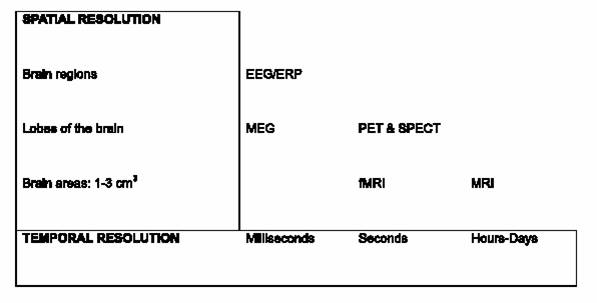
neuroscience of education, I think this is a very good introductory overview article. I found the overview of neuroscience methods particulary good. I had not appreciated the differential sensitivity of different brain study methodologies as a function of
temporal and
spatial sensitivity (see above figure). Readers interested in the application of neuroscience research to the study of severe reading (
dyslexia) and math (
dyscalculia) disabilities will find the later half of the article interesting, although I believe these disability-related reviews are more illustrative than definitive (does not integrate all relevant neuroscience research findings regarding these forms of
learning disabilites)
- Katzir, T & Paré-Blagoev, J. (2006) Applying Cognitive Neuroscience Research to Education: The Case of Literacy. Educational Psychologist, 41(1`), 53,74 (click here to view)
Abstract- Neuroscience has provided fascinating glimpses into the brain’s development and function. Despite remarkable progress, brain research has not yet been successfully brought to bear in many fields of educational psychology. In this article, work on literacy serves as a test case for an examination of potential future bridges linking mind, brain, and educational psychology. This article proposes a model for integrating research in the cognitive neurosciences with educational psychology and reviews how neuroscience is providing new data relevant to 3 major controversies in the field of dyslexia. This article also discusses the relevance of these findings for psychoeducational assessment and instruction and suggests innovative venues for interdisciplinary research.
Technorati Tags:
psychology,
educational psychology,
neuropsyhchology,
neuroscience,
neurology,
cognition,
cognitive,
intelligence,
IQ,
achievement,
learning,
dyslexia,
dyscalculia,
learning disabilities,
reading,
math,
fMRI,
brain,
IQ Brain Clock,
IQs Cornerpowered by
performancing firefox

 Announcing the first edition of the IQ Brain Clock EWOK (Evolving Web of Knowledge). A similar knowledge repository "in the sky" dealing with the WJ III test battery can be found at IQ's Corner (WJ III EWOK).