The human brain clock is intimately involved in wide array of human cognitive and motor behaviors. At this blog a number of clincal disorders have been associated with some degree of disturbance or damage to brain mechanisms related to mental timing. This informaiton is scattered across a variety of posts. I decided to pull it all together (as of today's date) in this post.
Mental timing (brain clock) has been implicated via research reported at this blog in:
ADHD and attention
Autismhttp://www.brainclock.net/search/label/autism
Various speech and language disorders
Tourette's syndrome
Cerbral palsy
Central auditory processing disorders (CAPD)
Reading disabilities/dyslexia (click here, here and here)
Various dopaminegeric-based disorders
Gate disorders
Stroke related dysfunction
A more detailed reference list of timing-related dysfunctions/disorder (e.g., aging related disorders--Alzheimer's, dementia; ADHD, motor coordination/timing disorders--gait, stroke,swallowing; speech and language disorders--aphasia/stroke/apraxia/speech; TBI) can be found in special white paper regarding the efficacy of various rhythm-based interventions.

Understanding the human brain clock & related neuroscience
Showing posts with label schizophrenia. Show all posts
Showing posts with label schizophrenia. Show all posts
Friday, November 11, 2011


Wednesday, June 17, 2009
More on schizophrenia and the mental clock

This is a follow-up post to a prior post re: a study (published in Brain and Cognition) linking mental timing and schizophrenia. I've now read the article closer and would like to share a little more of the content from the authors (prior post only included the abstract)
In the introduction, the authors state that the research literature suggests that:
Technorati Tags: psychology, educational psychology, school psychology, neuropsychology, clinical psychology, neuroscience, IQ, intelligence, mental timing, IQ Brain Clock, schizophrenia
In the introduction, the authors state that the research literature suggests that:
Schizophrenia may be associated with a fundamental disturbance in the temporal coordination of information processing in the brain, leading to dysfunctions in the timing of perceptual, cognitive, and motor processes (Bressler, 2003; Paulus & Braff, 2003; Phillips & Silverstein, 2003; Tononi & Edelman, 2000). These impairments of neural timing have also been associated with ‘‘disturbances of consciousness,” and may give rise to the expression of clinical symptoms associated with both positive (e.g., hallucinations, delusions) and negative (e.g., psychomotor poverty, poverty of speech) subtype classifications of the disorder (Andreasen, 1999; Hyde, Ziegler, & Weinberger, 1993; McGlashan & Hoffman, 2000).
Support for these conceptualizations is emerging with evidence that brain structures and neurotransmitter systems – such as dopamine, glutamate, and serotonin – that are directly linked to neural timing processes are also impaired in schizophrenia (Andreasen, 1999; Andreasen et al., 1998; Buhusi & Meck, 2007; Cheng, Ali, & Meck, 2007; Rao, Mayer, & Harrington, 2001; Rao et al., 1997; Volz et al., 2001). Despite the growing interest and centrality of these time-dependent conceptualizations of the pathophysiology of schizophrenia, there remains a paucity of research directly examining overt timing performance in the disorder. In addition, the majority of studies that have examined timing behavior in schizophrenia have employed temporal durations in the range of several seconds (Densen, 1977; Johnson & Petzel, 1971; Tysk, 1983a, 1983b, 1990; Volz et al., 2001; Wahl & Sieg, 1980), requiring higher cognitive processes beyond initial sensory registration for temporal encoding (Fraisse, 1984; Michon, 1985; Rammsayer & Lima, 1991). Thus, the aim of the present study was to delineate deficits of temporal perception from more generalized cognitive impairments in schizophrenia by assessing duration estimates in both the millisecond and seconds range using a well-established task of time perception.The primary purpose of the study was to move beyond prior studies that primarily focused on time estimation in the range of several secondsto time at the level of milliseconds. Also, the theoretical mental clock model used in this study was the classic pacemaker-accumulator model. One task frequently used in mental timing research is the temporal bisection task. The authors provide a nice description of this task:
a temporal bisection task was used to assess the timing of brief auditory durations (i.e., 300–600 ms) in individuals with schizophrenia and non-psychiatric control participants. The temporal bisection procedure required participants to first encode short and long anchor durations to which intermediate durations were subsequently compared and classified as most similar to either the short or the long anchor. The bisection point therefore refers to the duration at which short and long classifications are made with equal probability. In addition to brief durations in the millisecond range, participants in the present study were also required to estimate auditory durations in a second task employing intervals in the range of several seconds (i.e., 3–6 s).
Temporal bisection is unique to other tasks of time estimation with respect to its predictions and the inferences that can be drawn from temporal performance. In a simple timing task involving the estimation of a presented duration, differences in clock rate are reflected in performance differences. Specifically, a faster ‘‘internal clock” would result in the accumulation of a larger number of clock ‘‘pulses” during the timed interval, such that the summation of pulses would correspond to a longer duration than actually presented. A similar outcome would be observed for a slowed clock, with underestimations resulting from the accumulation of fewer pulses than would be needed to represent the presented durationIn the summary, the authors concluded that the timing deficits associated with schizophrenia are due primarily to perceptual or "clock" processes, and not other processes such as attention. Also implicated was the reference memory component of the pacemaker accumulator model.
Technorati Tags: psychology, educational psychology, school psychology, neuropsychology, clinical psychology, neuroscience, IQ, intelligence, mental timing, IQ Brain Clock, schizophrenia
Thursday, April 02, 2009
Schizophrenia and mental timing deficits: Another study
Yet another study (Carroll et al., in press; Brain and Cognition) implicating deficits in the internal brain clock and a clinical disorder - schizophrenia. Nice little study, with a matched control group, the suggests mental timing deficits (at the level of milli-seconds) may be related to some aspects of this disorder. See prior posts that suggest the same by clicking here.
Abstract:

Abstract:
Schizophrenia may be associated with a fundamental disturbance in the temporal coordination of information processing in the brain, leading to classic symptoms of schizophrenia such as thought disorder and disorganized and contextually inappropriate behavior. However, the majority of studies that have examined timing behavior in schizophrenia have employed temporal durations in the range of several seconds, which requires higher cognitive processes beyond initial sensory registration for temporal encoding. Accordingly, the present study assessed both millisecond and several-second duration estimates in schizophrenia using a well-established task of time perception. Twenty-eight individuals with schizophrenia and 31 non-psychiatric control participants completed two temporal bisection tasks, which required participants to make temporal judgments about auditory durations ranging from either 300 to 600 ms or 3000 to 6000 ms. Participants with schizophrenia displayed significantly greater timing variability under both millisecond and several-second timing conditions than the non-psychiatric group. These findings were consistent with parameter estimates obtained from a quantitative model of time estimation, and provide evidence for a fundamental timing deficit in schizophrenia that may be independent of the length of the to-be-timed duration.Technorati Tags: psychology, educational psychology, school psychology, neuropsychology, neuroscience, psychiatry, cognition, intelligence, mental timing, interval timing, pacemaker accumulator, IQ brain clock, brain clock
Sunday, February 01, 2009
IQ Brain Clock brain localization overview
I previously blogged about a special issue of Acta Neurobiologiae devoted to the minds brain clock. I provided a TOC and links to the papers. I just now skimmed one of the papers by Rubia & Smith (2004):
RUBIA K. and SMITH A. The neural correlates of cognitive time management: a review
My conclusion is that this is an excellent overview of the basic empirical research and theoretical literature regarding mental time-keeping (i.e., the IQ Brain Clock). It also provides a nice summary of the general consensus re: the major areas of the brain believed to be involved in motor and cognitive timing, areas featured in prior posts here. Below is a copy of the first concluding paragraph...where I've added tag links to all prior IQ Brain Clock posts that refer to these brain areas or concepts. I will shortly add Rubia to the mental timing scholars blogroll and this article to the key research articles section of this blog.
RUBIA K. and SMITH A. The neural correlates of cognitive time management: a review
My conclusion is that this is an excellent overview of the basic empirical research and theoretical literature regarding mental time-keeping (i.e., the IQ Brain Clock). It also provides a nice summary of the general consensus re: the major areas of the brain believed to be involved in motor and cognitive timing, areas featured in prior posts here. Below is a copy of the first concluding paragraph...where I've added tag links to all prior IQ Brain Clock posts that refer to these brain areas or concepts. I will shortly add Rubia to the mental timing scholars blogroll and this article to the key research articles section of this blog.
- In conclusion, this review on the neural correlates of cognitive time management shows that predominantly right hemispheric dorsolateral and inferior prefrontal cortices, anterior cingulate, the SMA, the basal ganglia and the lateral cerebellar hemispheres appear to be involved in both functions of motor timing and time estimation. Furthermore, the review shows that the dichotomy between motor and perceptive timing functions may be artificial. Both functions appear to be mediated by identical neural networks and may be inseparable.
Monday, January 12, 2009
CNTRICS: Consensus-based cognitive measurement in schizophrenia--a model worth examinig
 [double click on image to enlarge]
I was impressed to find that a group of scientists studying a common disorder (schizophrenia) had engaged in a consensus-building process to identify common sets of cognitive measures to use across their various research labs. This was all part of the Cognitive Neuroscience Treatment Research to Improve Cognition in Schizophrenia (CNTRICS) initiative. What a good model for improving the quality of research across researchers!
Maybe this model consensus-building activity could be adapted by those of us studying intelligence, the IQ Brain Clock, and cognitive related disorders in education and rehabilitation. Instead of our constant problem in comparing research studies with different measures used by different researchers, we could, at a minimum, at least establish a core set of "marker" measures to embed in each others favorite research batteries. Yes....at times I can be naive....but I believe in the power of consensus-building to improve research...and, more importantly, the probability of improving the quality of life for individuals with cognitive-related deficits and learning disorders. I've made a related plea for the adaptation of a common cognitive nomenclature/taxonomy (CHC theory) in many articles/chapters, most recently in the journal Intelligence.
Below are the abstracts. I've provided a link to the editorial introductory article. If anyone is interested in reading one or more of the other articles, articles that focus on measuring executive control, working memory, social cognitive and affective measures, promising paradigms, and control of attention, let me know...and I'd send a copy, but only in exchange for a guest blog post. The articles are worth a read, if for on other reason, for the nifty way many of the tasks discussed are presented via visual figures (see example of stroop task at the top of this post)--nice stuff.
Below are the abstracts:
Selecting Paradigms From Cognitive Neuroscience for Translation into Use in Clinical Trials: Proceedings of the Third CNTRICS Meeting (click here to read introductory editorial)
- This overview describes the goals and objectives of the third conference conducted as part of the Cognitive Neuroscience Treatment Research to Improve Cognition in Schizophrenia (CNTRICS) initiative. This third conference was focused on selecting specific paradigms from cognitive neuroscience that measured the constructs identified in the first CNTRICS meeting, with the goal of facilitating the translation of these paradigms into use in clinical trials contexts. To identify such paradigms, we had an open nomination process in which the field was asked to nominate potentially relevant paradigms and to provide information on several domains relevant to selecting the most promising tasks for each construct (eg, construct validity, neural bases, psychometrics, availability of animal models). Our goal was to identify 1–2 promising tasks for each of the 11 constructs identified at the first CNTRICS meeting. In this overview article, we describe the on-line survey used to generate nominations for promising tasks, the criteria that were used to select the tasks, the rationale behind the criteria, and the ways in which breakout groups worked together to identify the most promising tasks from among those nominated. This article serves as an introduction to the set of 6 articles included in this special issue that provide information about the specific tasks discussed and selected for the constructs from each of 6 broad domains (working memory, executive control, attention, long-term memory, perception, and social cognition).
CNTRICS Final Task Selection: Executive Control
- The third meeting of the Cognitive Neuroscience Treatment Research to Improve Cognition in Schizophrenia (CNTRICS) was focused on selecting promising measures for each of the cognitive constructs selected in the first CNTRICS meeting. In the domain of executive control, the 2 constructs of interest were ‘‘rule generation and selection’’ and ‘‘dynamic adjustments in control.’’ CNTRICS received 4 task nominations for each of these constructs, and the breakout group for executive control evaluated the degree to which each of these tasks met prespecified criteria. For rule generation and selection, the breakout group for executive control recommended the intradimensional/ extradimensional shift task and the switching Stroop for translation for use in clinical trial contexts in schizophrenia research. For dynamic adjustments in control, the breakout group recommended conflict and error adaptation in the Stroop and the stop signal task for translation for use in clinical trials. This article describes the ways in which each of these tasks met the criteria used by the breakout group to recommend tasks for further development.
CNTRICS Final Task Selection: Working Memory
- The third meeting of the Cognitive Neuroscience Treatment Research to Improve Cognition in Schizophrenia (CNTRICS) was focused on selecting promising measures for each of the cognitive constructs selected in the first CNTRICS meeting. In the domain of working memory, the 2 constructs of interest were goal maintenance and interference control. CNTRICS received 3 task nominations for each of these constructs, and the breakout group for working memory evaluated the degree to which each of these tasks met prespecified criteria. For goal maintenance, the breakout group for working memory recommended the AX-Continuous Performance Task/Dot Pattern Expectancy task for translation for use in clinical trial contexts in schizophrenia research. For interference control, the breakout group recommended the recent probes and operation/ symmetry span tasks for translation for use in clinical trials. This article describes the ways in which each of these tasks met the criteria used by the breakout group to recommend tasks for further development.
CNTRICS Final Task Selection: Social Cognitive and Affective Neuroscience–Based
Measures
- This article describes the results and recommendations of the third Cognitive Neuroscience Treatment Research to Improve Cognition in Schizophrenia meeting related to measuring treatment effects on social and affective processing. At the first meeting, it was recommended that measurement development focuses on the construct of emotion identification and responding. Five Tasks were nominated as candidate measures for this construct via the premeeting web-based survey. Two of the 5 tasks were recommended for immediate translation, the Penn Emotion Recognition Task and the Facial Affect Recognition and the Effects of Situational Context, which provides a measure of emotion identification and responding as well as a related, higher level construct, context-based modulation of emotional responding. This article summarizes the criteria-based, consensus building analysis of each nominated task that led to these 2 paradigms being recommended as priority tasks for development as measures of treatment effects on negative symptoms in schizophrenia.
Perception Measurement in Clinical Trials of Schizophrenia: Promising Paradigms
From CNTRICS
- The third meeting of the Cognitive Neuroscience Treatment Research to Improve Cognition in Schizophrenia (CNTRICS) focused on selecting promising measures for each of the cognitive constructs selected in the first CNTRICS meeting. In the domain of perception, the 2 constructs of interest were gain control and visual integration. CNTRICS received 5 task nominations for gain control and three task nominations for visual integration. The breakout group for perception evaluated the degree to which each of these tasks met prespecified criteria. For gain control, the breakout group for perception believed that 2 of the tasks (prepulse inhibition of startle and mismatch negativity) were already mature and in the process of being incorporated into multisite clinical trials. However, the breakout group recommended that steady-state visualevoked potentials be combined with contrast sensitivity to magnocellular vs parvocellular biased stimuli and that this combined task and the contrast-contrast effect task be recommended for translation for use in clinical trial contexts in schizophrenia research. For visual integration, the breakout group recommended the Contour Integration and Coherent Motion tasks for translation for use in clinical trials. This manuscript describes the ways in which each of these tasks met the criteria used by the breakout group to evaluate and recommend tasks for further development.
CNTRICS Final Task Selection: Control of Attention
- The construct of attention has many facets that have been examined in human and animal research and in healthy and psychiatrically disordered conditions. The Cognitive Neuroscience Treatment Research to Improve Cognition in Schizophrenia (CNTRICS) group concluded that control of attention—the processes that guide selection of taskrelevant inputs—is particularly impaired in schizophrenia and could profit from further work with refined measurement tools. Thus, nominations for cognitive tasks that provide discrete measures of control of attention were sought and were then evaluated at the third CNTRICS meeting for their promise for future use in treatment development. This article describes the 5 nominated measures and their strengths and weaknesses for cognitive neuroscience work relevant to treatment development. Two paradigms, Guided Search and the Distractor Condition Sustained Attention Task, were viewed as having the greatest immediate promise for development into tools for treatment research in schizophrenia and are described in more detail by their nominators.
Tuesday, July 01, 2008
Brain Clock Research Bytes # 1: Parkinsons, schizophrenia, and temporal pattern recognition
I found time to quickly skim a number of interesting journal articles this afternoon. Check out the following research bytes:
- Wong et al. (2008), in the Canadian Journal of Experimental Psychology, present an interesting sequential model of human temporal pattern recognition.
- Yet another study (Jones et al., in press, Brain and Cognition) linking the brain clock to Parkinson's with the usual cast of neuroscience characters implicated (basal ganglia; dopamine). A snipet from the authors conclusions "the data suggest that the integrity of the basal ganglia is necessary for ‘typical’ time production in the seconds range as well as for time reproduction at shorter intervals"
- In a prior post I reviewed one of the key brain clock research articles (see right side of this blog) by Buhusi and Meck 2006), where they implicated the brain clock in a variety of mental disorders, including schizophrenia. I just skimmed another article "in press" in Brain and Cognition (see link above in prior bulleted byte), this type by Carroll et al., that suggests a deficit in auditory temporal processing precision in schizophrenics.
Friday, November 17, 2006
Cerebellum differential time-keeping role
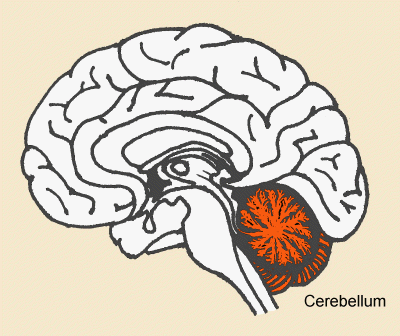
This is a follow-up post up on my prior posts regarding the three major systems of timing, the brain functions/structures involved in mental/interval time-keeping, and research implicating the brains master time clock in certain clinical disorders (click here)
According to Buhusi and Meck (2006), research has suggested that impaired mental/interval time-keeping in the seconds-to-minutes range is found in patients with disorders that involve dopaminergic pathways (Parkinson’s disease, Huntington’s disease,and schizophrenia. Coupled with research that has studied the impact of lesions in the cerebellum, these authors conclude that "the striatum and cerebellum are involved in different aspects of timing and time perception. Although the cerebellum is not essential for interval timing, it is required for correct millisecond timing"
Technorati Tags: psychology, educational psychology, neuroscience, neuropsychology, mental time keeping, interval timing, schizophrenia, Parkinsons, Huntingtons, cerebellum, intelligence, cognition, cognitive, time perception, dompamine
According to Buhusi and Meck (2006), research has suggested that impaired mental/interval time-keeping in the seconds-to-minutes range is found in patients with disorders that involve dopaminergic pathways (Parkinson’s disease, Huntington’s disease,and schizophrenia. Coupled with research that has studied the impact of lesions in the cerebellum, these authors conclude that "the striatum and cerebellum are involved in different aspects of timing and time perception. Although the cerebellum is not essential for interval timing, it is required for correct millisecond timing"
Technorati Tags: psychology, educational psychology, neuroscience, neuropsychology, mental time keeping, interval timing, schizophrenia, Parkinsons, Huntingtons, cerebellum, intelligence, cognition, cognitive, time perception, dompamine
powered by performancing firefox
Subscribe to:
Posts (Atom)