Showing posts with label working memory. Show all posts

Tuesday, June 14, 2016

Research byte: More on the critical importance of attentional control (AC)--this time in sports performance

The ever growing body of research re the importance of the construct of attentional control (AC) in all kinds of human performance is, IMHO, one of the most important findings in cognitive psychology during the past few years.  In my opinion, improving AC may be one of the key's to effective brain training/fitness programs.  Also, differences in the AC of individuals has important implications for understanding differences in cognitive functioning.
Available online 10 June 2016
Target Article

Working Memory, Attentional Control, and Expertise in Sports: A Review of Current Literature and Directions for Future Research

Choose an option to locate/access this article:

The aim of the present review was to investigate the theoretical framework of working memory as it relates to the control of attention in sport and thereby apply cognitive psychological theory to sports, but also use the sports domain to advance cognitive theory. We first introduce dual-process theories as an overarching framework for attention-related research in sports. Then a central mechanism is highlighted how working memory is involved in the control of attention in sports by reviewing research demonstrating that the activated contents in working memory control the focus of attention. The second part of the paper reviews literature showing that working memory capacity is an important individual difference variable that is predictive of controlling attention in a goal-directed manner and avoiding distraction and interference in sports. Finally, we address the question whether differences in working memory capacity contribute to sport expertise.

Keywords

  • Dual-process;
  • Working memory;
  • Attention;
  • Sport;
  • Individual differences

Research byte: Multi-domain training may improve attentional control (AC) in older adults


Multi-domain training enhances attentional control.
Psychology and Aging, Vol 31(4), Jun 2016, 390-408. http://dx.doi.org.ezp1.lib.umn.edu/10.1037/pag0000081

Abstract

Multi-domain training potentially increases the likelihood of overlap in processing components with transfer tasks and everyday life, and hence is a promising training approach for older adults. To empirically test this, 84 healthy older adults aged 64 to 75 years were randomly assigned to one of three single-domain training conditions (inhibition, visuomotor function, spatial navigation) or to the simultaneous training of all three cognitive functions (multi-domain training condition). All participants trained on an iPad at home for 50 training sessions. Before and after the training, and at a 6-month follow-up measurement, cognitive functioning and training transfer were assessed with a neuropsychological test battery including tests targeting the trained functions (near transfer) and transfer to executive functions (far transfer: attentional control, working memory, speed). Participants in all four training groups showed a linear increase in training performance over the 50 training sessions. Using a latent difference score model, the multi-domain training group, compared with the single-domain training groups, showed more improvement on the far transfer attentional control composite. Individuals with initially lower baseline performance showed higher training-related improvements, indicating that training compensated for lower initial cognitive performance. At the 6-month follow-up, performance on the cognitive test battery remained stable. This is one of the first studies to investigate systematically multi-domain training including comparable single-domain training conditions. Our findings suggest that multi-domain training enhances attentional control involved in handling several different tasks at the same time, an aspect in everyday life that is particularly challenging for older people. (PsycINFO Database Record (c) 2016 APA, all rights reserved)

Thursday, March 31, 2016

Research Byte: Multivariate Associations of Fluid Intelligence (Gf) and NAA - Is the P-FIT it?

When it rains--it pours.  Second posting today of research study reinforcing the importance of the P-FIT neuro-model of intelligence.

In a prior Interactive Metronome-Home blog post I provide an overview description of the P-FIT model.

 
Multivariate Associations of Fluid Intelligence and NAA

  1. Ryan J. Larsen1
+ Author Affiliations
  1. 1Beckman Institute for Advanced Science and Technology
  2. 2Neuroscience Program and
  3. 3Psychology Department, University of Illinois at Urbana-Champaign, Urbana, IL, USA
  4. 4Helen Wills Neuroscience Institute, University of California, Berkeley, Berkeley, CA, USA
  5. 5Psychology Department, University of Alberta, Edmonton, Alberta, Canada
  1. Address correspondence to Aki Nikolaidis. Email: g.aki.nikolaidis@gmail.com

Abstract

Understanding the neural and metabolic correlates of fluid intelligence not only aids scientists in characterizing cognitive processes involved in intelligence, but it also offers insight into intervention methods to improve fluid intelligence. Here we use magnetic resonance spectroscopic imaging (MRSI) to measure N-acetyl aspartate (NAA), a biochemical marker of neural energy production and efficiency. We use principal components analysis (PCA) to examine how the distribution of NAA in the frontal and parietal lobes relates to fluid intelligence. We find that a left lateralized frontal-parietal component predicts fluid intelligence, and it does so independently of brain size, another significant predictor of fluid intelligence. These results suggest that the left motor regions play a key role in the visualization and planning necessary for spatial cognition and reasoning, and we discuss these findings in the context of the Parieto-Frontal Integration Theory of intelligence.

Wednesday, December 16, 2015

Interactive Metronome (IM) is measuring and changing something real and important: An old-but-goodie (OBG) post


[This is an oldie-but-goodie (OGB) post that I originally posted as a guest blogger at the IM-HOME blog on Feb 2, 2012]


No human investigation can be called real science if it cannot be demonstrated mathematically
Leonardo da Vinci, Treatise on Painting (1651)
Progress in science depends on new techniques, new discoveries and new ideas, probably in that order Sydney Brenner (1980)
 
At the core of the IM intervention technology is a precise measurement system.  To users and clinicians the IM measurement system is transparent.  Yet, without the valid and precise measurement system, IM would not work.

In my “Brain or neural efficiency: Is it quickness or timing?” post, I advanced the hypothesis that the effectiveness of Interactive Metronome may be due to IM operating on a fundamental dimension of brain or neural efficiency, which intelligence scholars also relate to general intelligence (g).  I have also suggested that this mechanism improves control of attention and may allow individuals to “quiet a busy mind”and invoke “on-demand focus.”

As an applied intelligence test developer (click here), I have been intrigued by the underlying precise millisecond-based measurement system which is the heart of IM technology.  IM technology would not work if the underlying measurement system could not reliably measure differences in synchronized metronome tapping between individuals and changes within the same individual over repeated sessions. 

Wanting to know how precise the underlying IM measurement system is, I extracted the average millisecond scores from an unpublished 2003 Interactive Metronome document that reported average times for different age groups.  The sample consisted of the initial IM Long Form Assessment performance of 1,583 clinical and normal subjects ranging in age from 6 thru 60+.  It is important to note that the sample was not a nationally representative normal sample and was comprised of more clinical subjects receiving IM therapy.  Nevertheless, I wondered if this less-than-optimal set of data might demonstrate a pattern of increasingly shorter response times as individuals became older.  Why did I want to examine this?

Developmental increase in proficiency on tests and measures of human abilities is considered one form of evidence that a test or measurement system is reliably and validly measuring an important human ability.  In the case of intelligence, valid measures of cognitive abilities show developmental growth curves where the youngest subjects obtain the lowest raw scores and the average raw scores gradually increase with increasing age.  They eventually level out and then start a decline as old age sets in.  Below are growth curves from seven cognitive ability scores from the Woodcock-Johnson Battery—III, a test battery of which I am a co-author.  The important observation to note is that, despite the specific cognitive ability measure, all curves show low scores for the younger ages followed by acceleration of growth to a certain point.  Each curve then plateaus at a certain age range, after which age-related cognitive decline is noted, but at different rates for different abilities.  These curves are presented in the WJ III Technical Manual (McGrew & Woodcock, 1991) as a form of developmental validity evidence—which provides one piece of evidence that the WJ III tests are valid measures of different and important human intellectual abilities.
Scholars in intelligence have studied and postulated about the different rates of growth and decline for different abilities.  These are serious data about human intelligence and the measures used to capture differences in human abilities.  Within this context, I was ecstatic when I plotted the initial IM Long Form Assessment data (which is analogous to the first time a person is “tested” with the IM measurement system) and discovered the following plot.

 imnrm1.jpg

The first thing the reader should note are the individual data points (the dots).  The points show some random “bouncing around” which we measurement folks call sampling error.  The critical point is that they follow a systematic trend that can be estimated by fitting a mathematical curve to the data points. This was the same procedure used to develop the WJ III cognitive curves in the first figure.  In the second figure, the IM timing curve is demarcated in red.  We who develop test norms and study human ability growth curves generate these smoothed growth curves as they are the best estimate of the real reality of the data if extremely large number of individuals had been tested at each age (there would be much less bounce).

One does not need to be a rocket scientist to interpret the smoothed IM growth curve.  Individuals at the youngest ages, on the average, show the largest millisecond discrepancy from the IM reference tone.  Then, with increasing age, the average IM target-to-response for individuals decreases systematically as children age.  At approximately 25 years of age the curve “bottoms out,” and then as individuals get older, IM millisecond timing scores increase (or get less accurate).  The systematic nature of this curve is amazing, considering it is based on a less-than-optimal sample for determining what constitutes average.

If the reader is having a hard time relating the IM timing curve to the WJ III cognitive ability curves, I have taken the liberty of simply rotating and flipping the IM timing accuracy growth curve in the figure below.  Vioila (aka, walla—“there it is”)!  The curve has the same general shape as the WJ III cognitive ability growth curves!  The reason for the difference between the WJ III growth curves and the first IM timing growth curve is that the meaning of high and low scores are reversed—higher IM times mean lower skilled performance while lower scores on the WJ III battery are associated with lower performance (and vice versa).

Readers who are parents may have seen similar growth curves during well-child visits with the family doctor.  Below are growth charts for weight and length for male children from birth to 36 years.  Although covering a much smaller age span than the WJ III cognitive and IM timing curves above, the shape of the curves is identical for the comparable age ranges (gradually increasing with age).  The middle dark line in each set (labeled 50 for 50th percentile) is conceptually identical to the above single curve plots.  These physical measurement curves show the systematic and developmental nature of physical growth.

Why am I so excited about the IM timing growth curve?  Because it demonstrates, similar to the physical and intelligence growth curves, that the underlying measurement unit used as the core of IM therapy is measuring a human ability that follows a similar and expected developmental pattern.  Such curves are believed to be due, depending on the specific ability, to the influence of education and experiences as well as genetically-driven biological maturation of the central nervous system (CNS).  The IM timing curve is one form of evidence that the IM measurement system is measuring a fundamental human capacity.  This is extremely exciting!  It is one more piece of evidence that the IM core measurement technology is measuring and working on a core critical human ability. Coupled with other validity evidence previously discussed here and elsewhere, this additional piece of scientific evidence has convinced me that the IM measurement and intervention system is most likely measuring a fundamental aspect of the development of the central nervous system (e.g., neural efficiency).  The cognitive abilities I have suggested fall under the broad umbrella term of executive functions, and more specifically controlled attention (focus) and working memory.

A caveat before I close. The smoothed IM timing curve should not be used by IM providers to evaluate how typical, normal, or close-to-average a person is on their initial IM Long Form Assessment.  The mixed nature of the sample (normal and clinical subjects; more of the later) argues against such use.  Also, the curve only represents the average at each age and calculating and plotting the typical variability around the curve would also be necessary.  I deliberately left out the variability data curves so as not to encourage misuse of the information.

However, IM providers can evaluate their client’s performance by using the official IM Indicator Table.  A copy is reproduced below.  This table can be used to determine whether a client’s performance is in the “ballpark” for their age.  Providers simply locate the clients age in the row at the top then go down that column to find the millisecond score or range that includes their specific IM Long Form Assessment timing score.  The verbal description associated with each level (extremely deficient to exceptional) can be used to make quality of performance statements reflecting where an individual is at the time of the initial assessment.  The scores and labels should not be used for diagnostic purposes.  Instead, they can be used to describe, in approximate ball park terms, where an individual is at the time of the assessment when compared to others of the same age and to make comparisons about that same client’s performance over time.

Age
6
7 to 8
9 to 10
11 to 12
13 to 15
16+
Extreme Deficiency
280+
270+
260+
240+
215+
200+
Severe Deficiency
175-279
170-269
160-259
155-239
150-214
147-199
Below Average
120-174
90-169
80-159
75-154
72-149
70-146
Average
90-119
65-89
55-79
45-74
43-71
41-69
Above Average
56-89
45-64
38-54
36-44
33-42
30-40
Exceptional
40-55
32-44
28-37
26-35
23-32
22-29
Superior
Below 40
Below 32
Below 28
Below 26
Below 23
Below 22

In summary, I have traversed a number of empirical domains in my journey to understand IM.  The finding of such powerful and clear developmental evidence for the underlying IM measurement system is one of the final dots I connected which convinced me of the promise of IM.  The IM program is founded on a valid scientific measurement system of an important human cognitive ability (or constellation of related abilities).
 

Tuesday, December 01, 2015

Positive Cogmed working memory training study--math and reading

Front Psychol. 2015; 6: 1711.
Published online 2015 Nov 10. doi:  10.3389/fpsyg.2015.01711
PMCID: PMC4639603

Working Memory Training is Associated with Long Term Attainments in Math and Reading

Abstract

Training working memory (WM) using computerized programs has been shown to improve functions directly linked to WM such as following instructions and attention. These functions influence academic performance, which leads to the question of whether WM training can transfer to improved academic performance. We followed the academic performance of two age-matched groups during 2 years. As part of the curriculum in grade 4 (age 9–10), all students in one classroom (n = 20) completed Cogmed Working Memory Training (CWMT) whereas children in the other classroom (n = 22) received education as usual. Performance on nationally standardized tests in math and reading was used as outcome measures at baseline and two years later. At baseline both classes were normal/high performing according to national standards. At grade 6, reading had improved to a significantly greater extent for the training group compared to the control group (medium effect size, Cohen’s d = 0.66, p = 0.045). For math performance the same pattern was observed with a medium effect size (Cohen’s d = 0.58) reaching statistical trend levels (p = 0.091). Moreover, the academic attainments were found to correlate with the degree of improvements during training (p < 0.053). This is the first study of long-term (>1 year) effects of WM training on academic performance. We found performance on both reading and math to be positively impacted after completion of CWMT. Since there were no baseline differences between the groups, the results may reflect an influence on learning capacity, with improved WM leading to a boost in students’ capacity to learn. This study is also the first to investigate the effects of CWMT on academic performance in typical or high achieving students. The results suggest that WM training can help optimize the academic potential of high performers.
Keywords: working memory training, academic attainment, cognitive training, cogmed, educational psychology

Tuesday, November 17, 2015

Brain/cognitive training programs and transfer: More support for explanatory domain-general attentional control (AC) mechanism as significant key to effectivness

Another research review article that supports my hypothesis, which was invoked to explain the impact of Interactive Metronome (IM) on cognitive outcomes, that the primary mechanism of successful brain fitness or training programs may be the degree to which each program focuses on strengthening attention control (AC in CHC theory; aka, focus).  My report/white paper can be found here.  Additional information (including You Tube video presentation) available here.


The Mechanisms of Far Transfer From Cognitive Training: Review and Hypothesis.
Greenwood, Pamela M.; Parasuraman, Raja Neuropsychology, Nov 16 , 2015, No Pagination Specified. http://dx.doi.org.ezp1.lib.umn.edu/10.1037/neu0000235

Abstract

  • Objective: General intelligence is important for success in daily life, fueling interest in developing cognitive training as an intervention to improve fluid ability (Gf). A major obstacle to the design of effective cognitive interventions has been the paucity of hypotheses bearing on mechanisms underlying transfer of cognitive training to Gf. Despite the large amounts of money and time currently being expended on cognitive training, there is little scientific agreement on how, or even whether, Gf can be heightened by such training. Method: We review the relevant strands of evidence on cognitive-training-related changes in (a) cortical mechanisms of distraction suppression, and (b) activation of the dorsal attention network (DAN). We hypothesize that training-related increases in control of attention are important for what is termed far transfer of cognitive training to untrained abilities, notably to Gf. Results: We review the evidence that distraction suppression evident in behavior, neuronal firing, scalp electroencephalography, and hemodynamic change is important for protecting target processing during perception and also for protecting targets held in working memory. Importantly, attentional control also appears to be central to performance on Gf assessments. Consistent with this evidence, forms of cognitive training that increase ability to ignore distractions (e.g., working memory training and perceptual training) not only affect the DAN but also affect transfer to Gf. Conclusions: Our hypothesis is supported by existing evidence. However, to advance the field of cognitive training, it is necessary that competing hypotheses on mechanisms of far transfer of cognitive training be advanced and empirically tested. (PsycINFO Database Record (c) 2015 APA, all rights reserved)
Overview of the figure from MindHub Pub that summarizes the the hypothesis that IM, as well as other brain training programs, may be effective the more they impact the brain networks that underlie the attentional control (AC) system.  Click to enlarge

Wednesday, September 23, 2015

Research Byte: Children's working memory stability is frequently fluctuating across tasks, time within a day, and across days


Click on image to enlarge for easier reading

This study that is a good reminder to us who engage in cognitive testing.  What we may find during 1-1 clinical testing may not generalize 100% to real world.  In this study, varying trait stability of working memory during normal school days was found to be significant, with more variability (lack of stability) for some individuals.  I think teachers see this all the time.  This could also suggest that maybe brain-based working memory training programs should be targeted at those children who show the most time-to-time variability in working memory.

Thursday, August 13, 2015

More research suggesting ADHD may be due (in part) to an internal brain clock disorder

Another study linking distorted time-processing and ADHD.  Click here and here for posts about other related studies.  What I find interesting is that the various experimental timing measures used in these studies could easily be made into psychometric tests (with readily available technology) for inclusion on intelligence tests or other special purpose cognitive batteries.  Also, I have hypothesized in a MindHub Pub that some emerging neurotechnologies may improve ADHD (and related symptoms like attentional control and working memory) due to the fine-tuning of the human brain clock.

Other ADHD related research (brain connectivity, etc) can be found here.

Click on image to enlarge for easier reading,

Monday, August 03, 2015

MindHub Pub #2: The Science Behind Interactive Metronome: An Integration of Brain Clock, Temporal Processing, Brain Network and Neurocognitive Research and Theory

[This is an "oldie but goodie" (OBG) post that was originally posted on March 5, 2013]


The second MindHub Pub working paper is now available:  The Science Behind Interactive Metronome:  An Integration of Brain Clock, Temporal Processing, Brain Network and Neurocognitive Research and Theory.  The PDF document can be viewed/downloaded by clicking here.

This working paper is an integration of research and theory that attempts to explain the science behind the positive outcomes of the Interactive Metronome rehabilitative and brain training neurotechnology (the IM effect).  A three-level explanatory model involving three different levels of brain and neurocognitive constructs (McGrew, 2012) is described.   The three-levels are presented in the visual summary in the figure below.  Although the text focuses on explaining the IM effect on cognitive functions (focus, controlled attention, working memory, executive functions), the three-level hypothesized model should be considered a general explanatory framework for understanding the positive IM effect in other human performance domains as well (e.g., recovery from stroke; gait; motor coordination).

The three-level model described here can also be viewed as an IM-free integration of research and theory that explains the relations between the temporal processing (temporal g) of the human brain clock (s), brain regions and networks, brain network communication and synchronization (the parietal-frontal integration theory of intelligence [P-FIT] in particular), and the neurocognitive constructs of attentional control (focus), working memory, and executive functioning.

[Click on image to enlarge]

Sunday, September 21, 2014

ADHD: And even MORE evidence suggestive of a brain network connectivity disorder

And more evidence for ADHD as being related to poor brain network connectivity. (click here for more posts) Click on images to enlarge.


And, again, this extant research is consistent with the three-level hypothesized explanation of the impact of certain brain training programs on controlled attention (click here for special white paper as well as on-line PPT modules and keynote video presentation of this model).


- Posted using BlogPress from my iPad

Sunday, September 14, 2014

The external/internal-directed cognition (EDC/IDC) framework

I just skimmed the article below. I like the way it uses the terms external/internal-directed (ECD/ICD) cognition framework to discuss the differences and relations between the activities of the default brain network and the executive control networks (click here for excellent article explaining these two networks)

Click on images to enlarge


I resonate to this EDC/IDC framework as it is relevant to my white paper on improving attentional control (via IM training--although the paper, IMHO, is more about how different brain training programs may work). That hypothesized model is in the figure above, and can be found at the MindHub.


- Posted using BlogPress from my iPad

Tuesday, September 02, 2014

Working memory training (n-back task) improves fluid intelligence (Gf) 3-4 IQ points

Interesting meta-analysis suggestingthat working memory training, via the n-back task, over a relatively short period of time, can improve fluid intelligence/reasoning (Gf). Conservative estimate of 3-4 Gf IQ points improvement. Click on images to enlarge.


- Posted using BlogPress from my iPad

Sunday, November 17, 2013

Does working memory training work? For whom..and why or why not?

"Under which circumstances, and for which person, can WM be improved and why?"


The above title is a quote from a new article by van Basian and Oberauer (2013) that provides a balanced treatment of issues that should be examined when evaluating the wave of working memory training articles that are being published at a steady stream. They reviewed over 40 different working memory intervention studies. I particularly like the visual model of possible factors/mechanisms that should be considered.
Click on images to enlarge


Sunday, June 02, 2013

Another article implicating dlPFC and P-FIT model of intelligence--Importance to general intelligence

Another study implicating dorsolateral prefrontal cortex (dlPFC) and PFIT model of intelligence with regard to general intelligence (g), working memory and white matter tract-moderated functional brain network connectivity. Supports significant components of the three-level explanatory model articulated in MindHub Pub #2.


Friday, May 24, 2013

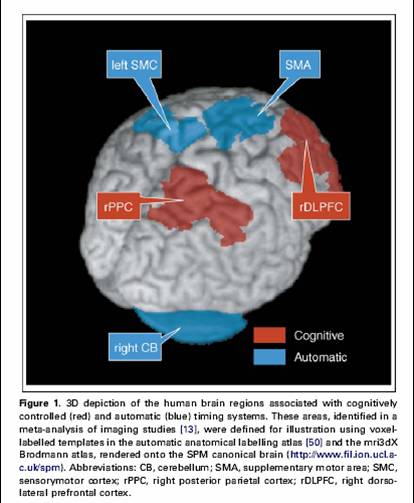
Automatic v controlled cognitive brain clock timing systems: A link with working memory?


[Double click on image to enlarge]

Contemporary research (Buhusi & Meck, 2005; Lewis & Miall, 2006) supports the idea that there are two mental timing circuits that can be dissociated: (1) an automatic timing system that works in the millisecond range, which is used in discrete-event (discontinuous) timing, and involves the cerebellum; and (2) a continuous-event, cognitively controlled timing system that requires attention and involves the basal ganglia and related cortical structures.

The above figure, which is based on a meta-analysis of studies (see Lewis & Miall, 2006), provides neurological evidence for two such systems via the localization of each system in different parts of the brain. What I (as a cognitive psychologist with a primary interest in psychological testing and theories of intelligence-see IQs Corner) find particularly intriguing is the conclusion (as reported in the Lewis & Miall, 2006 article as well as many other articles I've read) that the primary brain region associated with the cognitively controlled timing system is that also primarily associated with working memory--the dorsolateral prefrontal cortex (DLPFC).

  • Buhusi, W. & Meck, C. (Oct, 2005). What makes us tick: Functional and neural mechanism of interval timing. Nature Reviews: Neuroscience, 6, 755-765
  • Lewis, P. & Miall, C (2006). Remembering the time: a continuous clock. Trends in Cognitive Sciences, 10(9), 401-406.


Technorati Tags: , , , , , , , , , , , , , ,,,,,,

Friday, December 14, 2012

"I think...therefore IM" (Interactive Metronome)--Dr. Kevin McGrew IM 2012 Keynote Conference presentation

Keynote presentation by Dr. Kevin McGrew at the 2012 Interactive Metronome professional conference in San Antonio, Texas. Dr. McGrew presents his three-levels of interpretation research and theory-based hypothesis re: the reason IM improves cognitive performance across different domains. The primary message focuses on improving focus (controlled attention), working memory and executive functions. Recent brain network research implicates improve brain network communication via white matter tracts, particularly the Parietal-Frontal Integration Theory (P-FIT) of intelligence. 

Taping was from a distance so the audio, at times, is weak. Listening with ear buds suggested.  Also, a non-audio version of the complete set of PPT slides is available for more reflective viewing via my SlideShare account.

[Heads up - the "cat" video clip near the beginning is not a mistake.  Don't think that YouTube has done something weird--I comment on the interpretation of the cat video after it is over]


Below is a snippet of a part of the larger video that explains the key concepts and PPT-based animations that are used in the Keynote presentation.


Finally, if you are unfamiliar with the  IM technology, you might want to watch the following brief introductory video before viewing the Keynote video.  The video is a bit dated with regard to current understanding of how IM may work, as explained in the Keynote video above.  However, it is a good video for understanding the task demands of IM


As noted in my conflict of interest disclosure statement, I am an external paid consultant to IM (Director of Research and Science)

Wednesday, May 30, 2012

Time Travels with the Time Doc-Trip 1: Quieting the Busy Mind


Announcing the first issue of "Time Travels with the Time Doc--Trip 1: Quieting the Busy Mind". Check it out.

Conflict of interest- I serve as an external consultant in the form of the Science and Research Director for Interactive Metronome.


Posted using BlogPress from Kevin McGrew's iPad
www.themindhub.com