The human brain clock is intimately involved in wide array of human cognitive and motor behaviors. At this blog a number of clincal disorders have been associated with some degree of disturbance or damage to brain mechanisms related to mental timing. This informaiton is scattered across a variety of posts. I decided to pull it all together (as of today's date) in this post.
Mental timing (brain clock) has been implicated via research reported at this blog in:
ADHD and attention
Autismhttp://www.brainclock.net/search/label/autism
Various speech and language disorders
Tourette's syndrome
Cerbral palsy
Central auditory processing disorders (CAPD)
Reading disabilities/dyslexia (click here, here and here)
Various dopaminegeric-based disorders
Gate disorders
Stroke related dysfunction
A more detailed reference list of timing-related dysfunctions/disorder (e.g., aging related disorders--Alzheimer's, dementia; ADHD, motor coordination/timing disorders--gait, stroke,swallowing; speech and language disorders--aphasia/stroke/apraxia/speech; TBI) can be found in special white paper regarding the efficacy of various rhythm-based interventions.

Understanding the human brain clock & related neuroscience
Showing posts with label Huntingtons. Show all posts
Showing posts with label Huntingtons. Show all posts
Friday, November 11, 2011


Tuesday, October 16, 2007
Time Doc Byte # 3 - Brain clock importance and clinical groups

Here is my third Time Doc Byte. Categories - "importance" of the human brain clock and mental time-keeping; relevance to clinical groups/populations
This time the quotes come from a chapter from Meck (2003); Introduction to edited book - Functional and Neural Mechanisms of Interval Timing - yep, I've got the book and am hoping I can get through the technical and deep material - the book is listed as a "recommended book" on the right side of this blog).
Underline or italic emphasis added by blogmaster.
- The term interval timing is used to describe the temporal discrimination processes involved in the estimation and reproduction of relatively short during the seconds-to-minutes range that form the fabric of our everyday existence and unite our mental representations of actions and rhythmical structures.
- Human learning and memory is highly sensitive to temporal factors, and oscillator-based models have been proposed for the coding of serial order in memory...In addition, deficits in learning, memory, set shifting, and interval timing have been observed in a variety of patient populations with damage to the basal ganglia, including Parkinson's disease and Huntington's disease patients, as well as other cortical and subcortical brain structures affected by Alzheimer's disease, injury, and stroke.
- ...understanding temporal integration by the brain will be among the premier topics to unite systems, cellular, computational, and cognitive neuroscience over the next decade.
- It is interesting to note that some researchers have argued that a primary function of the internal clock is to allow for the efficient transfer of information from one stage of information processing to another at regularly spaced intervals.
Technorati Tags: psychology, educational psychology, neuropsychology, neuroscience, interval timing, brain clock, mental time keeping, Parkinsons, Huntingtons, Alzheimers, stroke, brain injury, temporal processing, Time Doc Byte
Powered by ScribeFire.
Friday, November 17, 2006
Cerebellum differential time-keeping role
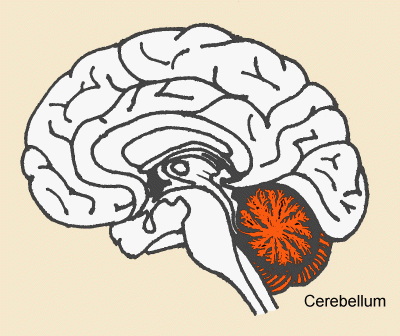
This is a follow-up post up on my prior posts regarding the three major systems of timing, the brain functions/structures involved in mental/interval time-keeping, and research implicating the brains master time clock in certain clinical disorders (click here)
According to Buhusi and Meck (2006), research has suggested that impaired mental/interval time-keeping in the seconds-to-minutes range is found in patients with disorders that involve dopaminergic pathways (Parkinson’s disease, Huntington’s disease,and schizophrenia. Coupled with research that has studied the impact of lesions in the cerebellum, these authors conclude that "the striatum and cerebellum are involved in different aspects of timing and time perception. Although the cerebellum is not essential for interval timing, it is required for correct millisecond timing"
Technorati Tags: psychology, educational psychology, neuroscience, neuropsychology, mental time keeping, interval timing, schizophrenia, Parkinsons, Huntingtons, cerebellum, intelligence, cognition, cognitive, time perception, dompamine
powered by performancing firefox
Subscribe to:
Posts (Atom)