Showing posts with label frontal lobles. Show all posts

Tuesday, March 08, 2016

Research Byte: Executive functions involve more than just the prefrontal structures--White matter matters

Neuroanatomical Substrates of Executive Functions: Beyond Prefrontal Structures

  • a University of California, San Francisco; Department of Neurology, Memory and Aging Center; San Francisco, CA
  • b University of Colorado, Denver Anschutz School of Medicine; Departments of Neurosurgery and Neurology; Rocky Mountain Alzheimer’s Disease Center; Aurora, CO
  • c University of California, Davis; Department of Neurology; Davis, CA

Highlights

•
Executive functions (EF) are not synonymous with ‘frontal’ tasks.
•
Global atrophy was the only independent predictor of EF.
•
Frontal volumes do not predict EF when statistically isolated from global atrophy.
•
White matter metrics remain predictors of EF, independent of global atrophy.

Abstract

Executive functions are often considered lynchpin “frontal lobe tasks”, despite accumulating evidence that a broad network of anterior and posterior brain structures supports them. Using a latent variable modeling approach, we assessed whether prefrontal grey matter volumes independently predict executive function performance when statistically differentiated from global atrophy and individual non-frontal lobar volume contributions. We further examined whether fronto-parietal white matter microstructure underlies and independently contributes to executive functions. We developed a latent variable model to decompose lobar grey matter volumes into a global grey matter factor and specific lobar volumes (i.e. prefrontal, parietal, temporal, occipital) that were independent of global grey matter. We then added mean fractional anisotropy (FA) for the superior longitudinal fasciculus (dorsal portion), corpus callosum, and cingulum bundle (dorsal portion) to models that included grey matter volumes related to cognitive variables in previous analyses. Results suggested that the 2-factor model (shifting/inhibition, updating/working memory) plus an information processing speed factor best explained our executive function data in a sample of 202 community dwelling older adults, and was selected as the base measurement model for further analyses. Global grey matter was related to the executive function and speed variables in all four lobar models, but independent contributions of the frontal lobes were not significant. In contrast, when assessing the effect of white matter microstructure, cingulum FA made significant independent contributions to all three executive function and speed variables and corpus callosum FA was independently related to shifting/inhibition and speed. Findings from the current study indicate that while prefrontal grey matter volumes are significantly associated with cognitive neuroscience measures of shifting/inhibition and working memory in healthy older adults, they do not independently predict executive function when statistically isolated from global atrophy and individual non-frontal lobar volume contributions. In contrast, better microstructure of fronto-parietal white matter, namely the corpus callosum and cingulum, continued to predict executive functions after accounting for global grey matter atrophy. These findings contribute to a growing literature suggesting that prefrontal contributions to executive functions cannot be viewed in isolation from more distributed grey and white matter effects in a healthy older adult cohort.

Friday, May 24, 2013

Automatic v controlled cognitive brain clock timing systems: A link with working memory?


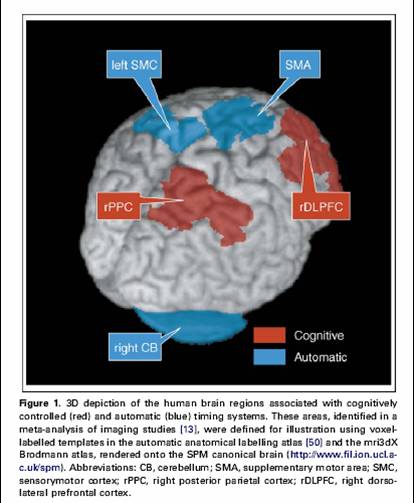
[Double click on image to enlarge]

Contemporary research (Buhusi & Meck, 2005; Lewis & Miall, 2006) supports the idea that there are two mental timing circuits that can be dissociated: (1) an automatic timing system that works in the millisecond range, which is used in discrete-event (discontinuous) timing, and involves the cerebellum; and (2) a continuous-event, cognitively controlled timing system that requires attention and involves the basal ganglia and related cortical structures.

The above figure, which is based on a meta-analysis of studies (see Lewis & Miall, 2006), provides neurological evidence for two such systems via the localization of each system in different parts of the brain. What I (as a cognitive psychologist with a primary interest in psychological testing and theories of intelligence-see IQs Corner) find particularly intriguing is the conclusion (as reported in the Lewis & Miall, 2006 article as well as many other articles I've read) that the primary brain region associated with the cognitively controlled timing system is that also primarily associated with working memory--the dorsolateral prefrontal cortex (DLPFC).

  • Buhusi, W. & Meck, C. (Oct, 2005). What makes us tick: Functional and neural mechanism of interval timing. Nature Reviews: Neuroscience, 6, 755-765
  • Lewis, P. & Miall, C (2006). Remembering the time: a continuous clock. Trends in Cognitive Sciences, 10(9), 401-406.


Technorati Tags: , , , , , , , , , , , , , ,,,,,,

Monday, July 26, 2010

Working memory and IQ brain clock training and mechanisms linked?

It is no secret that I believe that there is a significant link between contemporary working memory (and training related studies) and mental timing mechanisms (and training to improve) that can not be ignored.  I keep running across the common neurological mechanisms of the frontal (esp. the dorsolateral PFC) and parietal cortex's, the frontal-parietal loop, the basal ganglia and dopamine.  I have hypothesized about this in a variety of posts (esp. the possibility of a temporal g domain-general mechanism) and have made this link in a couple on-line PPT slide shows.  Klingberg's article below is entirely consistent with these hypotheses (click here for more info on Klingberg's strong program of working memory research).

Klingberg, T. (2010).  Training and plasticity of working memory.  Trends in Cognitive Sciences, 14 (7), 317-324. (click here to view)

Working memory (WM) capacity predicts performance in a wide range of cognitive tasks. Although WM capacity has been viewed as a constant trait, recent studies suggest that it can be improved by adaptive and extended training. This training is associated with changes in brain activity in frontal and parietal cortex and basal ganglia, as well as changes in dopamine receptor density. Transfer of the training effects to non-trained WM tasks is consistent with the notion of training-induced plasticity in a common neural network for WM. The observed training effects suggest that WM training could be used as a remediating intervention for individuals for whom low WM capacity is a limiting factor for academic performance or in everyday life.

Technorati Tags: , , , , , , , , , , , , , , , , , , , , , , , , , , ,

Tuesday, April 08, 2008

Scientific American Mind IQ Brain Clock article

Another popular press article addressing the importance of the brain and the perception/temporal processing of time...this time in the Feb/March 2008 issue of Scientific American Mind.

The cover of the issue teases the reader with the title "The time machine inside your head." The actual title of the article is "An odd sense of timing" by Pascal Wallisch (currently located as a Postdoctoral Fellow at NYU/CNS).

In general, given the page-length constraints of these popular press type of articles, this is a well-written article. As is the case with most articles that attempt to cut a wide swath in the coverage of a wide and deep field of research and theorization, it has a number of strengths and limitations. The author correctly points out the fact that many questions still remain unanswered regarding the neuro-cognitive mechanisms involved in human temporal processing.

The regular reader of the IQ Brain Clock understands that human time perception covers a broad array of timing behaviors that have been ordered on the order of 10-12 scales of magnitude (click here for prior post). Although not made explicit to the reader, the authors discussion of the precision of timing involved in the brains coordination of motor control/timing is referencing the mental timing system operating at the second and millsecond levels. A quick transition (in the article) is then made to the top end of the end of human timing systems, namely the circadian system that regulates sleep and wake cycles. Potentially lost in this transition is the important understanding that human beings have a wide range of behaviors that are governed by multiple systems of timing, each operating on a different range of time.

On the positive side, the author does touch on some of the key brain areas involved in the processing of time at the second and millisecond levels (the key focus of this blog), temporal processing important to intellectual performance (see prior posts regarding temporal g). Correct mention is made of the importance of the the basal ganglia, striatum, cerebullum, and frontal lobes (the prefrontal cortex/lobes should have received more mention..but I'm probably being a bit picky). The author makes use of two common metaphors used to explain the IQ brain clock, namely, the synchrony involved in the performance of a symphony orchestra (see "Brain Clock IM 2007 Keynote" PPT slides, located on the right side of the home blog page, for the use of this analogy in some of my attempts to explain mental timing) and the "beat of a metronome" to represent the "salvo of nerve cell impulses in the brain" that are "counted" by the brain to represent time.

A significant portion of the article, and probably the material of most popular interest, is the coverage of the subjective perception of time. That is, why, under different circumstances, does time seem to "fly" while in other circumstances time seems to "stand still." Readers who want more information should check check out a prior post re: temporal awareness.

Bottom line - I'm pleased to see the increased recognition of the internal brain clock in more mainstream media. Understanding human temporal processing, IMHO, has the potential to help us better understand a range of important intellectual behaviors and, more importantly, has the potential to produce neuro-cognitive based IQ Brain Clock "fine tunning" interventions that may improve intellectual and academic performance.


Technorati Tags: , , , , , , , , , , , , , , , , ,

Monday, December 11, 2006

Interesting/informative interview on Sharp Brains with Dr. Elkhonon Goldberg, a clinical professor of neurology at New York University School of Medicine. Topics covered include neuroimaging, the frontal lobes and the executive functions, cognitive training and brain fitness programs, and emotions and art.

Technorati Tags: , , , , , , , , , , , ,

powered by performancing firefox

Friday, December 08, 2006

Exec. Function and Clinical Neuropsych PPT

Chris Chatham, the author of the fantastic Developing Intelligence blog, has made available (in PPT or PDF format) a presentation he put together on clinical neuropsychology and executive function. Below is what Chris says about his presentation. His presentation can be downloaded for free from his site. Kudos to Chris.
  • This presention summarizes the essential findings from three studies on the clinical neuropsychology of executive function. It begins with a preface on the basic differences between cognitive neuroscience and clinical neuropsychology, then delving into the difficulties facing any attempt to use theories of executive dysfunction in clinical neuropsych (this section is based on the Royall et al paper)

  • The second half of the presentation deals with factor analyses of executive dysfunction among patients with traumatic brain injury, and ways in which patients with traumatic brain injury can be assessed and possibly rehabilitated.

Technorati Tags: , , , , , , , ,


powered by performancing firefox

Saturday, November 04, 2006

Cognitive Neuroscience and ADD/ADHD - from SharpBrains

Thanks to Sharp Brains for the post summarizing some of the recent developments regarding our understanding of brain structures and functions (role of frontal lobes; executive functioning; etc) and treatment (via brain fitness programs) of ADD/ADHD

SharpBrains continues to be great source for information regarding the use of neurotechology to enhance cognitive functioning.


Technorati Tags: , , , , , , , , , , , , , , , , , , ,

powered by performancing firefox