Showing posts with label dopamine. Show all posts

Monday, July 26, 2010

Working memory and IQ brain clock training and mechanisms linked?

It is no secret that I believe that there is a significant link between contemporary working memory (and training related studies) and mental timing mechanisms (and training to improve) that can not be ignored.  I keep running across the common neurological mechanisms of the frontal (esp. the dorsolateral PFC) and parietal cortex's, the frontal-parietal loop, the basal ganglia and dopamine.  I have hypothesized about this in a variety of posts (esp. the possibility of a temporal g domain-general mechanism) and have made this link in a couple on-line PPT slide shows.  Klingberg's article below is entirely consistent with these hypotheses (click here for more info on Klingberg's strong program of working memory research).

Klingberg, T. (2010).  Training and plasticity of working memory.  Trends in Cognitive Sciences, 14 (7), 317-324. (click here to view)

Working memory (WM) capacity predicts performance in a wide range of cognitive tasks. Although WM capacity has been viewed as a constant trait, recent studies suggest that it can be improved by adaptive and extended training. This training is associated with changes in brain activity in frontal and parietal cortex and basal ganglia, as well as changes in dopamine receptor density. Transfer of the training effects to non-trained WM tasks is consistent with the notion of training-induced plasticity in a common neural network for WM. The observed training effects suggest that WM training could be used as a remediating intervention for individuals for whom low WM capacity is a limiting factor for academic performance or in everyday life.

Technorati Tags: , , , , , , , , , , , , , , , , , , , , , , , , , , ,

Wednesday, June 17, 2009

More on schizophrenia and the mental clock


This is a follow-up post to a prior post re: a study (published in Brain and Cognition) linking mental timing and schizophrenia. I've now read the article closer and would like to share a little more of the content from the authors (prior post only included the abstract)

In the introduction, the authors state that the research literature suggests that:
Schizophrenia may be associated with a fundamental disturbance in the temporal coordination of information processing in the brain, leading to dysfunctions in the timing of perceptual, cognitive, and motor processes (Bressler, 2003; Paulus & Braff, 2003; Phillips & Silverstein, 2003; Tononi & Edelman, 2000). These impairments of neural timing have also been associated with ‘‘disturbances of consciousness,” and may give rise to the expression of clinical symptoms associated with both positive (e.g., hallucinations, delusions) and negative (e.g., psychomotor poverty, poverty of speech) subtype classifications of the disorder (Andreasen, 1999; Hyde, Ziegler, & Weinberger, 1993; McGlashan & Hoffman, 2000).
Support for these conceptualizations is emerging with evidence that brain structures and neurotransmitter systems – such as dopamine, glutamate, and serotonin – that are directly linked to neural timing processes are also impaired in schizophrenia (Andreasen, 1999; Andreasen et al., 1998; Buhusi & Meck, 2007; Cheng, Ali, & Meck, 2007; Rao, Mayer, & Harrington, 2001; Rao et al., 1997; Volz et al., 2001). Despite the growing interest and centrality of these time-dependent conceptualizations of the pathophysiology of schizophrenia, there remains a paucity of research directly examining overt timing performance in the disorder. In addition, the majority of studies that have examined timing behavior in schizophrenia have employed temporal durations in the range of several seconds (Densen, 1977; Johnson & Petzel, 1971; Tysk, 1983a, 1983b, 1990; Volz et al., 2001; Wahl & Sieg, 1980), requiring higher cognitive processes beyond initial sensory registration for temporal encoding (Fraisse, 1984; Michon, 1985; Rammsayer & Lima, 1991). Thus, the aim of the present study was to delineate deficits of temporal perception from more generalized cognitive impairments in schizophrenia by assessing duration estimates in both the millisecond and seconds range using a well-established task of time perception.
The primary purpose of the study was to move beyond prior studies that primarily focused on time estimation in the range of several secondsto time at the level of milliseconds. Also, the theoretical mental clock model used in this study was the classic pacemaker-accumulator model. One task frequently used in mental timing research is the temporal bisection task. The authors provide a nice description of this task:

a temporal bisection task was used to assess the timing of brief auditory durations (i.e., 300–600 ms) in individuals with schizophrenia and non-psychiatric control participants. The temporal bisection procedure required participants to first encode short and long anchor durations to which intermediate durations were subsequently compared and classified as most similar to either the short or the long anchor. The bisection point therefore refers to the duration at which short and long classifications are made with equal probability. In addition to brief durations in the millisecond range, participants in the present study were also required to estimate auditory durations in a second task employing intervals in the range of several seconds (i.e., 3–6 s).
Temporal bisection is unique to other tasks of time estimation with respect to its predictions and the inferences that can be drawn from temporal performance. In a simple timing task involving the estimation of a presented duration, differences in clock rate are reflected in performance differences. Specifically, a faster ‘‘internal clock” would result in the accumulation of a larger number of clock ‘‘pulses” during the timed interval, such that the summation of pulses would correspond to a longer duration than actually presented. A similar outcome would be observed for a slowed clock, with underestimations resulting from the accumulation of fewer pulses than would be needed to represent the presented duration
In the summary, the authors concluded that the timing deficits associated with schizophrenia are due primarily to perceptual or "clock" processes, and not other processes such as attention. Also implicated was the reference memory component of the pacemaker accumulator model.

Technorati Tags: , , , , , , , , , ,

Friday, March 06, 2009

ADHD and the brain clock: Rhythm as a diagnostic marker?


Yet another study (n=11; a pilot study so generalization is limited) implicating the IQ brain clock (mental time-keeping) and a clinical disorder---ADHD. The possible role of the brain clock and dopamine and ADHD is nothing new and has been reported previously at this blog (click here, here, and here.)

This study found that adults with ADHD lose their ability to keep rhythm (maintaining a tapping beat) when the tempo is varied. This pilot study suggest that the "effective span of rhythmic feel" is apparently contracted (narrower) in ADHD adults when compared to normals.

Might this not suggest that a sensitive metronome-based measurement technology (e.g., the measurement component of Interactive Metronome - conflict of interest disclosure---I'm on the scientific advisory board for IM), that can carefully calibrate the ability to maintain the "feel" for varying tempo's/rhythms mights serve as a diagnostic marker for possible ADHD?

Hmmmmmmmmmmm....interesting idea.

However....caution is in order. This is a small pilot study and only with adults. Generalization to a larger population and children and adolescents is not possible. Also....ADHD is a complex diagnosis that cannot be reduced to a single test, sign, marker, etc.

I'm excited as a researcher...as this continues to point towards the importance of the IQ Brain Clock


Technorati Tags: , , , , , , , , , ,

Sunday, February 01, 2009

IQ Brain Clock brain localization overview

I previously blogged about a special issue of Acta Neurobiologiae devoted to the minds brain clock. I provided a TOC and links to the papers. I just now skimmed one of the papers by Rubia & Smith (2004):

RUBIA K. and SMITH A.
The neural correlates of cognitive time management: a review 

My conclusion is that this is an excellent overview of the basic empirical research and theoretical literature regarding mental time-keeping (i.e., the IQ Brain Clock). It also provides a nice summary of the general consensus re: the major areas of the brain believed to be involved in motor and cognitive timing, areas featured in prior posts here. Below is a copy of the first concluding paragraph...where I've added tag links to all prior IQ Brain Clock posts that refer to these brain areas or concepts. I will shortly add Rubia to the mental timing scholars blogroll and this article to the key research articles section of this blog.

  • In conclusion, this review on the neural correlates of cognitive time management shows that predominantly right hemispheric dorsolateral and inferior prefrontal cortices, anterior cingulate, the SMA, the basal ganglia and the lateral cerebellar hemispheres appear to be involved in both functions of motor timing and time estimation. Furthermore, the review shows that the dichotomy between motor and perceptive timing functions may be artificial. Both functions appear to be mediated by identical neural networks and may be inseparable.

Wednesday, January 14, 2009

The IQ brain clock: Role of basal ganglia and cerebellum


[double click on image to enlarge}

Dr. Ivry, a "mental timing scholar" (aka., IQ Brain Clock doc) has done it again!

In a prior post I drooled over the means by which he explained possible different neural models of temporal processing (the IQ Brain Clock) via visual-graphic diagrams. As a result of his most recent article (see prior post link above), I went and found an earlier 2004 publication (with Spencer) that again presents an excellent visual-graphic explanation of hypothesized different neural timing models (see figure above), but more importantly, presents a very nice visual-graphic explanation of the hypothesized role of the basal ganglia (and dopamaine), which have been repeatedly implicated in mental timing and such clinical disorders as Parkinson's (see figure below). I've always known that the basal ganglia play a prominent role in mental timing, but have never been able to grasp (probably reflecting my limitations) the possible "why" or underlying mechanism. They offer an interesting and understandable hypothesis.


[double click on image to enlarge]

In the Ivry and Spencer (2004) article in Current Opinion in Neurobiology, the authors suggest that the basal ganglia works like a gating mechanism....which I have compared to the switch operator function in a railway system (see PPT slide show). According to the authors, who also prominently feature the cerebellum in brain clock timing system models:

  • The current evidence does not preclude distributed models or hypotheses that assign a central role for timing to another specialized system, such as the basal ganglia. As reviewed here, the results of imaging and lesion studies are ambiguous with respect to the role of the basal ganglia in timing short intervals. A clear dissociation between the cerebellar and the basal ganglia contributions on temporal processing tasks remains elusive, primarily because similar deficits have been observed in patients with lesions of either structure ..... The cerebellar hypothesis offers a parsimonious account over a broad set of tasks, and neurobiologically feasible models have been developed. Nonetheless, a specialized system hypothesis must be able to account for similar patterns of performance following damage to distinct systems.
  • As a starting point, we propose that the basal ganglia are an integral part of decision processes, operating as a threshold mechanism (Figure 2). Activations into the basal ganglia are gated such that only those reaching threshold are implemented [69]. The activation functions for different decisions can reflect multiple factors, such as goals, sensory inputs, and contextual information. These representations engage in a competitive process for control. According to this view, the basal ganglia ensure that response implementation or working memory updating does not occur until a criterion level of activation is reached. Dopamine inputs to the striatum modulate threshold settings, providing one mechanism by which the competition can be biased. Thresholds for reinforced actions are lowered, increasing the likelihood of implementation, even if the input patterns are unchanged.
An excellent and brief article. I will be adding it to the "key timing articles" link section of the IQ Brain Clock.

Technorati Tags: , , , , , , , , , , , , ,

Tuesday, July 01, 2008

Brain Clock Research Bytes # 1: Parkinsons, schizophrenia, and temporal pattern recognition

I found time to quickly skim a number of interesting journal articles this afternoon. Check out the following research bytes:
  • Yet another study (Jones et al., in press, Brain and Cognition) linking the brain clock to Parkinson's with the usual cast of neuroscience characters implicated (basal ganglia; dopamine). A snipet from the authors conclusions "the data suggest that the integrity of the basal ganglia is necessary for ‘typical’ time production in the seconds range as well as for time reproduction at shorter intervals"
  • In a prior post I reviewed one of the key brain clock research articles (see right side of this blog) by Buhusi and Meck 2006), where they implicated the brain clock in a variety of mental disorders, including schizophrenia. I just skimmed another article "in press" in Brain and Cognition (see link above in prior bulleted byte), this type by Carroll et al., that suggests a deficit in auditory temporal processing precision in schizophrenics.
Technorati Tags: , , , , , , , , , , , ,

Wednesday, November 22, 2006

Working memory and mental timing

I've previously attempted to summarize the gist of the conclusions of Dr. Penny Lewis (see "Mental timing scholars" section of the IQ Brain Clock) on the important association between mental/interval time-keeping and working memory. In addition, I recently posted a series of PowerPoint slides (see "On-line PPT slides" section of the IQ Brain Clock) where, if you take time to view the entire show, you will see that I've hypothesized that working memory (and other related neuropsychological constructs of executive function; controlled executive attention) most likely plays a prominent role in performance on SMT (synchronized metronome tapping) performance tasks, and, may be a causative factor in explaining the benefits of SMT-based training (e.g., Interactive Metronome).

Below are a few snipets from Dr. Lewis important paper ("Remembering the time: A continuous clock - a viewable copy is under the "Key research articles" section of this blog) that links working memory and the brain's master internal clock.
  • Behavioural evidence that working memory and time measurement draw upon the same cognitive resources stems from dual-task studies showing interference between these two types of processing. Both visuospatialand phonological working memory tasks disrupt timing, and the extent of such disruption has been shown to correlate with the extent of working memory load (e.g. number of items to be remembered, number of syllables to be rehearsed or degrees of mental rotation).
  • Turning to pharmacology, manipulations targeting working memory can also disrupt cognitive timing.
  • Additional evidence linking time perception to working memory stems from the observation that both are modulated by dopamine, a neurotransmitter which regulates activity throughout much of the brain, including the prefrontal cortex. The influence of prefrontal dopaminergic projections upon working memory is well documented
  • Because the basal ganglia are heavily innervated by dopamine, and because their function is severely disrupted in Parkinson’s disease, the influence of dopamine on subjective time measurement has typically been interpreted as support for the central role of these structures in timing.
  • Overall, the data on dopamine suggest a selective influence of prefrontal dopamine on more cognitive timing tasks, thus implying that this form of timing might be mediated via the same dopamine-sensitive processors as working memory.
Technorati Tags: , , , , , , , , , , , , , , , , , , , ,

powered by performancing firefox

Friday, November 17, 2006

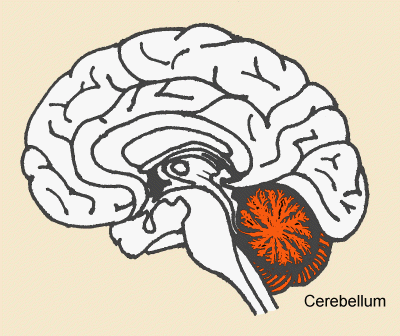
Cerebellum differential time-keeping role


This is a follow-up post up on my prior posts regarding the three major systems of timing, the brain functions/structures involved in mental/interval time-keeping, and research implicating the brains master time clock in certain clinical disorders (click here)

According to Buhusi and Meck (2006), research has suggested that impaired mental/interval time-keeping in the seconds-to-minutes range is found in patients with disorders that involve dopaminergic pathways (Parkinson’s disease, Huntington’s disease,and schizophrenia. Coupled with research that has studied the impact of lesions in the cerebellum, these authors conclude that "the striatum and cerebellum are involved in different aspects of timing and time perception. Although the cerebellum is not essential for interval timing, it is required for correct millisecond timing"

Technorati Tags: , , , , , , , , , , , , , ,


powered by performancing firefox