Showing posts with label SMT. Show all posts

Friday, July 31, 2015

The Time Doc's Interactive Metronome (IM)-Home guest posts


Most of my readers are aware of my interest in brain-clock based neurotechnologies, particularly as they relate to improving cognitive functioning. All posts related to this area of interest, as well as posts linking readers to other neuroscience developments, can be found here at the Brain Clock blog.

A few years back I also was a guest blogger (aka, the Time Doc) at the IM-Home blog. I frequently find myself directing people who contact me to some of those guest posts.  So, I've decided to provide a single link (click here) that will take readers to all my IM/brain clock guest posts. Enjoy.

I hope readers check out these posts and become more aware of the exciting neurotechnologies that are emerging based on the concept of temporal processing and the human brain clock.

[Click on image to enlarge]


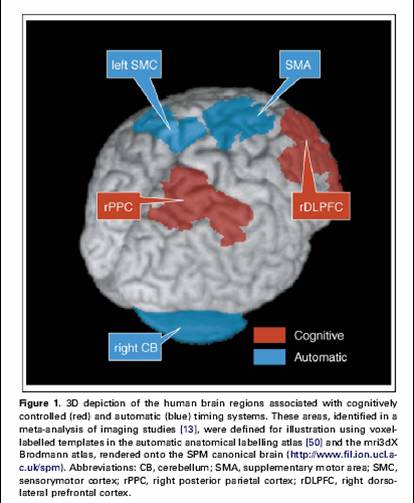
Synchronized metronome tapping (SMT) and the automatic/controlled timing systems of the brain


[This is an OBG (oldie but goodie) post first posted November 4, 2006 - this new post has a few corrections and the fixing of some broken links]

In a prior post, I highlighted a distinction contemporary mental time-keeping researchers make regarding two general types of human timing systems. Briefly, the automatic timing system works in the millisecond range of time, is used in discrete-event (discontinuous) timing, and involves the cerebellum. This contrasts with the continuous-event, cognitively controlled timing system that requires attention and involves the basal ganglia and related cortical structures.

In their article, Lewis and Maill (2006) provide further clarification of how they perceive differences between these two mental timing systems. According to Lewis and Maill, "it is not any single characteristic, but rather a constellation of several characteristics which determines which timing system is recruited in any particular task." The three task characteristics isolated by these researchers are: (a) the duration measured, (b) whether or not the timed intervals were defined by movement and, (c) whether timing was continuous (e.g. an unbroken series of predictable intervals) or intermittent (e.g. broken into discrete measurements by the presence of unpredictable irregular intervals).

Lewis and Maill conclude that "our analysis showed that having any two out of the three characteristics associated with a task type (cognitive or automatic) dramatically increased the probability that the areas associated with that timing system would be recruited. Accordingly, we can think of any task having two or more cognitive attributes (e.g. measuring more than a second, discontinuously, and without relying upon movement) as a ‘cognitively controlled timing task’, and any task with two or more of the opposing characteristics as an ‘automatic timing task’."How does this apply to understanding the brain structures and functions involved in SMT (synchronized metronome tapping; e.g., Interactive Metronome)? [click here for from info on SMT and IM and my necessary conflict of interest disclosures...just follow the link trails].

Given my understanding (and one personal experience with an SMT intervention), I would hypothesize that SMT interventions most likely tap both the automatic and controlled cognitive timing systems (and related neurological structures and functions). SMT-based interventions typically involve a motor component (e.g., clapping hands together to the beat), a continuous tone interval, and require responding in terms of milliseconds. These characteristics definitely would be associated with the automatic timing system.

However, although an individual (during SMT training) is trying to synchronize their tapping in terms of milliseconds, the duration between the continuous tones is more in the range of a second or so. Also, especially during initial stages of SMT, an individual's working memory [see prior post on the pacemaker accumulator model of mental time-keeping] is particularly taxed as one monitors the SMT visual and/or auditory feedback provided, makes a decision about whether they are responding "too fast" or "too slow", and then consciously implements a correction to their "beat" behavior. These later characteristics are more characteristic of the cognitively controlled timing system.

So...it is my hypothesis that both the automatic and cognitively controlled timing systems of mental or interval time-keeping are involved with SMT-based interventions. It is possible that both are significantly active during early stages of SMT training and, with improvement and progress over time, the role of the cognitively controlled system decreases and the automatic system is more responsible. These are only hypothesis and need empirical study.

  • Lewis, P. & Miall, C (2006). Remembering the time: a continuous clock. Trends in Cognitive Sciences, 10(9), 401-406.


Friday, September 18, 2009

Arts training improves cognition via attention: More support for IQ brain clock fine tunning hypothesis

I just read an interesting post at Cerebrum regarding the impact of training in the arts and improved cognition, hypothesized to occur due to improvement in attention.

I find the research very consistent with the proposed link between the mental timing (IQ Brain Clock) and improved cognitive performance, which has been hypothesized to impact the same basic cognitive functions (esp., controlled executive attention and executive functions).  I've blogged and PPT'd extensively at this blog, esp. with re: to neurotechnologies that focus on synchronized metronome tapping, a technology that deals with rhythm perception and production.

In my opinion, the research discussed at the Cerebrum adds to the growing literature suggesting a link between "fine tuning the temporal resolution of the brain clock" and improved cognitive efficiency.  Amy Vega and I recently published a research review report supporting the link between brain rhythm-based treatments and improvement in a diverse array of human performance domains. 

Technorati Tags: , , , , , , , , , , , , , , , , ,

Wednesday, December 19, 2007

Improved brain clock improves student performance: Media coverage

Today's edition of the Daytona Beach News-Journal includes an interesting report on a private schools use of a synchronized metronome tapping (SMT) intervention (viz., Interactive Metronome) with elementary school-age children. The article speaks for itself, with the staff reporting positive improvement in behavior and academics for students using the IM method.

As you will notice, myself, and my friend/colleague (Dr. Gordon Taub) were interviewed for the article. We were interviewed as the reporter read our recent journal publication in Psychology in the Schools, an article that reported positive reading improvement after the IM intervention.

This is one of my handful of experiences in being interviewed by a reporter. After spending at least one hour on the phone with the reporter, and sharing all kinds of information, it is interesting to see what comments I (we) made the survived the final cut. I'm pleased that the information attributed to Dr. Taub and I was accurate.

Be sure to watch the video that accompanies the article...it will give you a good feel for the basics of the IM (SMT-based) intervention.

As I've reported before, my involvement in the IM study with Dr. Taub was the impetus for my recent interest in temporal processing, mental/interval time-keeping, and the concept of an internal brain clock. It is why I started the IQ Brain Clock blog.

[See conflict of interest disclosure statement re: my role as a Scientific Advisor to IM]

Just in case this on-line article is ever pulled from the net, I've made a pdf copy available for viewing.


Technorati Tags: , , , , , , , , ,

Powered by ScribeFire.

Wednesday, November 22, 2006

Working memory and mental timing

I've previously attempted to summarize the gist of the conclusions of Dr. Penny Lewis (see "Mental timing scholars" section of the IQ Brain Clock) on the important association between mental/interval time-keeping and working memory. In addition, I recently posted a series of PowerPoint slides (see "On-line PPT slides" section of the IQ Brain Clock) where, if you take time to view the entire show, you will see that I've hypothesized that working memory (and other related neuropsychological constructs of executive function; controlled executive attention) most likely plays a prominent role in performance on SMT (synchronized metronome tapping) performance tasks, and, may be a causative factor in explaining the benefits of SMT-based training (e.g., Interactive Metronome).

Below are a few snipets from Dr. Lewis important paper ("Remembering the time: A continuous clock - a viewable copy is under the "Key research articles" section of this blog) that links working memory and the brain's master internal clock.
  • Behavioural evidence that working memory and time measurement draw upon the same cognitive resources stems from dual-task studies showing interference between these two types of processing. Both visuospatialand phonological working memory tasks disrupt timing, and the extent of such disruption has been shown to correlate with the extent of working memory load (e.g. number of items to be remembered, number of syllables to be rehearsed or degrees of mental rotation).
  • Turning to pharmacology, manipulations targeting working memory can also disrupt cognitive timing.
  • Additional evidence linking time perception to working memory stems from the observation that both are modulated by dopamine, a neurotransmitter which regulates activity throughout much of the brain, including the prefrontal cortex. The influence of prefrontal dopaminergic projections upon working memory is well documented
  • Because the basal ganglia are heavily innervated by dopamine, and because their function is severely disrupted in Parkinson’s disease, the influence of dopamine on subjective time measurement has typically been interpreted as support for the central role of these structures in timing.
  • Overall, the data on dopamine suggest a selective influence of prefrontal dopamine on more cognitive timing tasks, thus implying that this form of timing might be mediated via the same dopamine-sensitive processors as working memory.
Technorati Tags: , , , , , , , , , , , , , , , , , , , ,

powered by performancing firefox

Tuesday, November 07, 2006

Mental interval timing interventions - feature on IM

To date, the only intervention I'm aware of, that appears to deal with fine-tunning the brain's master mental/interval timing clock, is Interactive Metronome, a synchronized metronome tapping intervention. [Click here to see potential conflicts of interest - primarily being paid to be an external project evaluation consultant on a study].

For those unfamiliar with the IM method, a brief introductory video can be found at the IM site (click here).

At this time, I'm making a request of readers of this blog. If you know of other brain-based brain-fitness programs that focus on fine-tuning the minds master internal clock, or, indirectly appear to have an impact on the minds internal clock, please drop me a note. I want to find as many interventions relevant to this area of study as possible. Either post a "comment" at this blog or email me at: iap@earthlink.net

Thanks

Technorati Tags: , , , , , , , , , , , , , , , ,,

Saturday, November 04, 2006

Synchronized metronome tapping (SMT) and the automatic/controlled timing systems of the brain


In a prior post, I highlighted a distinction contemporary mental time-keeping researchers make regarding two general types of human timing systems. Briefly, the automatic timing system works in the millisecond range of time, is used in discrete-event (discontinuous) timing, and involves the cerebellum. This contrasts with the continuous-event, cognitively controlled timing system that requires attention and involves the basal ganglia and related cortical structures.

In their article, Lewis and Maill (2006) provide further clarification of how they perceive differences between these two mental timing systems. According to Lewis and Maill, "it is not any single characteristic, but rather a constellation of several characteristics which determines which timing system is recruited in any particular task." The three task characteristics isolated by these researchers are: (a) the duration measured, (b) whether or not the timed intervals were defined by movement and, (c) whether timing was continuous (e.g. an unbroken series of predictable intervals) or intermittent (e.g. broken into discrete measurements by the presence of unpredictable irregular intervals).

Lewis and Maill conclude that "our analysis showed that having any two out of the three characteristics associated with a task type (cognitive or automatic) dramatically increased the probability that the areas associated with that timing system would be recruited. Accordingly, we can think of any task having two or more cognitive attributes (e.g. measuring more than a second, discontinuously, and without relying upon movement) as a ‘cognitively controlled timing task’, and any task with two or more of the opposing characteristics as an ‘automatic timing task’."

How does this apply to understanding the brain structures and functions involved in SMT (synchronized metronome tapping; e.g., Interactive Metronome)? [click here for from info on SMT and IM and my necessary conflict of interest disclosures...just follow the link trails].

Given my understanding (and one personal experience with an SMT intervention), I would hypothesize that SMT interventions most likely tap both the automatic and controlled cognitive timing systems (and related neurological structures and functions). SMT-based interventions typically invovle a motor component (e.g., clapping hands together to the beat), a continuous tone interval, and require responding in terms of milliseconds. These characteristics definetely would be associated with the automatic timing system.

However, although an individual (during SMT training) is trying to synchronoize their tapping in terms of milliseconds, the duration between the continuous tones is more in the range of a second or so. Also, expecially during initial stages of SMT, an individual's working memory [see prior post on the pacemaker accumulator model of mental time-keeping] is partcularly taxed as one monitors the SMT visual and/or auditory feedback provided, makes a decision about whether they are responding "too fast" or "too slow", and then conciouslly implements a correction to their "beat" behavior. These later characteristics are more characteristic of the cognitively controlled timing system.

So...it is my hypothesis that both the automatic and cognitively controlled timing systems of mental or interval time-keeping are inolved with SMT-based interventions. It is possible that both are significantly active during early stages of SMT training and, with improvement and progress over time, the role of the cognitively controlled system decreases and the automatic system is more responsible. These are only hypothesis and need empirical study.

  • Lewis, P. & Miall, C (2006). Remembering the time: a continuous clock. Trends in Cognitive Sciences, 10(9), 401-406.

Technorati Tags: , , , , , , , , , , , , , , , ,,