Showing posts with label cerebellum. Show all posts

Saturday, December 10, 2011

Background noise may disrupt speech perception via neural timing synchronization problems

Yet more research supporting the role of the brain clock in human behavior, this time (again) focusing on the importance of neural timing/temporal resolution being negatively influenced by background noise. Impaired auditory signal processing may disrupt speech perception in invidiauls with speech perception problems.


Posted via DraftCraft app

Sunday, July 03, 2011

More evidence for brain network involved in controlled attention

A broken theme at the IQ Brain Clock is the hypothesis that the prefrontal cortex(especially the dorsolateral prefrontal), left parietal cortex , cerebellum, and basal ganglia network is key to mental timing, working memory and executive attention. Here is another study providing addition support for the first two cortical areas, with an extension to spatial working memory/attention and motor intention.

Click on images to enlarge


- iPost using BlogPress from my Kevin McGrew's iPad

Sunday, February 01, 2009

IQ Brain Clock brain localization overview

I previously blogged about a special issue of Acta Neurobiologiae devoted to the minds brain clock. I provided a TOC and links to the papers. I just now skimmed one of the papers by Rubia & Smith (2004):

RUBIA K. and SMITH A.
The neural correlates of cognitive time management: a review 

My conclusion is that this is an excellent overview of the basic empirical research and theoretical literature regarding mental time-keeping (i.e., the IQ Brain Clock). It also provides a nice summary of the general consensus re: the major areas of the brain believed to be involved in motor and cognitive timing, areas featured in prior posts here. Below is a copy of the first concluding paragraph...where I've added tag links to all prior IQ Brain Clock posts that refer to these brain areas or concepts. I will shortly add Rubia to the mental timing scholars blogroll and this article to the key research articles section of this blog.

  • In conclusion, this review on the neural correlates of cognitive time management shows that predominantly right hemispheric dorsolateral and inferior prefrontal cortices, anterior cingulate, the SMA, the basal ganglia and the lateral cerebellar hemispheres appear to be involved in both functions of motor timing and time estimation. Furthermore, the review shows that the dichotomy between motor and perceptive timing functions may be artificial. Both functions appear to be mediated by identical neural networks and may be inseparable.

Wednesday, January 14, 2009

The IQ brain clock: Role of basal ganglia and cerebellum


[double click on image to enlarge}

Dr. Ivry, a "mental timing scholar" (aka., IQ Brain Clock doc) has done it again!

In a prior post I drooled over the means by which he explained possible different neural models of temporal processing (the IQ Brain Clock) via visual-graphic diagrams. As a result of his most recent article (see prior post link above), I went and found an earlier 2004 publication (with Spencer) that again presents an excellent visual-graphic explanation of hypothesized different neural timing models (see figure above), but more importantly, presents a very nice visual-graphic explanation of the hypothesized role of the basal ganglia (and dopamaine), which have been repeatedly implicated in mental timing and such clinical disorders as Parkinson's (see figure below). I've always known that the basal ganglia play a prominent role in mental timing, but have never been able to grasp (probably reflecting my limitations) the possible "why" or underlying mechanism. They offer an interesting and understandable hypothesis.


[double click on image to enlarge]

In the Ivry and Spencer (2004) article in Current Opinion in Neurobiology, the authors suggest that the basal ganglia works like a gating mechanism....which I have compared to the switch operator function in a railway system (see PPT slide show). According to the authors, who also prominently feature the cerebellum in brain clock timing system models:

  • The current evidence does not preclude distributed models or hypotheses that assign a central role for timing to another specialized system, such as the basal ganglia. As reviewed here, the results of imaging and lesion studies are ambiguous with respect to the role of the basal ganglia in timing short intervals. A clear dissociation between the cerebellar and the basal ganglia contributions on temporal processing tasks remains elusive, primarily because similar deficits have been observed in patients with lesions of either structure ..... The cerebellar hypothesis offers a parsimonious account over a broad set of tasks, and neurobiologically feasible models have been developed. Nonetheless, a specialized system hypothesis must be able to account for similar patterns of performance following damage to distinct systems.
  • As a starting point, we propose that the basal ganglia are an integral part of decision processes, operating as a threshold mechanism (Figure 2). Activations into the basal ganglia are gated such that only those reaching threshold are implemented [69]. The activation functions for different decisions can reflect multiple factors, such as goals, sensory inputs, and contextual information. These representations engage in a competitive process for control. According to this view, the basal ganglia ensure that response implementation or working memory updating does not occur until a criterion level of activation is reached. Dopamine inputs to the striatum modulate threshold settings, providing one mechanism by which the competition can be biased. Thresholds for reinforced actions are lowered, increasing the likelihood of implementation, even if the input patterns are unchanged.
An excellent and brief article. I will be adding it to the "key timing articles" link section of the IQ Brain Clock.

Technorati Tags: , , , , , , , , , , , , ,

Saturday, December 20, 2008

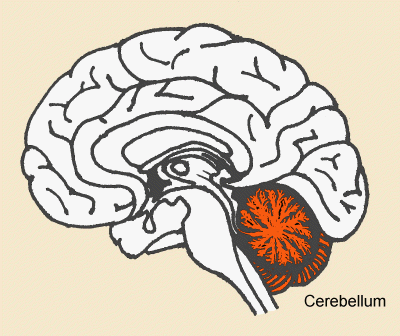
The Cerebellum journal


So much to read....so little time.

It is impossible to stay abreast of the wide-ranging and diverse scholarly publications that report on different pieces of the internal brain clock.  A pleasant problem.   As we know, the cerebellum is clearly implicated in various aspects of mental-time keeping, esp. that dealing with motor behavior.  Today I learned that there is a journal devoted just to research on the cerebellum.  As stated at the journal web page:

  • The Cerebellum is devoted to the science of the cerebellum and its role in ataxia and other disorders. This region, with more neurons than all other brain structures, attracts intense interest: in the genetics of cerebellar ataxias, in the roles of the cerebellum in motor control and cognitive function, and amid an ageing population, in diseases associated with cerebellar dysfunction.
  • The Cerebellum is a central source for the latest developments in a growing field. Coverage spans fundamental neurosciences including molecular and cellular biology; behavioural neurosciences and neurochemistry; genetics; fundamental and clinical neurophysiology; neurology and neuropathology; cognition and neuroimaging.
  • The official publication of the Society for Research on the Cerebellum, the journal benefits neuroscientists in molecular and cellular biology; neurophysiologists; researchers in neurotransmission; neurologists; radiologists; paediatricians; neuropsychologists; students of neurology and psychiatry and others.
Technorati Tags: , , , , , , , , ,

Friday, October 31, 2008

Understanding the IQ brain clock: Excellent overview article


[double click on image to enlarge]

Damn I love the journal Trends in Cognitive Science. It routinely publishes concise articles that circumscribe the state of the knowledge in important areas of human cognition/intelligence. I just finished reading yet another outstanding article ("Dedicated and intrinsic models of time perception") by Ivry and Schlerf (2008) (click to review)

Throughout the past year I've posted material regarding different neural models that have been advanced to explain the IQ brain clock (temporal processing). I've never felt I've done a good job in pulling all of this together. These authors do an exceptional job in describing the four primary hypothesized models that have been advanced to explain the neural mechanisms underlying the human brain clock. More importantly they do so which the aid of great visual-graphics (see the one above). I liked the article so much that I've added it to the "key research articles" section of this blog and have also added Dr. Ivry to the "mental timing scholars" link section.
  • Abstract: Two general frameworks have been articulated to describe how the passage of time is perceived. One emphasizes that the judgment of the duration of a stimulus depends on the operation of dedicated neural mechanisms specialized for representing the temporal relationships between events. Alternatively, the representation of duration could be ubiquitous, arising from the intrinsic dynamics of nondedicated neural mechanisms. In such models, duration might be encoded directly through the amount of activation of sensory processes or as spatial patterns of activity in a network of neurons. Although intrinsic models are neurally plausible, we highlight several issues that must be addressed before we dispense with models of duration perception that are based on dedicated processes.
A few tidbits extracted (directly) from the article, some that reinforce information posted at the IQ Brain Clock over the past few years---and some that is new. italics added by blogmaster:
  • we focus on a fundamental question that has defined much of the recent discussion: is our perception of the passage of time the consequence of dedicated, clock-like neural mechanisms? Or is duration coded in an accessible manner as an intrinsic and ubiquitous property of neural activity?
  • The facile manner with which we compare time across different modalities suggests some sort of internal clock.
  • Dedicated models of time perception are, at their core, modular. As vision scientists speak of dedicated mechanisms for color or motion perception, modular models of time perception entail some sort of specialized mechanism that represents the temporal relationship between events. The pacemaker-counter model is one example of a modular system .
  • Intrinsic models offer a radically different perspective on the perception of time. These models assume that there is no specialized brain system for representing temporal information, asserting that time is inherent in neural dynamics.
  • the cerebellar timing hypothesis is based on the assumption that the cerebellum has a unique representational capability and is accessed whenever a particular task requires precise timing.
  • Similar arguments have been developed for other neural regions that might serve as dedicated timing systems [25]. These include the basal ganglia [26,27], supplementary motor area [28,29] and prefrontal cortex, especially in the right hemisphere [30,31]. For the most part, converging evidence has been offered in support of all of these candidate regions.
  • considerable debate continues on the question of whether temporal-processing deficits are uniquely associated with damage to a particular neural structure.
  • Other dedicated models avoid localization issues by postulating that the representation of time results from activity across a network of regions
  • The role of nontemporal factors on perceived duration Performance on time-perception tasks entails several component processes, many of which are not specific to time. These include attention, working memory and long-term or reference memor

Technorati Tags: , , , , , , , , , , ,

Wednesday, July 02, 2008

Developmental coordination disorders: Special journal issue

Given the critical importance of the brain clock in motor coordination and functioning, readers of the IQ Brain Clock blog might want to check out a post at my sister blog (IQs Corner) that features a special issue of Human Movement Science dealing with developmental coordination disorder.

Technorati Tags: , , , , , , , , , , , , , , ,

Thursday, May 01, 2008

Cerebullum control of mental activities: New model


[double click on image to enlarge]

Thanks to Neurodudes for the post regarding a new/revised theory of how the cerebellum, which we know is intimately involved in timing of motor movements, may be involved in the control of cognition. I love the nice model figure (see above). I'm particularly pleased to see the role of executive functions, working memory, and central attention....neuro-cognitive mechanisms I've blogged about repeatedly as being significantly involved in the IQ Brain Clock, temporal processing (temporal g), and mental time-keeping.

According to Neurodudess, "the great Masao Ito, originator of one of the classic theories of cerebellar function, has published a new theory in the recent issue of Nature Neuroscience regarding how the cerebellum may be involved in control of cognition."

Check out the complete post at Neurodudes. If you feel up to reading the original article, click here.


Thursday, March 15, 2007

Brain clock temporal processing review article

I just finished reading Mauk and Buonomano's 2004 review (Annual Review of Neuroscience) of "The Neural Basis of Temporal Processing." This is a bit of a hard read, but it is a good general overview summary article on contemporary mental time-keeping or temporal processing research and theory. All major mental time-keeping models are discussed, although the authors have a clear preference for the state-dependent distributed "emergent" neural models (vs. the internal clock model). I've posted a link to the article (that includes some yellow highlighting I did while reading the article) in the "key research articles" section of this blog. This is a good article for getting a handle on some of the key terms and theoretical concepts/models. I hope to take the notes I extracted and make some specific posts in the near future. I'm doing this reading largely to try get a handle on this entire domain of research....my learning curve is a bit slow right now.

A key comment in the review is that this field of research is very much in it's formative stage (stage of infancy).

Technorati Tags: , , , , , , , , , , , , ,

powered by performancing firefox

Wednesday, March 14, 2007

The cerebellum and Tinker Toys

Check out the ENL blog for an interesting study showing brain activation areas when observing or performing construction with Tinker Toys. Not surprisingly, the cerebellum was hot and active during this activity, an activity with significant motor learning.

Technorati Tags: , , , , , , , , ,


powered by performancing firefox

Wednesday, February 14, 2007

What makes us tick? Nice research summary

Previously in this blog I've drawn attention to one of the key contemporary articles dealing with the neural mechanisms of mental/interval time keeping (by Buhusi and Meck). A copy of the complete article is listed under the "Key Research articles" portion of this blog ("What Makes Us Tick?).

Today I ran across a nice bulleted Neuroscience ummary of the article. It can be found by clicking here.

Technorati Tags: , , , , , , , , , ,


powered by performancing firefox

Friday, December 22, 2006

Cerebellum and dyslexia controversy

As noted in a prior post, there has been a recent firestorm surrounding the controversial Dore Achievement Centers cerebellum-based treatment approach to severe reading disabilities (dyslexia). The Myomancy blog has been particularly prominent in covering the controversy and issues surrounding the cerebellum-based Dore Achievement Centers treatment. Given the role of the cerebellum in certain forms of mental/interval time-keeping, I find this controversy and surrounding research of interest.

The mental/interval time-keeping research has implicated the cerebellum in behaviors that operate at the millisecond range of time keeping, but not at the interval levels. I think this point may be relevant to the whole Dore controversy. As summarized previously, more complex cognitive behaviors (e.g., reading) most likely involve both the millisecond and interval level time-keeping systems. The interval level system appears to be important for such cognitive abilities as working memory and executive function, higher-level cognitive functions important for intelligence and achievement.

Thus, if a treatment for dyslexia is based ONLY on the millisecond system (primarily the cerebellum), it is not surprising that there is controversy. Such a brain-based treatment may only be focusing on one brain-related component for reading....while ignoring others (cognitive abilities and functions more dependent on the interval timing system).

This hypothesis is supported by a recent meta-analysis re: the role of impaired balance (due to the cerebellum) and developmental dyslexia. The reference and abstract (and URL link) are provided below. Bottom line--according to this meta-analysis and the mental/interval time-keeping research presented previously at this blog---a treatment focused only on the functions/abilities mediated by the cerebellum is likely only touching on a small portion of the complex set of abilities involved in reading. Brain-based treatments for reading (and other academics) most likely need to also include activities that address cognitive abilities mediated by cognitively controlled interval time-keeping brain mechanisms. I believe the article speaks for itself (although I have added emphasis via italics).
  • Rochell, K. & Talcott, J. (2006). Impaired balance in developmental dyslexia? A meta-analysis of the contending evidence. Journal of Child Psychology and Psychiatry, 47(11), 1159–1166 (click here to view)

Abstract
  • Background: Developmental dyslexia is typically defined by deficits in phonological skills, but it is also associated with anomalous performance on measures of balance. Although balance assessments are included in several screening batteries for dyslexia, the association between impairments in literacy and deficits in postural stability could be due to the high co-occurrence of dyslexia with other developmental disorders in which impairments of motor behaviour are also prevalent. Methods: We identified 17 published studies that compared balance function between dyslexia and control samples and obtained effect-sizes for each. Contrast and association analyses were used to quantify the influence of hypothesised moderator variables on differences in effects across studies. Results: The mean effect-size of the balance deficit in dyslexia was .64 (95% CI ¼ .44–.78) with heterogeneous findings across the population of studies. Probable co-occurrence of other developmental disorders and variability in intelligence scores in the dyslexia samples were the strongest moderator variables of effect-size. Conclusions: Balance deficits are associated with dyslexia, but these effects are apparently more strongly related to third variables other than to reading ability. Deficits of balance may indicate increased risk of developmental disorder, but are unlikely to be uniquely associated with dyslexia. Keywords: Meta-analysis, dyslexia, attention-deficit/hyperactivity disorder, balance, postural stability. Abbreviations: ADHD: attention deficit, hyperactivity disorder; DCD: developmental coordination disorder; FSIQ: full-scale intelligence quotient.
Technorati Tags: , , , , , , , , , , , , , , , , , ,

powered by performancing firefox

Wednesday, December 13, 2006

Mental time clock - fewer brain areas involved?

In prior posts re: mental/interval time-keeping, I have drawn on key neuroscience research articles regarding the potential brain areas/functions involved in the brain's master clock (this information was summarized in the "Interactive Metronome: Whats happening under the hood" on-line PPT slide show available on the right side of this blog) . This week I ran across a new fMRI study that questions the number and breadth of involvement of some of these key areas of the brain (viz., cerebullum, basal ganglia, frontal-striatal loop, dorsolateral prefrontal cortex, parietal lobe) in mental time-keeping. Below is the article reference and abstract. I believe the article speaks for itself.

As with all science, this is one more bit of information that needs to be added to the extant research knowledge base. The preponderance of research to date suggests the involvement of the areas summarized above, but this new study needs to examined (and hopefully replicated) so that possible adjustments to current thinking can be modified as needed.

I've also placed this article in the the "key research articles" section of this blog.

Livesey, A., Wall, M. Smith, A. (2007). Time perception: Manipulation of task difficulty dissociates clock functions from other cognitive demands Neuropsychologia,45,321–331. (click here to view)

Abstract (italics added by blogmaster)
  • Previous studies suggest the involvement in timing functions of a surprisingly extensive network of human brain regions. But it is likely that while some of these regions play a fundamental role in timing, others are activated by associated task demands such as memory and decisionmaking. In two experiments, time perception (duration discrimination) was studied under two conditions of task difficulty and neural activation was compared using fMRI. Brain activation during duration discrimination was contrasted with activation evoked in a control condition (colour discrimination) that used identical stimuli. In the first experiment, the control task was slightly easier than the time task. Multiple brain areas were activated, in line with previous studies. These included the prefrontal cortex, cerebellum, inferior parietal lobule and striatum. In the second experiment, the control task was made more difficult than the time task. Much of the differential time-related activity seen in the first experiment disappeared and in some regions (inferior parietal cortex, pre-SMA and parts of prefrontal cortex) it reversed in polarity. This suggests that such activity is not specifically concerned with timing functions, but reflects the relative cognitive demands of the two tasks. However, three areas of time-related activation survived the task-difficulty manipulation: (i) a small region at the confluence of the inferior frontal gyrus and the anterior insula, bilaterally, (ii) a small portion of the left supramarginal gyrus and (iii) the putamen. We argue that the extent of the timing “network” has been significantly over-estimated in the past and that only these three relatively small regions can safely be regarded as being directly concerned with duration judgements.
Technorati Tags: , , , , , , , , , , ,

powered by performancing firefox

Saturday, November 25, 2006

Cerebellum-based treatment program controversy

I've never done any reading or investigation of the Dore cerebellum-based treatment program for ADHD and dyslexia. Apparently the program, and the methods used to promote/sell it, are in the midst of some kind of controversy. I have little to add.

This is an FYI post to a story at the Myomancy blog, a blog that has posts with extensive links that one can follow to learn more about this brain-based treatment and surrounding issues and controversies.

Technorati Tags: , , , , , , , , , , , , , ,


powered by performancing firefox

Friday, November 17, 2006

Cerebellum differential time-keeping role


This is a follow-up post up on my prior posts regarding the three major systems of timing, the brain functions/structures involved in mental/interval time-keeping, and research implicating the brains master time clock in certain clinical disorders (click here)

According to Buhusi and Meck (2006), research has suggested that impaired mental/interval time-keeping in the seconds-to-minutes range is found in patients with disorders that involve dopaminergic pathways (Parkinson’s disease, Huntington’s disease,and schizophrenia. Coupled with research that has studied the impact of lesions in the cerebellum, these authors conclude that "the striatum and cerebellum are involved in different aspects of timing and time perception. Although the cerebellum is not essential for interval timing, it is required for correct millisecond timing"

Technorati Tags: , , , , , , , , , , , , , ,


powered by performancing firefox

Thursday, October 26, 2006

Mental time keeping and human speech

Earlier today I made an FYI post (with link to article) dealing with the role of the timing function of the auditory brainstem in speech. This reminded me of an article in a recent special issue of Cognitive Brain Research that reviewed recent neuroscience research (lesion and neuroimaging) that investigated the role of timing in human speech.
  • Schirmer, A (2004). Timing speech: a review of lesion and neuroimaging findings. Cognitive Brain Research, 21, 269–287 (click to view)
What I find particularly interesting is the spotlight (in this review article) on the basal ganglia, cerebullum and the left frontal cortex in speech-related timing behavior. Why?

Because the preponderance of mental interval time-keeping research consistently is pointing to the "master internal brain clock" being localized in the same general areas; particularly the basal ganglia, cerebullum, dorsolateral prefrontal cortex, and the frontial-striatal loop (Buhusi & Meck; 2005; Janata & Grafton, 2003; Nobre & O’Reilly, 2004; Peretz & Zatorre, 2005). Schimer concludes that the "BG [basal ganglia] and the cerebellum might perform more general timing operations that feed into other cognitive processes such as the processes specific to speech." In other words, Shimer is arguing for a domain-general, brain-based, mental time-keeper that functions in synchrony with possible domain-specific cognitive mechanisms specific to speech behavior.


Abstract
  • Time is a fundamental dimension of behavior and as such underlies the perception and production of speech. This paper reviews patient and neuroimaging studies that investigated brain structures that support temporal aspects of speech. The left-frontal cortex, the basal ganglia, and the cerebellum represent structures that have been implicated repeatedly. A comparison with the structures involved in the timing of nonspeech events (e.g., tones, lights, finger movements) suggests both commonalities and differences: while the basal ganglia and the cerebellum contribute to the timing of speech and non-speech events, the contribution of left-frontal cortex seems to be specific to speech or rapidly changing acoustic information. Motivated by these commonalities and differences, this paper presents assumptions about the function of basal ganglia, cerebellum, and cortex in the timing of speech.
Technorati Tags: , , , , , , , , , , , , , , , , , , ,

powered by performancing firefox