
Understanding the human brain clock & related neuroscience
Showing posts with label domain general. Show all posts
Showing posts with label domain general. Show all posts
Friday, November 11, 2011
Domain-general v domain-specific mechanisms in intelligence and learning
I have often referred to the human brain clock as representing a domain-general cognitive mechanism, in contrast to a domain-specific mechanism. I recently found an excellent article that describes the fundamental difference between "jack-of-all-trade" (domain-general) and compartmentalized or modular (domain-specific) brain-based cognitive mechanisms, placed within the context of evoultionary psychology. Both classess of mechanisms are important for human cognition and learning. For those who really want to understand this distinction, I would recommend the 2005 article "The evolution of domain-general mechnaisms in intelligence and learning" (Journal of General Psychology (by Chiappe & McDonald).


Friday, August 14, 2009
Brain rhythm treatment efficacy: Can we fine-tune our brain clocks?
 Brain rhythm. Got it? Need it? Is it important? Can you modify your brain rhythm to improve cognitive or motor performance?
I'm pleased to announce the availability of the Institute for Applied Psychometrics Research Report No. 9: The efficacy of rhythm-based (mental timing) treatments with subjects with a variety of clinical disorders: A brief review of theoretical, diagnostic, and treatment research (McGrew & Vega, 2009).
As faithful readers of the IQ Brain Clock blog know, I started this mental-timing niche blog after serving as a consultant on a neurotechnology intervention treatment program that produced positive academic outcomes in elementary school-age children (Taub, McGrew & Keith, 2007). Since that time I've systematically tracked research related to the concept of human temporal processing and mental timing--which I often refer to as the "IQ Brain Clock." Whenever I've found a research report of interest I've tried to share it via a short blog post. As these studies accumulated, it became clear there was a huge empirical and theoretical literature base, across a very diverse array of disciplines (e.g., neurorehabilitation, biology, neurobiology, neurochemistry, music perception, psychology, neuropsychology, rehabilitation sciences, etc.) that supported the importance of mental time-keeping in understanding an array of human behaviors. As a scientist this has had me intellectually curious for a number of years.
Yet...the applied hat I also wear constantly gnawed at me regarding the potential applied relevance. Even though there was clear evidence for some kind of neural-based brain timing, were there any practical implications? More specifically, could this research lead to improved diagnoses/classification of clinical disorders (and/or atypical development) in a number of human behavior domains and, furthermore, did it have potential treatment implications. I had seen the potential treatment implications in the Taub et al. study, but that was only one study.
Over the past week I, together with Amy Vega (Clinical Education Director at Interactive Metronome; IM), finally gathered together all the research citations I had been accumulating (over the past 3-4 years) and decided to investigate whether mental timing (temporal processing) research had potential diagnostic implications. More importantly, we wanted to see if mental timing-based treatments (specifically brain rhythm perception and production) had positive implications for education and rehabilitation.
Our "first cut" of this effort is the above IAP Research Report. Below are a few quotes from the report:
does sufficient evidence exist to support the temporal processing (mental timekeeping) theory-diagnosis/classification-treatment three-legged stool? With a few caveats, we believe that collectively the preponderance of positive outcomes (across the 23 listed studies) indicates that rhythm-based mental-timing treatments have merit for clinical use and warrant increased clinical use and research attention
positive treatment outcomes were reported for all four forms of rhythm-based treatment. Positive outcomes were also observed for normal subjects and, more importantly, across a variety of clinical disorders (e.g., aphasia, apraxia, coordination/movement disorders, TBI, CP, Parkinson’s disease,
stroke/CVA, Down’s syndrome, ADHD)
One notable observation of interest is that 15 of the 23 studies (the RAS, AOS-RRT and SMT treatment studies) all employed some form of auditory-based metronome to pace or cue the subjects targeted rhtymic behavior.
We conclude that the use of external metronome-based rhythm tools (tapping to a beat, metronome-based rhythmic pacing, rhythmic-cuing via timed pulses/beats) is a central tool to improving temporal processing and mental-timing.
Our concluding statement was:
given the converging research that points toward a possible neurologically-based domain-general internal mental-timing mechanism (i.e., a potentially modifiable internal brain clock), it is possible that the efficacy of all four classes of rhythm-based treatments are operating (in their own way) on “fine tuning the temporal resolution of the human brain clock.” Our temporal resolution fine-tuning hypothesis is consistent with the temporal resolution power (TRP) hypothesis (Rammsayer & Brandler, 2002, 2007) that indicates that oscillatory brain process are responsible for the efficiency and speed of neural-based information processing. We hypothesize, via the temporal resolution fine-tuning hypothesis, that the positive outcomes for rhythm perception and production based treatments may be due to these treatments increasing the efficiency and speed of information processing in brain-based neural networks responsible for the planning, execution and synchronization of complex human behaviors.We consider this report as a first step--providing the foundation for future expanded manuscripts and potential research. The PDF text of the report can be downloaded or viewed by clicking here. The report also includes three appendices. Appendix A (click here), B (click here), and C (click here). Please note that Appendix A and B are large (approx 11 and 9 MB each) and you might want to download then when hooked directly to the internet (not via wifi).
We urge both academic and applied researchers to embrace the temporal processing (mental timing) theory--diagnostic/classification--treatment literature reviewed in this report and increase efforts to understand the links between the three legs of the mental timing stool. The positive effects of current “brain rhythm” treatment programs for many types of disorders, across a variety of human performance domains, is encouraging, particularly when placed in the context of the emerging science and theory of the human brain clock.
Finally, we would be remiss if we did not report our potential conflicts of interest. These are noted on the cover page of the report. Amy Vega is Clinical Education Director for Interactive Metronome (IM), one of the four major brain rhythm interventions covered in this brief research report. Myself, I'm not employed by IM, but I do serve on the IM Scientific Advisory board.
Enjoy the report. Tune up your brain...get it in rhythm with this emerging field of brain-based science and applied technology.
PS - Appendix B includes "foundational" basic or theoretical mental timing research reports. Unfortunately, our PDF software technology did not allow for the integration of all the PDF files in this appendix. If you want the read the additional six manuscripts, they can be found under the Key Research Articles section of this blog---they are designated with an asterisk (*)
Technorati Tags: psychology, educational psychology, school psychology, neuropsychology, neuroscience, neurotechnology, brain fitness, brain rhythm, rhythm perception, rhythm production, mental time-keeping, brain clock, interval timing, metronome pacing, metronome treatments
Thursday, May 01, 2008
Tic toc brain clock. More on timing and intelligence.
Got it! Tick toc the brain clock. I found a copy of the recent journal article linking rhythmic accuracy and intelligence (that I commented on last week).
If you are a regular reader of the IQ Brain Clock, you can probably guess that this Journal of Neuroscience article by Ullen et al. (2008; abstract below) has me excited! The literature reviewed and results hit on many constructs, hypothesis, ideas, etc. that I've presented at this humble blog re: the potential importance of mental/interval time-keeping (the IQ Brain Clock; temporal processing/g) and general intelligence.
A few sample comments from the authors (and the blogmaster) are featured below:
Tic toc
Abstract
Technorati Tags: psychology, educational psychology, school psychology, neuropsychology, neuroscience, IQ, intelligence, temporal g, temporal processing, IQ Brain Clock, prefrontal lobes
If you are a regular reader of the IQ Brain Clock, you can probably guess that this Journal of Neuroscience article by Ullen et al. (2008; abstract below) has me excited! The literature reviewed and results hit on many constructs, hypothesis, ideas, etc. that I've presented at this humble blog re: the potential importance of mental/interval time-keeping (the IQ Brain Clock; temporal processing/g) and general intelligence.
A few sample comments from the authors (and the blogmaster) are featured below:
- Recent studies suggest that temporal discrimination and judgment tasks may correlate higher with g (general intelligence) than classic reaction time (RT) tasks, tasks that have, for decades, been considered the best available measures of the biological correlates of brain efficiency (see new, destined to be classic, book on the RT paradigm in intelligence research by A. Jensen--Clocking the Mind). "Neural factors influencing accuracy of timing may thus be fundamental to intelligence."
- Study limitation. I believe the use of a single measure for general intelligence (The Ravens Progressive Matrices), although a common practice, warrants some degree of caution. Some psychometric researchers equate performance on the RPM, which is a well established measure of fluid reasoning/intelligence (Gf), with g. I've read enough research that suggest that the Gf=g argument is not 100% established. So, IMHO, the current study may suggest a link between rhythmic abilities (and temporal processing) and Gf...not necessarily g. I'd like to see a similar study with a g measure comprised of a wide range of Gf-Gc (CHC) abilities, like that used in Rammsayer's temporal g research (which the current study reinforces).
- It is amazing that a simply isochronous tapping task (subjects listen to 20 auditory metronome clicks and then must continue the same beat, without the metronome, for 45 more beats) correlates with Gf. The authors concluded that "we demonstrate that intelligence is related to millisecond accuracy in isochronous tapping, a simple timing task that does not involve response selection or information processing of the type typically required in the elementary cognitive tasks (Deary, 2001) and in which interval-to-interval variability is primarily controlled by automatic processes."
- Consistent with prior posts and my IQ Brain Clock powerpoint presentations, it is exciting to find that these researchers confirm the importance of the prefrontal lobes. The authors conclude that "tapping variability and intelligence share neural substrates in the prefrontal white substance."
Tic toc
Abstract
- General intelligence is correlated with the mean and variability of reaction time in elementary cognitive tasks, as well as with performance on temporal judgment and discrimination tasks. This suggests a link between the temporal accuracy of neural activity and intelligence. However, it has remained unclear whether this link reflects top-down mechanisms such as attentional control and cognitive strategies or basic neural properties that influence both abilities. Here, we investigated whether millisecond variability in a simple, automatic timing task, isochronous tapping, correlates with intellectual performance and, using voxel-based morphometry, whether these two tasks share neuroanatomical substrates. Stability of tapping and intelligence were correlated and related to regional volume in overlapping right prefrontal white matter regions. These results suggest a bottom-up explanation of the link between temporal stability and intellectual performance, in which more extensive prefrontal connectivity underlies individual differences in both variables.
Wednesday, December 19, 2007
Improved brain clock improves student performance: Media coverage
Today's edition of the Daytona Beach News-Journal includes an interesting report on a private schools use of a synchronized metronome tapping (SMT) intervention (viz., Interactive Metronome) with elementary school-age children. The article speaks for itself, with the staff reporting positive improvement in behavior and academics for students using the IM method.
As you will notice, myself, and my friend/colleague (Dr. Gordon Taub) were interviewed for the article. We were interviewed as the reporter read our recent journal publication in Psychology in the Schools, an article that reported positive reading improvement after the IM intervention.
This is one of my handful of experiences in being interviewed by a reporter. After spending at least one hour on the phone with the reporter, and sharing all kinds of information, it is interesting to see what comments I (we) made the survived the final cut. I'm pleased that the information attributed to Dr. Taub and I was accurate.
Be sure to watch the video that accompanies the article...it will give you a good feel for the basics of the IM (SMT-based) intervention.
As I've reported before, my involvement in the IM study with Dr. Taub was the impetus for my recent interest in temporal processing, mental/interval time-keeping, and the concept of an internal brain clock. It is why I started the IQ Brain Clock blog.
[See conflict of interest disclosure statement re: my role as a Scientific Advisor to IM]
Just in case this on-line article is ever pulled from the net, I've made a pdf copy available for viewing.
Technorati Tags: psychology, educational psychology, school psychology, neuropsychology, neuroscience, neurotechnology, brain clock, Interactive Metronome, mental time keeping, temporal processing
As you will notice, myself, and my friend/colleague (Dr. Gordon Taub) were interviewed for the article. We were interviewed as the reporter read our recent journal publication in Psychology in the Schools, an article that reported positive reading improvement after the IM intervention.
This is one of my handful of experiences in being interviewed by a reporter. After spending at least one hour on the phone with the reporter, and sharing all kinds of information, it is interesting to see what comments I (we) made the survived the final cut. I'm pleased that the information attributed to Dr. Taub and I was accurate.
Be sure to watch the video that accompanies the article...it will give you a good feel for the basics of the IM (SMT-based) intervention.
As I've reported before, my involvement in the IM study with Dr. Taub was the impetus for my recent interest in temporal processing, mental/interval time-keeping, and the concept of an internal brain clock. It is why I started the IQ Brain Clock blog.
[See conflict of interest disclosure statement re: my role as a Scientific Advisor to IM]
Just in case this on-line article is ever pulled from the net, I've made a pdf copy available for viewing.
Technorati Tags: psychology, educational psychology, school psychology, neuropsychology, neuroscience, neurotechnology, brain clock, Interactive Metronome, mental time keeping, temporal processing
Powered by ScribeFire.
Tuesday, December 11, 2007
Controlled attention, working memory and brain clock
Central to my thinking regarding the temporal brain clock is the notion of working memory. A number of models of working memory have been proposed, with the first and most prominent being the working memory (WM) model of Baddeley and Hitch (1974).
Myself....I've been very interested in the controlled executive attention (CEA) model of WM of Engle, Kane, and Conway. For readers who have kept up with this blog, and/or those who have heard me present on the IQ Brain Clock (see on-line viewable PPT slide section of this blog page), it is clear that I believe that there is a strong link between the brain clock's temporal processor and the construct of working memory....esp. the shared link in the dorsolateral prefrontal cortex and the central role that CEA plays in the brain clock, working memory, and temporal processing based timing interventions.
Today I skimmed a very nice and concise explanation/definition of the CEA model of WM. The following was in the introduction of an article by Colflesh and Conway (2007) Psychonomic Bulletin and Review:
Technorati Tags: psychology, educational psychology, school psychology, neuropsychology, neuroscience, mental timing, interval timing, brain clock, temporal processing, Gsm, working memory, attention, executive function
Myself....I've been very interested in the controlled executive attention (CEA) model of WM of Engle, Kane, and Conway. For readers who have kept up with this blog, and/or those who have heard me present on the IQ Brain Clock (see on-line viewable PPT slide section of this blog page), it is clear that I believe that there is a strong link between the brain clock's temporal processor and the construct of working memory....esp. the shared link in the dorsolateral prefrontal cortex and the central role that CEA plays in the brain clock, working memory, and temporal processing based timing interventions.
Today I skimmed a very nice and concise explanation/definition of the CEA model of WM. The following was in the introduction of an article by Colflesh and Conway (2007) Psychonomic Bulletin and Review:
- According to the CEA model of WM "there is a domain-general component of WM responsible for guiding attention as well as domain-specific components responsible for maintenance of task-relevant information. Individuals who score high on tests of working memory capacity (WMC) therefore may do so because of greater controlled attention and/or because of better use of domain-specific skills and strategies to aid maintenance. Engle and colleagues have argued that the domain-general controlled attention ability is related to both higher-level cognition, such as fluid intelligence, reading comprehension, and problem solving, and lower level cognition, such as performance of simple visual and auditory attention tasks that require cognitive control."
Technorati Tags: psychology, educational psychology, school psychology, neuropsychology, neuroscience, mental timing, interval timing, brain clock, temporal processing, Gsm, working memory, attention, executive function
Powered by ScribeFire.
Saturday, March 17, 2007
Cognitive construct of attention - a review

The most recent Annual Review of Psychology had a nice overview article (by Posner and Rothbart..click here to view) dealing with research on the cognitive construct of attention. I found Figure 2 and Table 1 (above) particularly informative. Below are some key quotes from the article. Given my prior reading and posts regarding the importance of executive attention, I was particularly interested in Posner and Rothbart's suggestion that executive attention may be a domain general learning mechanism that may be trainable. The italics and/or underlining below were added by this blogmaster.
- In recent years, attention has been one of the fastest growing of all fields within cognitive psychology and cognitive neuroscience.
- Certainly many, perhaps even most, imaging studies have been concerned with anatomical issues. As Figure 2 illustrates, several functions of attention have been shown to involve specific anatomical areas that carry out important functions.
- Imaging data have supported the presence of three networks related to different aspects of attention (Fan et al. 2005). These networks carry out the functions of alerting, orienting, and executive attention (Posner & Fan 2007). A summary of the anatomy and chemical modulators involved in the three networks is shown in Table 1. Alerting is defined as achieving and maintaining a state of high sensitivity to incoming stimuli; orienting is the selection of information from sensory input; and executive attention involves mechanisms for monitoring and resolving conflict among thoughts, feelings, and responses.
- ..we have argued that the executive attention network is involved in self-regulation of positive and negative affect as well as a wide variety of cognitive tasks underlying intelligence (Duncan et al. 2000). This idea suggests an important role for attention in moderating the activity of sensory, cognitive, and emotional systems.
- There is considerable evidence that the executive attention network is of great importance in the acquisition of school subjects such as literacy (McCandliss et al. 2003) and in a wide variety of other subjects that draw upon general intelligence (Duncan et al.2000).
- It has been widely believed by psychologists that training involves only specific domains, and that more general training of the mind, for example, by formal disciplines like mathematics or Latin, does not generalize beyond the specific domain trained (Thorndike 1903, Simon 1969). However, attention may be an exception to this idea. Attention involves specific brain mechanisms, as we have seen, but its function is to influence the operation of other brain networks (Posner & Rothbart 2007). Anatomically, the network involving resolution of conflict overlaps with brain areas related to general intelligence (Duncan et al. 2000). Training of attention either explicitly or implicitly is sometimes a part of the school curriculum (Posner&Rothbart 2007), but additional studies are needed to determine exactly how and when attention training can best be accomplished and its long-lasting importance.
- Executive attention represents a neurodevelopmental process in children and adolescents, the alteration which could affect the propensity for the development of a number of disorders.
Technorati Tags: psychology, educational psychology, neuropsychology, neuroscience, intelligence, IQ, cognition, executive attention, attention, domain general, learning, education, ADHD
powered by performancing firefox
Thursday, October 26, 2006
Mental time keeping and human speech
 Earlier today I made an FYI post (with link to article) dealing with the role of the timing function of the auditory brainstem in speech. This reminded me of an article in a recent special issue of Cognitive Brain Research that reviewed recent neuroscience research (lesion and neuroimaging) that investigated the role of timing in human speech.
- Schirmer, A (2004). Timing speech: a review of lesion and neuroimaging findings. Cognitive Brain Research, 21, 269–287 (click to view)
Because the preponderance of mental interval time-keeping research consistently is pointing to the "master internal brain clock" being localized in the same general areas; particularly the basal ganglia, cerebullum, dorsolateral prefrontal cortex, and the frontial-striatal loop (Buhusi & Meck; 2005; Janata & Grafton, 2003; Nobre & O’Reilly, 2004; Peretz & Zatorre, 2005). Schimer concludes that the "BG [basal ganglia] and the cerebellum might perform more general timing operations that feed into other cognitive processes such as the processes specific to speech." In other words, Shimer is arguing for a domain-general, brain-based, mental time-keeper that functions in synchrony with possible domain-specific cognitive mechanisms specific to speech behavior.
Abstract
- Time is a fundamental dimension of behavior and as such underlies the perception and production of speech. This paper reviews patient and neuroimaging studies that investigated brain structures that support temporal aspects of speech. The left-frontal cortex, the basal ganglia, and the cerebellum represent structures that have been implicated repeatedly. A comparison with the structures involved in the timing of nonspeech events (e.g., tones, lights, finger movements) suggests both commonalities and differences: while the basal ganglia and the cerebellum contribute to the timing of speech and non-speech events, the contribution of left-frontal cortex seems to be specific to speech or rapidly changing acoustic information. Motivated by these commonalities and differences, this paper presents assumptions about the function of basal ganglia, cerebellum, and cortex in the timing of speech.
powered by performancing firefox
Wednesday, October 25, 2006
Introduction to pacemaker-accumulator mental time-keeping model
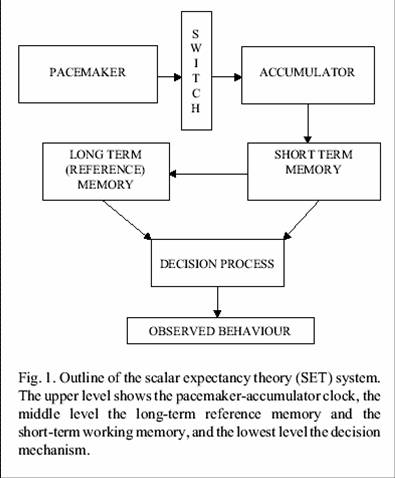 I previously made a couple of tease posts re: the predominant theoretical model of mental interval time-keeping (viz., the pacemaker-accumulator model). It is now time to "buck up" and provide my brief overview. Above is the best figure I've found to date (click here to see the original source article).
Human behavior based on the perception and timing in the range of seconds-to-minutes has traditionally been explained bythe pacemaker–accumulator model. The pacemaker-accumulator model (PAM), which is based on scalar expectancy or timing theory (Church, 1984; Gibbon et al., 1984; Meck, 1983), “is relatively straightforward, and provides powerful explanations of both behavioural and physiological data” (Buhusi & Meck, 2005; p. 755).
Briefly, the PAM model implicates the processing of temporal information via three synchronized modular information processing systems (see Buhusi & Mech, 2005.) The “clock” system consists of a dopaminergic pacemaker that regularly generates or emits neural ticks or pulses that are transferred (via a “gaiting” switch) to the accumulator, which accumulates ticks/pulses (neural counting) that correspond to a specific time interval. The raw representation of the stimulus duration in the accumulator is then transferred to working memory, a component of the PAM “memory” system. The contents of working memory are then compared against a “reference standard” in the long-term (reference) memory, the second component of the PAM memory system. Finally, the “decision” level of the PAM is conceptualized to consist of a comparator that determines an appropriate response based on a decision rule which involves a comparison between the interval duration value present in working memory and the corresponding duration value in reference memory. In other words, a comparison is made between the contents of reference memory (the standard) and working memory (viz., are they “close?”).
Considerable research evidence suggests that the PAM could be conceptualized as domain-general master internal clock central to many complex human behaviors (see Buhusi & Meck, 2005 and Lewis & Miall, 2006). Mental interval time-keeping and temporal processing research has suggested that a higher mental clock rate enables individuals to perform specific sequences of mental operations faster and reduces the probability of occurrence of interfering incidents (i.e., less disinhibition), two conditions that produce superior performance on cognitive tasks as well as more efficient basic information processing skills (Rammsayer & Brandler, in press).
Technorati Tags: psychology, educational psychology, cognition, school psychology, neuropsychology, neuroscience, neurology, intelligence, IQ, interval timing, mental timing, brain timing, master clock, brain clock, IQ Brain Clock.temporal tracking, temporal processing,Interactive Metronome,scalar timing
Tuesday, October 17, 2006
Types of elementary timing or temporal processing experiences
According the Rammsayer and Brandler (2006, in press), a major controversy in the field of human timing is whether psychological time is governed by a unitary (domain-general) timing mechanism, separate (domain-specific) mechanisms, and/or whether a domain-general internal mental clock can explain the subset of distinct elementary temporal/timing experiences.
What are the major classes of elementary timing experiences that a master internal mental clock theory/model would need to explain? According the Rammsay and Brandler, they are:
Technorati Tags: psychology, educational psychology, cognition, school psychology, neuropsychology, neuroscience, neurology, intelligence, IQ, interval timing, mental timing, brain timing, master clock, brain clock, temporal processing, rhythum perception, temporal order judgements, IQ Brain Clock
What are the major classes of elementary timing experiences that a master internal mental clock theory/model would need to explain? According the Rammsay and Brandler, they are:
- Interval timing: Is often explained by the general assumption of a hypothetical internal clock based on neural counting. The neural pacemaker generates pulses or ticks with the number of pulses corresponding to a physical time interval that is recorded by an accumulator. The number of pulses counted during a given time interval is the internal representation of this interval.
- Rhythm perception: The subjective grouping of objectively separate events or discrimination processes in serial temporal patterns.
- Temporal-order judgment (TOJ): Refers to the question of how much time must intervene between the onsets of two different stimuli for their order to be perceived correctly.
- Simultaneity and successiveness: Concerned with the size of the temporal interval between two sensory events that is required for them to be perceived as two separate events (successiveness) rather than fused as one event (simultaneity)
Technorati Tags: psychology, educational psychology, cognition, school psychology, neuropsychology, neuroscience, neurology, intelligence, IQ, interval timing, mental timing, brain timing, master clock, brain clock, temporal processing, rhythum perception, temporal order judgements, IQ Brain Clock
Monday, October 16, 2006
Internal brain/mental clock as domain-general mechanism
It is an assumption of the IQ Brain Clock blog, based on my reading of the extant psychological and neuroscience literature, that a master internal master clock can be conceptualized as a domain-general cognitive mechanism. A few comments by what I mean by domain-general:
Technorati Tags: psychology, educational psychology, cognition, school psychology, neuropsychology, neuroscience, neurology, intelligence, IQ, interval timing, mental timing, brain timing, master clock, brain clock, IQ Brain Clock.temporal tracking, temporal processing
- There is a long-standing tradition within psychological research to search for general principles or cognitive mechanisms that can be used to address all aspects of behavior and cognition (e.g., g or general intelligence)
- Such mechanisms are not tied to any specific content or domain and can be applied to a wide range of novel problems and domains of performance
- “Jack-of-all-trades” mechanisms (Chiappe & McDonald,2005)
Technorati Tags: psychology, educational psychology, cognition, school psychology, neuropsychology, neuroscience, neurology, intelligence, IQ, interval timing, mental timing, brain timing, master clock, brain clock, IQ Brain Clock.temporal tracking, temporal processing
powered by performancing firefox
Subscribe to:
Posts (Atom)