Timing Training in Female Soccer Players: Effects on Skilled Movement Performance and Brain Responses. Frontiers in Human Neuroscience. Article link.
Marius Sommer, Charlotte K. Häger, Carl Johan Boraxbekk and Louise Rönnqvist
Abstract
Although trainers and athletes consider “good timing skills” critical for optimal sport
performance, little is known in regard to how sport-specific skills may benefit from timing training. Accordingly, this study investigated the effects of timing training on soccer skill performance and the associated changes in functional brain response in elite- and sub-elite female soccer players. Twenty-five players (mean age 19.5 years; active in the highest or second highest divisions in Sweden), were randomly assigned to either an experimental- or a control group. The experimental group (n = 12) was subjected to a 4-week program (12 sessions) of synchronized metronome training (SMT). We evaluated effects on accuracy and variability in a soccer cross-pass task. The associated brain response was captured by functional magnetic resonance imaging (fMRI) while watching videos with soccer-specific actions. SMT improved soccer cross-pass performance, with a significant increase in outcome accuracy, combined with a decrease in outcome variability. SMT further induced changes in the underlying brain response associated with observing a highly familiar soccer-specific action, denoted as decreased activation in the cerebellum post SMT. Finally, decreased cerebellar activation was associated with improved cross-pass performance and sensorimotor synchronization. These findings suggest a more efficient neural recruitment during action observation after SMT. To our knowledge, this is the first controlled study providing behavioral and neurophysiological evidence that timing training may positively influence soccer-skill, while strengthening the action-perception coupling via enhanced sensorimotor synchronization abilities, and thus influencing the underlying brain responses.
Conclusion
In summary, this is the first controlled study demonstrating that improved motor timing and multisensory integration, as an effect of SMT, also is associated with changes in functional brain response. The present study provides both behavioral and neurophysiological evidence that timing training positively influences soccer-skill, strengthens the action-perception coupling by means of enhanced sensorimotor synchronization abilities, and affect underlying brain responses. These findings are in accordance with the idea that SMT may result in increased brain communication efficiency and synchrony between brain regions (McGrew, 2013), which in the present study was evident by reduced activation within brain areas important for temporal planning, movement coordination and action recognition and understanding (cerebellum). Also, our results complement findings indicating that the cerebellum plays an important role in the action-perception coupling (Christensenetal.,2014),and confirm recent theories supporting a cognitive-perceptual role of the cerebellum (e.g., Roth et al., 2013).Probing the influence of timing training on the underlying brain activation during soccer specific action observation is an important approach as it provides a window into the brain plasticity associated with non-task specific (timing) training, and to the underlying brain activation of skilled performance. The present study suggests that the underlying brain activation during action observation, which is claimed to be important for action recognition and understanding (e.g., Rizzolatti and Craighero, 2004), may be influenced in other ways than through task-specific training (e.g., Calvo-Merino et al., 2005) or observational learning (e.g., Cross et al., 2013). Such knowledge of how SMT may alter brain activity within regions facilitating the action perception coupling is likely important for enhancing training techniques within sports, as well as for developing new rehabilitative techniques for many clinical populations.
- Posted using BlogPress from my iPad

Understanding the human brain clock & related neuroscience
Showing posts with label mental timing. Show all posts
Showing posts with label mental timing. Show all posts
Saturday, September 29, 2018


Wednesday, July 18, 2018
White matter matters: Changes in white matter tracts due to reading intervention
More research supporting “white matter matters”.

Rapid and widespread white matter plasticity during an intensive reading intervention
Nature Communications
Elizabeth Huber, Patrick M. Donnelly, Ariel Rokem & Jason D. Yeatman
ABSTRACT
White matter tissue properties are known to correlate with performance across domains ranging from reading to math, to executive function. Here, we use a longitudinal intervention design to examine experience-dependent growth in reading skills and white matter in grade school-aged, struggling readers. Diffusion MRI data were collected at regular intervals during an 8-week, intensive reading intervention. These measurements reveal large-scale changes throughout a collection of white matter tracts, in concert with growth in reading skill. Additionally, we identify tracts whose properties predict reading skill but remain fixed throughout the intervention, suggesting that some anatomical properties stably predict the ease with which a child learns to read, while others dynamically reflect the effects of experience. These results underscore the importance of considering recent experience when interpreting cross-sectional anatomy–behavior correlations. Widespread changes throughout the white matter may be a hallmark of rapid plasticity associated with an intensive learning experience.
Very interesting. The arcuate fasciculus tracts have also been implicated in higher order thinking (Gf) such as in the P-FIT model of intelligence. Also see white paper that implicates the AF in temporal processing “brain clock” timing interventions
- Posted using BlogPress from my iPad

Rapid and widespread white matter plasticity during an intensive reading intervention
Nature Communications
Elizabeth Huber, Patrick M. Donnelly, Ariel Rokem & Jason D. Yeatman
ABSTRACT
White matter tissue properties are known to correlate with performance across domains ranging from reading to math, to executive function. Here, we use a longitudinal intervention design to examine experience-dependent growth in reading skills and white matter in grade school-aged, struggling readers. Diffusion MRI data were collected at regular intervals during an 8-week, intensive reading intervention. These measurements reveal large-scale changes throughout a collection of white matter tracts, in concert with growth in reading skill. Additionally, we identify tracts whose properties predict reading skill but remain fixed throughout the intervention, suggesting that some anatomical properties stably predict the ease with which a child learns to read, while others dynamically reflect the effects of experience. These results underscore the importance of considering recent experience when interpreting cross-sectional anatomy–behavior correlations. Widespread changes throughout the white matter may be a hallmark of rapid plasticity associated with an intensive learning experience.
Very interesting. The arcuate fasciculus tracts have also been implicated in higher order thinking (Gf) such as in the P-FIT model of intelligence. Also see white paper that implicates the AF in temporal processing “brain clock” timing interventions
- Posted using BlogPress from my iPad
Thursday, May 17, 2018
Interactive Metronome study: Clapping in time parallels literacy and calls upon overlapping neural mechanisms in early readers
Clapping in time parallels literacy and calls upon overlapping neural mechanisms in early readers
Annals of the New York Academy Of Science. Article link here.
Link to complete paper at IM site.
Silvia Bonacina Jennifer Krizman Travis White‐Schwoch Nina Krau
Abstract
The auditory system is extremely precise in processing the temporal information of perceptual events and using these cues to coordinate action. Synchronizing movement to a steady beat relies on this bidirectional connection between sensory and motor systems, and activates many of the auditory and cognitive processes used when reading. Here, we use Interactive Metronome, a clinical intervention technology requiring an individual to clap her hands in time with a steady beat, to investigate whether the links between literacy and synchronization skills, previously established in older children, are also evident in children who are learning to read. We tested 64 typically developing children (ages 5–7 years) on their synchronization abilities, neurophysiological responses to speech in noise, and literacy skills. We found that children who have lower variability in synchronizing have higher phase consistency, higher stability, and more accurate envelope encoding—all neurophysiological response components linked to language skills. Moreover, performing the same task with visual feedback reveals links with literacy skills, notably processing speed, phonological processing, word reading, spelling, morphology, and syntax. These results suggest that rhythm skills and literacy call on overlapping neural mechanisms, supporting the idea that rhythm training may boost literacy in part by engaging sensory‐motor systems.
- Posted using BlogPress from my iPad
Annals of the New York Academy Of Science. Article link here.
Link to complete paper at IM site.
Silvia Bonacina Jennifer Krizman Travis White‐Schwoch Nina Krau
Abstract
The auditory system is extremely precise in processing the temporal information of perceptual events and using these cues to coordinate action. Synchronizing movement to a steady beat relies on this bidirectional connection between sensory and motor systems, and activates many of the auditory and cognitive processes used when reading. Here, we use Interactive Metronome, a clinical intervention technology requiring an individual to clap her hands in time with a steady beat, to investigate whether the links between literacy and synchronization skills, previously established in older children, are also evident in children who are learning to read. We tested 64 typically developing children (ages 5–7 years) on their synchronization abilities, neurophysiological responses to speech in noise, and literacy skills. We found that children who have lower variability in synchronizing have higher phase consistency, higher stability, and more accurate envelope encoding—all neurophysiological response components linked to language skills. Moreover, performing the same task with visual feedback reveals links with literacy skills, notably processing speed, phonological processing, word reading, spelling, morphology, and syntax. These results suggest that rhythm skills and literacy call on overlapping neural mechanisms, supporting the idea that rhythm training may boost literacy in part by engaging sensory‐motor systems.
- Posted using BlogPress from my iPad
Wednesday, November 30, 2016
Special issue of brain-based mental timing: Current Opinion in Behavioral Sciences
All I can say is WOW!!! I stumbled across this treasure chest of diverse state-of-the art research that clearly demonstrates the rich multi-disciplinary focus of research on the human brain clock or temporal processing. Over 40 articles by many of the top notch scholars in this historically old and ever increasing area of active research.
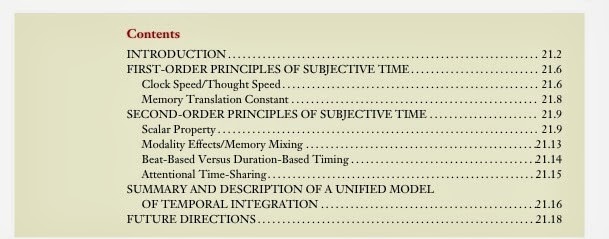
I would be fooling myself if I said I will find time to read all of these articles..let alone just a handful. Instead, I have provided a table of contents so readers can review the various topics covered. I have stashed it away on my hard drive for ready reference when needed.
Also, given my love for good visual-graphic representation of models and processes, I have selected a handful of some of the more understandable figures from across the articles....trust me, there are MANY figures scattered across this issue and many are very complex and detailed. I have only selected those that might inform readers of some ideas via relatively "simple" figures (they belong in my "Gv hall of fame gallery").
So much to read, so little "time"
Click on images to enlarge


Posted using BlogPress from my iPad
I would be fooling myself if I said I will find time to read all of these articles..let alone just a handful. Instead, I have provided a table of contents so readers can review the various topics covered. I have stashed it away on my hard drive for ready reference when needed.
Also, given my love for good visual-graphic representation of models and processes, I have selected a handful of some of the more understandable figures from across the articles....trust me, there are MANY figures scattered across this issue and many are very complex and detailed. I have only selected those that might inform readers of some ideas via relatively "simple" figures (they belong in my "Gv hall of fame gallery").
So much to read, so little "time"
Click on images to enlarge
Posted using BlogPress from my iPad
Monday, January 11, 2016
Your brain is a time machine: An oldie-but-goodie (OBG) post
This is an OBG (oldie-but-goodie) post I originally made on the IM-HOME blog
Time and space are the two fundamental dimensions of our lives. All forms of human behavior require us to process and understand information we receive from our environment in either spatial or temporal patterns. Even though mental timing (temporal processing) research is in a stage of infancy (when compared to spatial processing) important insights regarding the human brain clock have emerged.
Below is a list (albeit incomplete) of some of the major conclusions regarding the human brain clock. The sources for these statements come from my review of the temporal processing and brain clock literature during the past five years. Most of this information has been disseminated at the Brain Clock blog or the Brain Clock Evolving Web of Knowledge (EWOK). The goal of this post is to provide a Readers Digest summary of the major conclusions. This material can serve as a set of "talking points" at your next social event where you can impress your friends and family as you explain why you use the high-tech IM "clapper" (with a cowbell tone no less) either as a provider or as client.
Our brains measure time constantly. It's hard to find any complex human behavior where mental timing is not involved. Timing is required to walk, talk, perform complex movements and coordinate information flow across the brain for complex human thought. Think about moving your arm and hand to grasp a coffee cup. The messages to perform this task originate in your brain, which is not directly connected to your arm, hands and fingers. The ability to perform the necessary motor movements is possible only because the mind and extremities are connected via timing. Precisely timed neural messages connect your brain and extremities. You are a time machine.

Humans are remarkably proficient at internally perceiving and monitoring time to produce precisely timed behaviors and thinking. “We are aware of how long we have been doing a particular thing, how long it has been since we last slept, and how long it will be until lunch or dinner. We are ready, at any moment, to make complex movements requiring muscle coordination with microsecond accuracy, or to decode temporally complex auditory signals in the form of speech or music. Our timing abilities are impressive…” (Lewis & Walsh, 2005, p. 389).
To deal with time, humans have developed multiple timing systems that are active over more than 10 orders of magnitude with various degrees of precision (see figure below from Buhusi & Meck, 2005). These different timing systems can be classified into three general classes (viz., circadian, interval, and millisecond timing), each associated with different behaviors and brain structures and mechanisms. The fastest timing system (millisecond or interval timing) is involved in a numerous human behaviors such as speech and language, music perception and production, coordinated motor behaviors, attention, and thinking. This fast interval timing system is the most important timing system for understanding and diagnosing clinical disorders and for developing and evaluating effective treatment interventions for educational and rehabilitation settings. It is this timing system, and the relevant research, that is relevant to understanding Interactive Metronome. (Note. See my conflict of interest statement at this blog. I have an ongoing consulting relationship with IM).

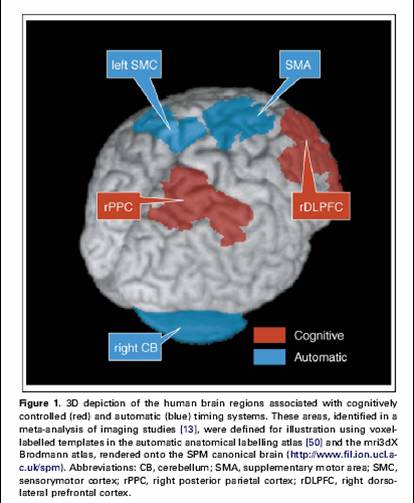
Although there is consensus that the human brain contains some kind of clock, the jury is still out on the exact brain mechanisms and locations. It is also not clear whether there is one functional master clock or a series of clocks deployed in different brain areas. The areas of the brain most consistently associated with milli-second interval mental timing are the cerebellum, anterior cingulate, basal ganglia, the dorsolateral prefrontal cortex, right parietal cortex, motor cortex, and the frontal-striatal loop. That is a mouthful of technical brain terms. But, if you can memorize them and have them roll of your tongue with ease you will “shock and awe” your family and friends. Most of these areas of the brain are illustrated below. Now, if you really want to demonstrate your expertise, get your own illustrated “brain-in-a-pocket”. These images were generated by the free 3D Brain app available for your iPhone or iPad. Even cooler is the fact that you can rotate the images with your finger! You can give neuroanatomy lessons anytime…anywhere!


Research suggests that mental interval timing is controlled by two sub-systems. The automatic timing system processes discrete-event (discontinuous) timing in milliseconds. The cognitively-controlled timing system deals with continuous-event timing (in seconds) that requires controlled attention and working memory. Both systems are likely involved in IM. For example, the synchronized clapping requires motor planning and execution, functions most associated with the automatic timing system. However, the cognitive aspects of IM (focus, controlled attention, executive functions) invoke the cognitively controlled timing system. Aren’t these brain images awesome?

The dominant model in the brain clock research literature is that of a centralized internal clock that functions as per the pacemaker–accumulator model. Briefly, this is a model where an oscillator beating at a fixed frequency generates tics that are detected by a counter. For now I am just going to tease you with an image of this model. You can read more about this model at the Brain Clock blog.

Research suggests that the brain mechanisms underlying mental timing can be fine-tuned (modified) via experience and environmental manipulation. Modifiability of mental interval timing and subsequent transfer suggest a domain-general timing mechanism that, if harnessed via appropriately designed timing-based interventions, may improve human performance in a number of important cognitive and motor domains.
Wednesday, December 16, 2015
Interactive Metronome (IM) is measuring and changing something real and important: An old-but-goodie (OBG) post
[This is an oldie-but-goodie (OGB) post that I originally posted as a guest blogger at the IM-HOME blog on Feb 2, 2012]

No human investigation can be called real science if it cannot be demonstrated mathematically
Leonardo da Vinci, Treatise on Painting (1651)
Progress in science depends on new techniques, new discoveries and new ideas, probably in that order Sydney Brenner (1980)
At the core of the IM intervention technology is a precise
measurement system. To users and clinicians the IM measurement system
is transparent. Yet, without the valid and precise measurement system,
IM would not work.
In my “Brain or neural efficiency: Is it quickness or timing?” post, I advanced the hypothesis that the effectiveness of Interactive Metronome may be due to IM operating on a fundamental dimension of brain or neural efficiency, which intelligence scholars also relate to general intelligence (g). I have also suggested that this mechanism improves control of attention and may allow individuals to “quiet a busy mind”and invoke “on-demand focus.”
As an applied intelligence test developer (click here),
I have been intrigued by the underlying precise millisecond-based
measurement system which is the heart of IM technology. IM technology
would not work if the underlying measurement system could not reliably
measure differences in synchronized metronome tapping between
individuals and changes within the same individual over repeated
sessions.
Wanting to know how precise the underlying IM measurement system is,
I extracted the average millisecond scores from an unpublished 2003
Interactive Metronome document that reported average times for different
age groups. The sample consisted of the initial IM Long Form
Assessment performance of 1,583 clinical and normal subjects ranging in
age from 6 thru 60+. It is important to note that the sample was not a
nationally representative normal sample and was comprised of more
clinical subjects receiving IM therapy. Nevertheless, I wondered if
this less-than-optimal set of data might demonstrate a pattern of
increasingly shorter response times as individuals became older. Why
did I want to examine this?
Developmental increase in proficiency on tests and measures of human
abilities is considered one form of evidence that a test or measurement
system is reliably and validly measuring an important human ability.
In the case of intelligence, valid measures of cognitive abilities show developmental growth curves
where the youngest subjects obtain the lowest raw scores and the
average raw scores gradually increase with increasing age. They
eventually level out and then start a decline as old age sets in. Below
are growth curves from seven cognitive ability scores from the Woodcock-Johnson Battery—III,
a test battery of which I am a co-author. The important observation to
note is that, despite the specific cognitive ability measure, all
curves show low scores for the younger ages followed by acceleration of
growth to a certain point. Each curve then plateaus at a certain age
range, after which age-related cognitive decline is noted, but at
different rates for different abilities. These curves are presented in
the WJ III Technical Manual (McGrew & Woodcock, 1991) as a form of developmental validity evidence—which provides one piece of evidence that the WJ III tests are valid measures of different and important human intellectual abilities.


The first thing the reader should note are the individual data points (the dots). The points show some random “bouncing around” which we measurement folks call sampling error. The critical point is that they follow a systematic trend that can be estimated by fitting a mathematical curve to the data points. This was the same procedure used to develop the WJ III cognitive curves in the first figure. In the second figure, the IM timing curve is demarcated in red. We who develop test norms and study human ability growth curves generate these smoothed growth curves as they are the best estimate of the real reality of the data if extremely large number of individuals had been tested at each age (there would be much less bounce).
One does not need to be a rocket scientist to interpret the smoothed IM growth curve. Individuals at the youngest ages, on the average, show the largest millisecond discrepancy from the IM reference tone. Then, with increasing age, the average IM target-to-response for individuals decreases systematically as children age. At approximately 25 years of age the curve “bottoms out,” and then as individuals get older, IM millisecond timing scores increase (or get less accurate). The systematic nature of this curve is amazing, considering it is based on a less-than-optimal sample for determining what constitutes average.
If the reader is having a hard time relating the IM timing curve to the
WJ III cognitive ability curves, I have taken the liberty of simply
rotating and flipping the IM timing accuracy growth curve in the figure
below. Vioila (aka, walla—“there it is”)! The curve has the
same general shape as the WJ III cognitive ability growth curves! The
reason for the difference between the WJ III growth curves and the first
IM timing growth curve is that the meaning of high and low scores are
reversed—higher IM times mean lower skilled performance while lower
scores on the WJ III battery are associated with lower performance (and
vice versa).

Readers who are parents may have seen similar growth curves during well-child visits with the family doctor. Below are growth charts for weight and length for male children from birth to 36 years. Although covering a much smaller age span than the WJ III cognitive and IM timing curves above, the shape of the curves is identical for the comparable age ranges (gradually increasing with age). The middle dark line in each set (labeled 50 for 50th percentile) is conceptually identical to the above single curve plots. These physical measurement curves show the systematic and developmental nature of physical growth.

Why am I so excited about the IM timing growth curve? Because it demonstrates, similar to the physical and intelligence growth curves, that the underlying measurement unit used as the core of IM therapy is measuring a human ability that follows a similar and expected developmental pattern. Such curves are believed to be due, depending on the specific ability, to the influence of education and experiences as well as genetically-driven biological maturation of the central nervous system (CNS). The IM timing curve is one form of evidence that the IM measurement system is measuring a fundamental human capacity. This is extremely exciting! It is one more piece of evidence that the IM core measurement technology is measuring and working on a core critical human ability. Coupled with other validity evidence previously discussed here and elsewhere, this additional piece of scientific evidence has convinced me that the IM measurement and intervention system is most likely measuring a fundamental aspect of the development of the central nervous system (e.g., neural efficiency). The cognitive abilities I have suggested fall under the broad umbrella term of executive functions, and more specifically controlled attention (focus) and working memory.
A caveat before I close. The smoothed IM timing curve should not be used by IM providers to evaluate how typical, normal, or close-to-average a person is on their initial IM Long Form Assessment. The mixed nature of the sample (normal and clinical subjects; more of the later) argues against such use. Also, the curve only represents the average at each age and calculating and plotting the typical variability around the curve would also be necessary. I deliberately left out the variability data curves so as not to encourage misuse of the information.
However, IM providers can evaluate their client’s performance by using the official IM Indicator Table. A copy is reproduced below. This table can be used to determine whether a client’s performance is in the “ballpark” for their age. Providers simply locate the clients age in the row at the top then go down that column to find the millisecond score or range that includes their specific IM Long Form Assessment timing score. The verbal description associated with each level (extremely deficient to exceptional) can be used to make quality of performance statements reflecting where an individual is at the time of the initial assessment. The scores and labels should not be used for diagnostic purposes. Instead, they can be used to describe, in approximate ball park terms, where an individual is at the time of the assessment when compared to others of the same age and to make comparisons about that same client’s performance over time.
Age
|
6
|
7 to 8
|
9 to 10
|
11 to 12
|
13 to 15
|
16+
|
| Extreme Deficiency |
280+
|
270+
|
260+
|
240+
|
215+
|
200+
|
| Severe Deficiency |
175-279
|
170-269
|
160-259
|
155-239
|
150-214
|
147-199
|
| Below Average |
120-174
|
90-169
|
80-159
|
75-154
|
72-149
|
70-146
|
| Average |
90-119
|
65-89
|
55-79
|
45-74
|
43-71
|
41-69
|
| Above Average |
56-89
|
45-64
|
38-54
|
36-44
|
33-42
|
30-40
|
| Exceptional |
40-55
|
32-44
|
28-37
|
26-35
|
23-32
|
22-29
|
| Superior |
Below 40
|
Below 32
|
Below 28
|
Below 26
|
Below 23
|
Below 22
|
In summary, I have traversed a number of empirical domains in my journey to understand IM. The finding of such powerful and clear developmental evidence for the underlying IM measurement system is one of the final dots I connected which convinced me of the promise of IM. The IM program is founded on a valid scientific measurement system of an important human cognitive ability (or constellation of related abilities).
Thursday, August 13, 2015
More research suggesting ADHD may be due (in part) to an internal brain clock disorder

Another study linking distorted time-processing and ADHD. Click here and here for posts about other related studies. What I find interesting is that the various experimental timing measures used in these studies could easily be made into psychometric tests (with readily available technology) for inclusion on intelligence tests or other special purpose cognitive batteries. Also, I have hypothesized in a MindHub Pub that some emerging neurotechnologies may improve ADHD (and related symptoms like attentional control and working memory) due to the fine-tuning of the human brain clock.
Other ADHD related research (brain connectivity, etc) can be found here.
Click on image to enlarge for easier reading,
Other ADHD related research (brain connectivity, etc) can be found here.
Click on image to enlarge for easier reading,
Friday, July 31, 2015
The Time Doc's Interactive Metronome (IM)-Home guest posts

Most of my readers are aware of my interest in brain-clock based neurotechnologies, particularly as they relate to improving cognitive functioning. All posts related to this area of interest, as well as posts linking readers to other neuroscience developments, can be found here at the Brain Clock blog.
A few years back I also was a guest blogger (aka, the Time Doc) at the IM-Home blog. I frequently find myself directing people who contact me to some of those guest posts. So, I've decided to provide a single link (click here) that will take readers to all my IM/brain clock guest posts. Enjoy.
I hope readers check out these posts and become more aware of the exciting neurotechnologies that are emerging based on the concept of temporal processing and the human brain clock.
[Click on image to enlarge]

Synchronized metronome tapping (SMT) and the automatic/controlled timing systems of the brain
[This is an OBG (oldie but goodie) post first posted November 4, 2006 - this new post has a few corrections and the fixing of some broken links]
In a prior post, I highlighted a distinction contemporary mental time-keeping researchers make regarding two general types of human timing systems. Briefly, the automatic timing system works in the millisecond range of time, is used in discrete-event (discontinuous) timing, and involves the cerebellum. This contrasts with the continuous-event, cognitively controlled timing system that requires attention and involves the basal ganglia and related cortical structures.
In their article, Lewis and Maill (2006) provide further clarification of how they perceive differences between these two mental timing systems. According to Lewis and Maill, "it is not any single characteristic, but rather a constellation of several characteristics which determines which timing system is recruited in any particular task." The three task characteristics isolated by these researchers are: (a) the duration measured, (b) whether or not the timed intervals were defined by movement and, (c) whether timing was continuous (e.g. an unbroken series of predictable intervals) or intermittent (e.g. broken into discrete measurements by the presence of unpredictable irregular intervals).
Lewis and Maill conclude that "our analysis showed that having any two out of the three characteristics associated with a task type (cognitive or automatic) dramatically increased the probability that the areas associated with that timing system would be recruited. Accordingly, we can think of any task having two or more cognitive attributes (e.g. measuring more than a second, discontinuously, and without relying upon movement) as a ‘cognitively controlled timing task’, and any task with two or more of the opposing characteristics as an ‘automatic timing task’."How does this apply to understanding the brain structures and functions involved in SMT (synchronized metronome tapping; e.g., Interactive Metronome)? [click here for from info on SMT and IM and my necessary conflict of interest disclosures...just follow the link trails].
Given my understanding (and one personal experience with an SMT intervention), I would hypothesize that SMT interventions most likely tap both the automatic and controlled cognitive timing systems (and related neurological structures and functions). SMT-based interventions typically involve a motor component (e.g., clapping hands together to the beat), a continuous tone interval, and require responding in terms of milliseconds. These characteristics definitely would be associated with the automatic timing system.
However, although an individual (during SMT training) is trying to synchronize their tapping in terms of milliseconds, the duration between the continuous tones is more in the range of a second or so. Also, especially during initial stages of SMT, an individual's working memory [see prior post on the pacemaker accumulator model of mental time-keeping] is particularly taxed as one monitors the SMT visual and/or auditory feedback provided, makes a decision about whether they are responding "too fast" or "too slow", and then consciously implements a correction to their "beat" behavior. These later characteristics are more characteristic of the cognitively controlled timing system.
So...it is my hypothesis that both the automatic and cognitively controlled timing systems of mental or interval time-keeping are involved with SMT-based interventions. It is possible that both are significantly active during early stages of SMT training and, with improvement and progress over time, the role of the cognitively controlled system decreases and the automatic system is more responsible. These are only hypothesis and need empirical study.
- Lewis, P. & Miall, C (2006). Remembering the time: a continuous clock. Trends in Cognitive Sciences, 10(9), 401-406.
Brain networks and fine tunning the networks: An OBG post
[This is an OBG (oldie but goodie) post first posted December 16, 2011]
Man has always known that the brain is the center of human behavior. Early attempts at understanding which locations in the brain controlled different functions were non-scientific and included such practices as phrenology. This pseudoscience believed that by feeling the bumps of a persons head it was possible to draw conclusions about specific brain functions and traits of the person.
(double click on any image to enlarge)

Eventually brain science revealed that different regions of the brain where specialized for different specific cognitive processes (but it was not related to the phrenological brain bump maps). This has been called the modular or functional specialization view of the brain, which is grounded in the conclusion that different brain areas acted more-or-less as independent mechanisms for completing specific cognitive functions.
One of the most exciting developments in contemporary neuroscience is the recognition that the human brain processes information via different brain circuits or loops which at a higher level can be studied as large scale brain networks. Although the modular view still provides important brain insights, the accumulating evidence suggests that it has serious limitations and might in fact be misleading (Bresslor and Menon, 2010). One of the best summaries of this cutting edge research is that by Bresslor and Menon.

Large scale brain network research suggests that cognitive functioning is the result of interactions or communication between different brain systems distributed throughout the brain. That is, when performing a particular task, just one isolated brain area is not working alone. Instead, different areas of the brain, often far apart from each other within the geographic space of the brain, are communicating through a fast-paced synchronized set of brain signals. These networks can be considered preferred pathways for sending signals back and forth to perform a specific set of cognitive or motor behaviors.
To understand preferred neural pathways, think of walking on a college campus where there are paved sidewalks connecting different buildings that house specialized knowledge and activities. If you have spent anytime on a college campus, one typically finds foot-worn short cuts in the grass that are the preferred (and more efficient) means by which most people move between building A and B. The combined set of frequently used paved and unpaved pathways are the most efficient or preferred pathways for moving efficiently between buildings. The human brain has developed preferred communication pathways that link together different brain circuits or loops in order to quickly and efficiently complete specific tasks.
According to Bresslor and Menon (2010), “a large-scale functional network can therefore be defined as a collection of interconnected brain areas that interact to perform circumscribed functions.” More importantly, component brain areas in these large-scale brain networks perform different roles. Some act as controllers or task switchers that coordinate, direct and synchronize the involvement of other brain networks. Other brain networks handle the flow of sensory or motor information and engage in conscious manipulation of the information in the form of “thinking.”

As illustrated in the figure above, neuroscientists have identified a number of core brain network nodes or circuits. The important new insight is that these various nodes or circuits are integrated together into a grander set of higher-level core functional brain networks. Three important core networks are receiving considerable attention in explaining human behavior.
Major functional brain networks

The default mode (DMN) or default brain network (shown in blue) is what your brain does when not engaged in specific tasks. It is the busy or active part of your brain when you are mentally passive. According to Bresslor and Brennon the “DMN is seen to collectively comprise an integrated system for autobiographical, self-monitoring and social cognitive functions.” It has also been characterized as responsible for REST (rapid episodic spontaneous thinking). In other words, this is the spontaneous mind wandering and internal self-talk and thinking we engage in when not working on a specific task or, when completing a task that is so automatized (e.g., driving a car) that our mind starts to wander and generate spontaneous thoughts. As I have discussed previously (at IM-HOME blog), the default network is responsible for the unquiet or noisy mind. And, it is likely that people differ in amount of spontaneous mind wandering (which can be both positive creative thinking or distracting thoughts), with some having a very unquiet mind that is hard to turn off, while others can turn off the inner thought generation and self-talk and display tremendous self-focus or controlled attention to perform a cognitively or motorically demanding task. A very interesting discussion of the serendipitous discovery and explanation of the default brain network is in the following soon to be published scientific article.

The salience network (shown in yellow) is a controller or network switcher. It monitors information from within (internal input) and from the external world arounding us, which is constantly bombarding us with information. Think of the salience network as the air traffic controller of the brain. Its job is to scan all information bombarding us from the outside world and also that from within our own brains. This controller decides which information is most urgent, task relevant, and which should receive priority in the que of sending brain signals to areas of the brain for processing. This controlling network must suppress either the default or executive networks depending on the task at hand. It must suppress one, and activate the other. Needless to say, this decision making and distribution of information must require exquisite and efficient neural timing as regulated by the brain clock(s).
Finally, the central-executive network (CEN; shown in red) “is engaged in higher-order cognitive and attentional control.” In other words, when you must engage your conscious brain to work on a problem, place information in your working memory as you think, focus your attention on a task or problem, etc., you are “thinking” and must focus your controlled attention. As I understand this research, the salience or controller network is a multi-switching mechanism that is constantly initiating dynamic switching between the REST (sponatenous and often creative unique mind wandering) and thinking networks to best match the current demands you are facing.
According to Bresslor and Melon, not only is this large scale brain network helping us better understand normal cognitive and motor behavior, it is providing insights into clinical disorders of the brain. Poor synchronization between the three major brain networks has been implicated in Alzheimer’s, schizophrenia, autism, the manic phase of bipolar and Parkinson’s (Bresslor and Melon, 2010), disorders that have all been linked to a brain or neural timing (i.e, the brain clock or clocks). I also believe that ADHD would be implicated. If the synchronized millisecond based communication between and within these large networks is compromised, and if the network traffic controller (the salience network) is disrupted in particular, efficient and normal cognition or motor behavior can be compromised.
I find this emerging research fascinating. I believe it provides a viable working hypothesis to explain why different brain fitness or training neurotechnologies have shown promise in improving cognitive function in working memory, ADHD, and other clinical disorders. It is my current hypothesis that various brain training technologies may focus on different psychological constructs (e.g., working memory; planning; focus or controlled attention), but their effectiveness may all be directly or indirectly facilitating the sychronization between the major brain networks. More specifically, by strengthening the ability to invoke the salience or controller network, a person can learn to suppress, inhibit or silence the REST-producing default brain network more efficiently, long enough to exert more controlled attention or focus when invoking the thinking central executive network. Collectively these brain fitness technologies may all improving the use of those abilities called executive function, or what I have called the personal brain manager. Those technologies that focus on rhythm or brain timing are those I find most fascinating. For example, the recent example of the use of melodic intonation therapy with Congresswoman Gabby Giffords (she suffered serious brain trauma due to a gun shot) demonstrates how rhythm-based brain timing therapies may help repair destroyed preferred and efficient neural pathways or, develop new pathways, much like the development of a new foot worn pathway in the grass on a college campus if a preferred pathway is disrupted by a new building, temporary work or rennovation, or some other destruction of a preferred and efficient network of movement path.
To understand the beauty of the synchronized brain, it is best to see the patterns of brain network connections in action. Below is a video called the “Meditating Mind.” I urge you to view the video for a number of reasons.
A number of observations should be clear. First, during the first part of the video the brain is seen as active even during a resting state. This is visual evidence of the silent private dialogue (REST) of the default mode or network of the brain. Next, the video mentions the rhythm of increased and decreased neural activation as the brain responds to no visual information or presentation of a video. The changes in color and sound demonstrate the rich rhythmic synchronization of large and different parts of the brain, depending on whether the brain is engaged in a passive or active cognitive task. The beauty of the rapidly changing and spreading communication should make it obvious that efficient rhythmic synchronization of timing of brain signals to and from different networks or circuits is critical to efficient brain functioning.
Finally, the contrast between the same brain under normal conditions and when engaged in a form of meditation is striking. Clearly when this person’s brain is mediating, the brain is responding with a change in rates and frequency of brain network activation and synchrony. As I described in my personal IM-HOME based experience post, mastering Interactive Metronome (IM) therapy requires “becoming one with the tone”…which sounds similar to the language of those who engage in various forms of meditation. Could it be that the rhythmic demans of IM, which require an individual to “lock on” to the auditory tone and stay in that synchronized, rhythmic and repetitive state for as long as possible, might be similar to the underlying mechanics of some forms of meditation, which also seek to suppress irrelevant and distracting thoughts and eventually “let the mind go"---posibsly to follow a specific train of thought with complete and distraction free focus.
Yes…this is speculation. I am trying to connect research-based and personal experience dots. It is exciting. My IM-HOME based induce personal focus experience makes sense from the perspective of the function and interaction between the three major large scale brain networks.
Saturday, June 27, 2015

Thursday, June 25, 2015
IM "matter of time" overview

A nice brief overview of some important brain timing findings.
See my conflict of interest link regarding this post.
Thursday, June 25, 2015
7:03 PM
Saturday, February 21, 2015
Research Byte: Strong working memory (WM)--fluid intelligence (Gf) relationship not due to time allowed on both sets of tasks
Very good article that does not support Chuderski's research that had suggested a relationship between time on task (not the same as cognitive processing speed-Gs) and fluid reasoning or working memory. The current study reinforces the very high (but not 1.0) effect size from working memory to Gf. However, how much time an individual (at least for young adults) spends on working memory or fluid tasks does not explain the strong WM--Gf relation. Generalization to children and the elderly cannot be made without further research.
What I find particularly interesting is the authors hypothesis that one possible general mechanism explanation for the WM-->Gf link is temporal based processing of information. This is consistent with the temporal power resolution hypotheses (or temporal g) of Rammsayer and colleagues and a large body of research I have reported at the Brain Clock blog. If you visit that link, pay particular attention to the MindHub Pub2 that presents a three-level hypothesized model for understanding the IM effect. Note that at the lowest neurocognitive and biological level of intelligence research, I have hypothesized that temporal g (and not Jensen's reaction time g) may be one of the key domain-general mechanisms driving critical cognitive abilities, especially working memory and fluid intelligence.
As per the recent four-level reductionistic framework (see brief 10 minute video explanation) I have offered to organize intelligence related research (adapted from Earl Hunt's work), the current study links research at the psychometric, information processing, and neurocognitive and biological (neural efficiency) levels.
Click on images to enlarge.


- Posted using BlogPress from my iPad
What I find particularly interesting is the authors hypothesis that one possible general mechanism explanation for the WM-->Gf link is temporal based processing of information. This is consistent with the temporal power resolution hypotheses (or temporal g) of Rammsayer and colleagues and a large body of research I have reported at the Brain Clock blog. If you visit that link, pay particular attention to the MindHub Pub2 that presents a three-level hypothesized model for understanding the IM effect. Note that at the lowest neurocognitive and biological level of intelligence research, I have hypothesized that temporal g (and not Jensen's reaction time g) may be one of the key domain-general mechanisms driving critical cognitive abilities, especially working memory and fluid intelligence.
As per the recent four-level reductionistic framework (see brief 10 minute video explanation) I have offered to organize intelligence related research (adapted from Earl Hunt's work), the current study links research at the psychometric, information processing, and neurocognitive and biological (neural efficiency) levels.
Click on images to enlarge.


- Posted using BlogPress from my iPad
Friday, January 16, 2015
Timing and Time Perception Journal

I am not sure how I missed this journal being started in 2013. It looks like an awesome resource for cutting edge research on the brain clock, brain timing, temporal processing, etc. I will monitor it on a regular basis. Click here for more information on the journal.
Double click on image to enlarge
Double click on image to enlarge
Friday, January 16, 2015
1:51 PM
Saturday, July 05, 2014
The good and bad news on time perception research
Click on image to enlarge

- Posted using BlogPress from my iPad

- Posted using BlogPress from my iPad
Wednesday, June 25, 2014
Friday, September 27, 2013
New review regarding human brain clock research and theory
Hot off the press, in the prestigious Annual Review of Psychology has an excellent review (Allman et al., 2013) of contemporary research and theory regarding many aspects of the human brain clock (brain clock timing; temporal g). I will be adding this to the Key Research Article blogroll section of this blog.
A few images from the article to give an advance peek. [Click on images to enlarge]


A few images from the article to give an advance peek. [Click on images to enlarge]



Monday, November 26, 2012
"I think...therefore IM" - Kevin McGrew keynote slides at Interactive Metronome 2012 conference
This past October I delivered the keynote address at the annual Interactive Metronome professional conference in San Antonio, TX. The title of my address was “I think…therefore IM.” The IM staff is busy editing the video of all presentations, including my address. I am anxious for the final edited videos to be announced.
[Click on image to enlarge]

For those who just can’t wait, I have taken the liberty of
uploading copies of the key slides from my address to my SlideShare account. You can
view the slides on-line or download them for off-line viewing. The disadvantage of viewing these static
slides is you will not hear what I said during each slide—which for some slides
was considerable. Also, the live
presentation had some nifty moving images that demonstrated certain key concepts
(e.g., a moving red ball to demonstrate focus/controlled attention and how it
can be captured or disrupted). In a
prior IM-HOME post I included a video that included some of these effects with a
brief voice narration. You can view this
video at my prior IM-HOME
keynote preview post.
[Click on image to enlarge]

The most important part of the presentation was a three-tiered
explanation (see slide above) of the theoretical and research-based hypotheses regarding the
underlying brain and cognitive constructs involved in the cognitive component
of IM training—and, its ability to produce positive outcomes across a variety
of human cognitive performance domains.
That is, “what is happening under
the IM hood?”
You can access the static PPT slides either by visiting the SlideShare show directly (click here). Or, you can visit The MindHub®
portal where the slide show is listed under the neurotechnology section
of Research and Reports. If you have not checked out the MindHub, I would suggest you give it a
glance as it is a portal to a wide array of information regarding human
cognitive abilities, assessment, school learning, applied neurotechnologies
(i.e., IM), etc.

Be sure to sign up for the MindHub newsletter. The next
edition is planned for e-delivery in the next 1-2 weeks. The availability of the IM conference videos
will be announced in the MindHub newsletter. They will also be announced at the Brain
Clock blog.
Subscribe to:
Posts (Atom)