Showing posts with label cog controlled timing. Show all posts

Friday, July 31, 2015

Synchronized metronome tapping (SMT) and the automatic/controlled timing systems of the brain


[This is an OBG (oldie but goodie) post first posted November 4, 2006 - this new post has a few corrections and the fixing of some broken links]

In a prior post, I highlighted a distinction contemporary mental time-keeping researchers make regarding two general types of human timing systems. Briefly, the automatic timing system works in the millisecond range of time, is used in discrete-event (discontinuous) timing, and involves the cerebellum. This contrasts with the continuous-event, cognitively controlled timing system that requires attention and involves the basal ganglia and related cortical structures.

In their article, Lewis and Maill (2006) provide further clarification of how they perceive differences between these two mental timing systems. According to Lewis and Maill, "it is not any single characteristic, but rather a constellation of several characteristics which determines which timing system is recruited in any particular task." The three task characteristics isolated by these researchers are: (a) the duration measured, (b) whether or not the timed intervals were defined by movement and, (c) whether timing was continuous (e.g. an unbroken series of predictable intervals) or intermittent (e.g. broken into discrete measurements by the presence of unpredictable irregular intervals).

Lewis and Maill conclude that "our analysis showed that having any two out of the three characteristics associated with a task type (cognitive or automatic) dramatically increased the probability that the areas associated with that timing system would be recruited. Accordingly, we can think of any task having two or more cognitive attributes (e.g. measuring more than a second, discontinuously, and without relying upon movement) as a ‘cognitively controlled timing task’, and any task with two or more of the opposing characteristics as an ‘automatic timing task’."How does this apply to understanding the brain structures and functions involved in SMT (synchronized metronome tapping; e.g., Interactive Metronome)? [click here for from info on SMT and IM and my necessary conflict of interest disclosures...just follow the link trails].

Given my understanding (and one personal experience with an SMT intervention), I would hypothesize that SMT interventions most likely tap both the automatic and controlled cognitive timing systems (and related neurological structures and functions). SMT-based interventions typically involve a motor component (e.g., clapping hands together to the beat), a continuous tone interval, and require responding in terms of milliseconds. These characteristics definitely would be associated with the automatic timing system.

However, although an individual (during SMT training) is trying to synchronize their tapping in terms of milliseconds, the duration between the continuous tones is more in the range of a second or so. Also, especially during initial stages of SMT, an individual's working memory [see prior post on the pacemaker accumulator model of mental time-keeping] is particularly taxed as one monitors the SMT visual and/or auditory feedback provided, makes a decision about whether they are responding "too fast" or "too slow", and then consciously implements a correction to their "beat" behavior. These later characteristics are more characteristic of the cognitively controlled timing system.

So...it is my hypothesis that both the automatic and cognitively controlled timing systems of mental or interval time-keeping are involved with SMT-based interventions. It is possible that both are significantly active during early stages of SMT training and, with improvement and progress over time, the role of the cognitively controlled system decreases and the automatic system is more responsible. These are only hypothesis and need empirical study.

  • Lewis, P. & Miall, C (2006). Remembering the time: a continuous clock. Trends in Cognitive Sciences, 10(9), 401-406.


Friday, May 24, 2013

Automatic v controlled cognitive brain clock timing systems: A link with working memory?


[Double click on image to enlarge]

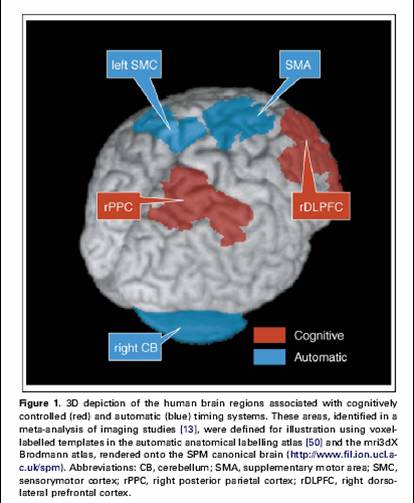
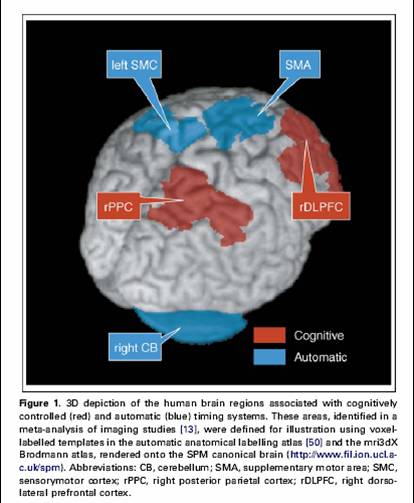
Contemporary research (Buhusi & Meck, 2005; Lewis & Miall, 2006) supports the idea that there are two mental timing circuits that can be dissociated: (1) an automatic timing system that works in the millisecond range, which is used in discrete-event (discontinuous) timing, and involves the cerebellum; and (2) a continuous-event, cognitively controlled timing system that requires attention and involves the basal ganglia and related cortical structures.

The above figure, which is based on a meta-analysis of studies (see Lewis & Miall, 2006), provides neurological evidence for two such systems via the localization of each system in different parts of the brain. What I (as a cognitive psychologist with a primary interest in psychological testing and theories of intelligence-see IQs Corner) find particularly intriguing is the conclusion (as reported in the Lewis & Miall, 2006 article as well as many other articles I've read) that the primary brain region associated with the cognitively controlled timing system is that also primarily associated with working memory--the dorsolateral prefrontal cortex (DLPFC).

  • Buhusi, W. & Meck, C. (Oct, 2005). What makes us tick: Functional and neural mechanism of interval timing. Nature Reviews: Neuroscience, 6, 755-765
  • Lewis, P. & Miall, C (2006). Remembering the time: a continuous clock. Trends in Cognitive Sciences, 10(9), 401-406.

Technorati Tags: , , , , , , , , , , , , , ,,,,,,

Friday, November 17, 2006

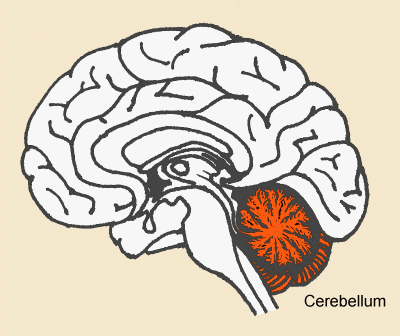
Cerebellum differential time-keeping role


This is a follow-up post up on my prior posts regarding the three major systems of timing, the brain functions/structures involved in mental/interval time-keeping, and research implicating the brains master time clock in certain clinical disorders (click here)

According to Buhusi and Meck (2006), research has suggested that impaired mental/interval time-keeping in the seconds-to-minutes range is found in patients with disorders that involve dopaminergic pathways (Parkinson’s disease, Huntington’s disease,and schizophrenia. Coupled with research that has studied the impact of lesions in the cerebellum, these authors conclude that "the striatum and cerebellum are involved in different aspects of timing and time perception. Although the cerebellum is not essential for interval timing, it is required for correct millisecond timing"

Technorati Tags: , , , , , , , , , , , , , ,


powered by performancing firefox

Wednesday, November 15, 2006

Interactive Metronome keynote PPT slides posted: New blog feature

I've added a new feature to the IQ Brain Clock blog. You can see a new section on the right side, down a bit, called "On-line PPT slides." I plan to post any relevant PPT slides related to the purpose of this blog. Currently only one set has been posted..."Interactive Metronome: Whats happening under the hood?"
This was my keynote presentation as an external speaker at the October, 2006 IM conference in Austin, TX. See prior posts regarding my external consultant/evaluator potential "conflict of interest" with regard to IM.

Technorati Tags: , , , , , , , , , , ,


powered by performancing firefox

Saturday, November 04, 2006

Synchronized metronome tapping (SMT) and the automatic/controlled timing systems of the brain


In a prior post, I highlighted a distinction contemporary mental time-keeping researchers make regarding two general types of human timing systems. Briefly, the automatic timing system works in the millisecond range of time, is used in discrete-event (discontinuous) timing, and involves the cerebellum. This contrasts with the continuous-event, cognitively controlled timing system that requires attention and involves the basal ganglia and related cortical structures.

In their article, Lewis and Maill (2006) provide further clarification of how they perceive differences between these two mental timing systems. According to Lewis and Maill, "it is not any single characteristic, but rather a constellation of several characteristics which determines which timing system is recruited in any particular task." The three task characteristics isolated by these researchers are: (a) the duration measured, (b) whether or not the timed intervals were defined by movement and, (c) whether timing was continuous (e.g. an unbroken series of predictable intervals) or intermittent (e.g. broken into discrete measurements by the presence of unpredictable irregular intervals).

Lewis and Maill conclude that "our analysis showed that having any two out of the three characteristics associated with a task type (cognitive or automatic) dramatically increased the probability that the areas associated with that timing system would be recruited. Accordingly, we can think of any task having two or more cognitive attributes (e.g. measuring more than a second, discontinuously, and without relying upon movement) as a ‘cognitively controlled timing task’, and any task with two or more of the opposing characteristics as an ‘automatic timing task’."

How does this apply to understanding the brain structures and functions involved in SMT (synchronized metronome tapping; e.g., Interactive Metronome)? [click here for from info on SMT and IM and my necessary conflict of interest disclosures...just follow the link trails].

Given my understanding (and one personal experience with an SMT intervention), I would hypothesize that SMT interventions most likely tap both the automatic and controlled cognitive timing systems (and related neurological structures and functions). SMT-based interventions typically invovle a motor component (e.g., clapping hands together to the beat), a continuous tone interval, and require responding in terms of milliseconds. These characteristics definetely would be associated with the automatic timing system.

However, although an individual (during SMT training) is trying to synchronoize their tapping in terms of milliseconds, the duration between the continuous tones is more in the range of a second or so. Also, expecially during initial stages of SMT, an individual's working memory [see prior post on the pacemaker accumulator model of mental time-keeping] is partcularly taxed as one monitors the SMT visual and/or auditory feedback provided, makes a decision about whether they are responding "too fast" or "too slow", and then conciouslly implements a correction to their "beat" behavior. These later characteristics are more characteristic of the cognitively controlled timing system.

So...it is my hypothesis that both the automatic and cognitively controlled timing systems of mental or interval time-keeping are inolved with SMT-based interventions. It is possible that both are significantly active during early stages of SMT training and, with improvement and progress over time, the role of the cognitively controlled system decreases and the automatic system is more responsible. These are only hypothesis and need empirical study.

  • Lewis, P. & Miall, C (2006). Remembering the time: a continuous clock. Trends in Cognitive Sciences, 10(9), 401-406.

Technorati Tags: , , , , , , , , , , , , , , , ,,

Wednesday, October 25, 2006

Automatic vs cognitively controlled cognitive timing: Plus working memory link


[Double click on image to enlarge]

Contemporary research (Buhusi & Meck, 2005; Lewis & Miall, 2006) supports the idea that there are two mental timing circuits that can be dissociated: (1) an automatic timing system that works in the millisecond range, which is used in discrete-event (discontinuous) timing, and involves the cerebellum; and (2) a continuous-event, cognitively controlled timing system that requires attention and involves the basal ganglia and related cortical structures.

The above figure, which is based on a meta-analysis of studies (see Lewis & Miall, 2006), provides neurological evidence for two such systems via the localization of each system in different parts of the brain. What I (as a cognitive psychologist with a primary interest in psychological testing and theories of intelligence-see IQs Corner) find particularly intriguing is the conclusion (as reported in the Lewis & Miall, 2006 article as well as many other articles I've read) that the primary brain region associated with the cognitively controlled timing system is that also primarily associated with working memory--the dorsolateral prefrontal cortex (DLPFC).

More on this potentially important relationship in future posts.
  • Buhusi, W. & Meck, C. (Oct, 2005). What makes us tick: Functional and neural mechanism of interval timing. Nature Reviews: Neuroscience, 6, 755-765
  • Lewis, P. & Miall, C (2006). Remembering the time: a continuous clock. Trends in Cognitive Sciences, 10(9), 401-406.


Technorati Tags: , , , , , , , , , , , , , ,,,,,,

Monday, October 16, 2006

Time is fundamental dimension of life: Interval and milisecond mental timing

I'm now convinced, after considerable reading of psychological and neuroscience research the past few years, that Buhusi and Meck (2005) are correct (and they are not the first to make this obvious statement) that "time is a fundamental dimension" of life. I must confess that, as an applied psychometrican, I've failed to appreciate the importance of timing and temporal cognitive processes in my measurement/assessment work to date. I hope, via this blog, to make up some ground.

In their October 2005 article in Nature Reviews: Neuroscience (What makes us tick? Functional and nural mechanisms of interval timing), the authors present a very interesting figure (that represents a compilation of animal and human studies) that suggests that, in order "to deal with time, organisms have developed multiple systems that are active over more than 10 orders of magnitude with varying degrees of precision." A larger version of this excellent figure can be viewed by clicking here.

As can be seen in the figure, three general classes of timing systems, that are associated with different behaviors, brain structures, and brain mechanisms, have been identified. The three systems are labled circadian, interval, and milisecond timing. The later two (interval and milisecond) are the two systems of particular interest to the IQ Brain Clock blog, as they appear most involved in empirical and theoretical explanations related to cognitive/intellectual functioning, my primary area of interest (see IQs Corner). Brief defintions (from Buhusi and Meck, 2005) follow below
  • Interval timing: Perception, estimation and discrimination of durations in the range of seconds-to-minutes- to-hours.
  • Milisecond timing: Perception, estimation and discrimination of durations in the sub-second range.
More to come.


powered by performancing firefox