Showing posts with label education. Show all posts

Monday, December 10, 2012

"Ned the Neuron" and "Your Fantastic Elastic Brain": Let's educate our children about their brains and brain fitness


Just in time for holiday shopping—some educational materials to help children learn more about their brains and brain fitness.

I believe that children should be taught, at an appropriate level with engaging media, to understand important concepts about their brains and learning. If you are a parent, educator, or therapist who wants to teach children information that will allow them to better understand themselves and empower their thinking (how they can control and modify their minds and behavior; a Growth Mindset), it is nice to know that a variety of groups have recently developed engaging books, videos and apps regarding the human brain and brain training or plasticity.  I recently discovered two sources of material that are worth attention.

The Adventures of Ned the Neuron is a free iPad app.  This well constructed app is 34 full color pages of material.  


The app includes:
  • Read to Me function with voice over and soundtrack
  • Interactive educational diagrams
  • Three mini-games
  • Over 30 neuroscience concepts introduced
The original version crashed on original generation one iPads, but that has now been fixed and it works without a hitch on my iPad (generation one).  A brief introductory video is available for viewing.  Additional information regarding this free app can be found at the Kizoom website.  The app can be found at the iTunes App Store link at the Kizoom website.  Below are a few select screen shots (the last being a collage of all screens). 

 [Click on images to enlarge]


Your Fantastic Elastic Brain:  Stretch It, Shape It is a multimedia resource by the DEAK Group.  It includes an app, a book, posters, and other education related resources.  These materials are not free, but the costs are minimal and, in my opinion, are good investments in the education of children.  My only complaint is that the app frequently crashed when I tried to navigate from one page to a different section of the program.  I am using a generation one iPad, so I don’t know the extent to which this generalizes to later iPads.  Visit the link above to learn more and to find a link to the iTunes App Store.


The book is also available at Amazon.com.  A brief introductory video is available for viewing at the web site or on YouTube

A few select screen shots from the app are below.


Monday, March 02, 2009

School recess and learning

Thanks to the ENL blog for this story tip

http://eideneurolearningblog.blogspot.com/2009/03/recess-essential-for-improving.html


Sent from KMcGrew iPhone (IQMobile). (If message includes an image-
double click on it to make larger-if hard to see)

Monday, March 31, 2008

State of the brain fitness software revolution

Brain fitness. Clearly a hot buzz phrase the past few years. What does it mean? What is happening? Where is it headed? Should I purchase some of the advertised software/technology to keep my mind fresh and protected from the influence of aging? Curious minds want to know...and Sharp Brains has provided the most comprehensive synthesis of the brain fitness software field to date.

As mentioned previously, Sharp Brains recently published "State of the Brain Fitness Software Market 2008." Before proceeding I need to mention that, IMHO, the Sharp Brains organization is the leading critical voice in the field of brain fitness. I've often called them the Ralph Nader of brain fitness. Thus, I believe their first "state of the market" report should receive serious attention by anyone interested in this emerging field. It is my understanding that a similar hardware report is in development. I can't wait!

It is not possible to summarize the information packed 87-paged report in a blog post, so I'll only provide a few tidbits.

First, as stated at the Sharp Brain web page:
  • The report tracks developments at over 20 public and private companies offering tools to assess and train brain functions and provides important industry data, insights and analysis to help investors, executives, entrepreneurs, and policy makers navigate the opportunities and risks of this rapidly growing market. The report discusses the implications of cognitive science on healthy aging and a number of disorders such as attention deficits, dyslexia, stroke and traumatic brain injury, schizophrenia, autism, mild cognitive impairment, and Alzheimer’s disease. The report also provides information and frameworks to help institutional buyers make informed purchase decisions about brain fitness programs.
A few (select) highlights:
  • Revenues for the US brain fitness software market was estimated to reach $225 million in revenues in 2007...reflecting a large increase from $100 million in 2005. Clearly the brain fitness movement has reached and passed the tipping point.
  • Considerable confusion exists in the market. Many products and claims proliferate, but, according to Sharp Brains, only five programs have demonstrated positive cognitive effects in tightly controlled research studies (e.g., studies that use randomized controlled trials). Readers are encouraged to visit the Sharp Brains web page and blog for objective evaluations of new and emerging brain fitness product claims.
  • The consumer brain fitness market showed significant gains from 2005 to 2007 (from a few million in 2005 to $80 million). Consumers should expect an increasing array of products directly targeted at the end-user consumer. Expect a number of new software and technology start up companies to join the bandwagon this year.
  • Nintendo's Brain Age and training games are credited as being one of the major forces in the increased interest in brain fitness.
  • There are four primary customer segments: consumers, healthcare & insurance providers, K12 school systems, and fortune 1000 companies, military,and sports teams.
  • Does any of this glitzy stuff work? It depends. As is the case with most cognitive or educational interventions, short-term (proximal) improvement (measured in weeks) is often demonstrated. However, the evidence for long-term (distal) improvement and maintenance is minimal to none, and consists largely of circumstantial evidence. Long-term improvement due to cognitive-based interventions has been one of the more elusive searches for the holy grail in the area of intelligence.
I could go on, and on, and on. If you are interested in capturing an accurate picture of the state of the brain software research and market there is only one option...purchase their report. The report is organized into seven chapters:
  • Why now? Market Overview
  • The Science of Brain Fitness: Neuroplasticity, Neurogenisis and the Cognitive Reserve
  • Consumers--Taking Charge of Their Brain Health
  • Healthcare and Insurance Providers--Focus on Preventive Health
  • K12 School Systems--Responding to Learning Disabilities in New Ways
  • Fortune 1000 Companies, Military and Sports Teams--Improving Productivity
  • Future Directions: Market trends 2007-20015.
Other brain-related blogs have commented on this report. For example, check out the Brain Injury News and Information Blog.

Finally, given that I'm an educational psychologist who has consulted on a research project (using randomized control and treatment groups) that demonstrated short-term (proximal) positive academic effects for the Interactive Metronome technology (click here for more information and here for conflict of interest disclosure), I was most interested in the conclusion that the K-12 educational market "remains largely untapped due to limited research linking cognitive training to academic performance." I hope this changes. I predict that there will be increased interest in the application of brain fitness software and hardware in the K-12 school-age market, most likely driven first by parents purchasing products in hopes of improving the educational performance of their children.


Technorati Tags: , , , , , , , , , ,

Wednesday, December 19, 2007

Improved brain clock improves student performance: Media coverage

Today's edition of the Daytona Beach News-Journal includes an interesting report on a private schools use of a synchronized metronome tapping (SMT) intervention (viz., Interactive Metronome) with elementary school-age children. The article speaks for itself, with the staff reporting positive improvement in behavior and academics for students using the IM method.

As you will notice, myself, and my friend/colleague (Dr. Gordon Taub) were interviewed for the article. We were interviewed as the reporter read our recent journal publication in Psychology in the Schools, an article that reported positive reading improvement after the IM intervention.

This is one of my handful of experiences in being interviewed by a reporter. After spending at least one hour on the phone with the reporter, and sharing all kinds of information, it is interesting to see what comments I (we) made the survived the final cut. I'm pleased that the information attributed to Dr. Taub and I was accurate.

Be sure to watch the video that accompanies the article...it will give you a good feel for the basics of the IM (SMT-based) intervention.

As I've reported before, my involvement in the IM study with Dr. Taub was the impetus for my recent interest in temporal processing, mental/interval time-keeping, and the concept of an internal brain clock. It is why I started the IQ Brain Clock blog.

[See conflict of interest disclosure statement re: my role as a Scientific Advisor to IM]

Just in case this on-line article is ever pulled from the net, I've made a pdf copy available for viewing.


Technorati Tags: , , , , , , , , ,

Powered by ScribeFire.

Wednesday, August 15, 2007

Friday, December 22, 2006

Cerebellum and dyslexia controversy

As noted in a prior post, there has been a recent firestorm surrounding the controversial Dore Achievement Centers cerebellum-based treatment approach to severe reading disabilities (dyslexia). The Myomancy blog has been particularly prominent in covering the controversy and issues surrounding the cerebellum-based Dore Achievement Centers treatment. Given the role of the cerebellum in certain forms of mental/interval time-keeping, I find this controversy and surrounding research of interest.

The mental/interval time-keeping research has implicated the cerebellum in behaviors that operate at the millisecond range of time keeping, but not at the interval levels. I think this point may be relevant to the whole Dore controversy. As summarized previously, more complex cognitive behaviors (e.g., reading) most likely involve both the millisecond and interval level time-keeping systems. The interval level system appears to be important for such cognitive abilities as working memory and executive function, higher-level cognitive functions important for intelligence and achievement.

Thus, if a treatment for dyslexia is based ONLY on the millisecond system (primarily the cerebellum), it is not surprising that there is controversy. Such a brain-based treatment may only be focusing on one brain-related component for reading....while ignoring others (cognitive abilities and functions more dependent on the interval timing system).

This hypothesis is supported by a recent meta-analysis re: the role of impaired balance (due to the cerebellum) and developmental dyslexia. The reference and abstract (and URL link) are provided below. Bottom line--according to this meta-analysis and the mental/interval time-keeping research presented previously at this blog---a treatment focused only on the functions/abilities mediated by the cerebellum is likely only touching on a small portion of the complex set of abilities involved in reading. Brain-based treatments for reading (and other academics) most likely need to also include activities that address cognitive abilities mediated by cognitively controlled interval time-keeping brain mechanisms. I believe the article speaks for itself (although I have added emphasis via italics).
  • Rochell, K. & Talcott, J. (2006). Impaired balance in developmental dyslexia? A meta-analysis of the contending evidence. Journal of Child Psychology and Psychiatry, 47(11), 1159–1166 (click here to view)

Abstract
  • Background: Developmental dyslexia is typically defined by deficits in phonological skills, but it is also associated with anomalous performance on measures of balance. Although balance assessments are included in several screening batteries for dyslexia, the association between impairments in literacy and deficits in postural stability could be due to the high co-occurrence of dyslexia with other developmental disorders in which impairments of motor behaviour are also prevalent. Methods: We identified 17 published studies that compared balance function between dyslexia and control samples and obtained effect-sizes for each. Contrast and association analyses were used to quantify the influence of hypothesised moderator variables on differences in effects across studies. Results: The mean effect-size of the balance deficit in dyslexia was .64 (95% CI ¼ .44–.78) with heterogeneous findings across the population of studies. Probable co-occurrence of other developmental disorders and variability in intelligence scores in the dyslexia samples were the strongest moderator variables of effect-size. Conclusions: Balance deficits are associated with dyslexia, but these effects are apparently more strongly related to third variables other than to reading ability. Deficits of balance may indicate increased risk of developmental disorder, but are unlikely to be uniquely associated with dyslexia. Keywords: Meta-analysis, dyslexia, attention-deficit/hyperactivity disorder, balance, postural stability. Abbreviations: ADHD: attention deficit, hyperactivity disorder; DCD: developmental coordination disorder; FSIQ: full-scale intelligence quotient.
Technorati Tags: , , , , , , , , , , , , , , , , , ,

powered by performancing firefox

Tuesday, November 28, 2006

Mental timing and reading ach study "in press"

The following manuscript has been accepted for publication in the journal Psychology in the Schools. Yes...I am a coauthor and readers should check out my prior conflict of interest disclosure notice regarding my involvement as an external consultant to Interactive Metronome.

I will post more information once the article is formally published.
  • Taub, G., McGrew, K. & Keith, T. (in press). Improvements in interval time tracking and effects on reading achievement. Psychology in the Schools.
Abstract
  • This paper examines the effect of improvements in timing/rhythmicity on students’ reading achievement. A total of 86 participants, attending a public charter school receiving Title 1 funding, completed pre- and post-test measures of reading achievement from the Woodcock-Johnson III Tests of Achievement (Woodcock, McGrew, Mather, 2001), Comprehensive Test of Phonological Processing (Torgesen, Wagner, & Rashotte, 1999a), Test of Word Reading Efficiency (Torgesen, Wagner, & Rashotte, 1999b), and Test of Silent Word Reading Fluency (Mather, Hamil, Allen, & Roberts, 2004). Students in the experimental group participated in a 4 week intervention designed to improve their timing/rhythmicity by reducing the latency in their response to a synchronized metronome beat, referred to as a synchronized metronome tapping (SMT) intervention. The intervention required, on average, 15 daily 50 minute sessions. The results from this non-academic intervention indicate the experimental group’s post-test scores on select measures of reading were significantly higher than the non-treatment control group’s scores at the end of 4 weeks. This paper provides a brief overview of domain-general cognitive abilities believed effected by SMT interventions and provides a preliminary hypothesis to explain how a non-academic intervention designed to improve timing/rhythmicity can demonstrate a statistically significant effect on students’ reading achievement scores.
Technorati Tags: , , , , , , , , , , , , , , , , , ,

powered by performancing firefox

Saturday, November 25, 2006

Cerebellum-based treatment program controversy

I've never done any reading or investigation of the Dore cerebellum-based treatment program for ADHD and dyslexia. Apparently the program, and the methods used to promote/sell it, are in the midst of some kind of controversy. I have little to add.

This is an FYI post to a story at the Myomancy blog, a blog that has posts with extensive links that one can follow to learn more about this brain-based treatment and surrounding issues and controversies.

Technorati Tags: , , , , , , , , , , , , , ,


powered by performancing firefox

Wednesday, November 22, 2006

Interactive metronome and CAPD treatment


A little internet mouse alerted me to the following dissertation, a dissertation that investigated the effect of synchronized metronome tapping (SMT - using the Interactive Metronome protocol) on central auditory processing disorders (CAPD). This investigation must only be considered a small pilot/clinical trial given that only 8 subjects were treated. Replication in larger samples is needed.
  • The Effect of Interactive Metronome Training on Children’s SCAN-C Scores. Etra, Joel L., 2006: Applied Dissertation, Nova Southeastern University, Fischler School of Education and Human Services. Auditory Perception/Auditory Training/ Auditory Tests/Audiology. (click here for a copy I was able to secure)
Abstract
  • In this study, the effect of Interactive Metronome, a treatment for attention deficit that requires the subject to match a computer generated rhythm, on auditory processing in male and female children ages nine to fourteen was investigated. Eight children were administered the SCAN-C and then were given the 15-hour Interactive Metronome training and administered the SCAN-C again. SCAN-C raw scores showed a significant increase (p = .002). SCAN-C subtests of dichotic listening showed greater improvements than the other subtests. It is suggested that Interactive Metronome may affect auditory processing disorders by influencing neurological organization. It was concluded that Interactive Metronome could be an effective treatment for disorders of auditory processing. Potential difficulties in the provision of Interactive Metronome were discussed. Additional research was suggested with larger and more diverse samples as well as different trainers. More research into the design of the Interactive Metronome training schedule was also suggested.

Technorati Tags: , , , , , , , , , , , , , , , , ,

powered by performancing firefox

Wednesday, November 15, 2006

Biofeedback to help students do better on tests?

A tip-of-that hat to SharpBrains for the FYI post about an article in Technology and Learning Magazine about how a school system is using a PC-based biofeedback program with third graders to "calm" students down before taking tests. I'd like to see an actual controlled study, but the anecdotal reports of higher test scores are interesting.

Technorati Tags: , , , , , , , , , , , ,

powered by performancing firefox

Friday, October 20, 2006

Application of cognitive neuroscience research to education: Good overview/intro article

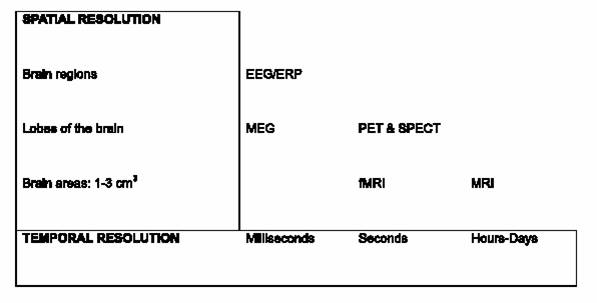
Following up on yesterday's small burst of posts regarding the fact/fiction surrounding the implications of brain-based (i.e., based on neuroscience) for education, I found the following very good overview article. Although not exhaustive or a definitive statement of the state-of-the-art of the neuroscience of education, I think this is a very good introductory overview article. I found the overview of neuroscience methods particulary good. I had not appreciated the differential sensitivity of different brain study methodologies as a function of temporal and spatial sensitivity (see above figure). Readers interested in the application of neuroscience research to the study of severe reading (dyslexia) and math (dyscalculia) disabilities will find the later half of the article interesting, although I believe these disability-related reviews are more illustrative than definitive (does not integrate all relevant neuroscience research findings regarding these forms of learning disabilites)

  • Katzir, T & Paré-Blagoev, J. (2006) Applying Cognitive Neuroscience Research to Education: The Case of Literacy. Educational Psychologist, 41(1`), 53,74 (click here to view)
Abstract
  • Neuroscience has provided fascinating glimpses into the brain’s development and function. Despite remarkable progress, brain research has not yet been successfully brought to bear in many fields of educational psychology. In this article, work on literacy serves as a test case for an examination of potential future bridges linking mind, brain, and educational psychology. This article proposes a model for integrating research in the cognitive neurosciences with educational psychology and reviews how neuroscience is providing new data relevant to 3 major controversies in the field of dyslexia. This article also discusses the relevance of these findings for psychoeducational assessment and instruction and suggests innovative venues for interdisciplinary research.
Technorati Tags: , , , , , , , , , , , , , , , , , , ,

powered by performancing firefox

Neuroscience of learning (brain-based learning): Posts moving to The IQ Brain Clock

FYI. The following post was just made to IQs Corner blog. Long story short....posts related to the neuroscience of learning (esp. in education) will now be made to The IQ Brain Clock blog (what you are now reading)

  • Yesterday's posts (click here, here) dealing with facts and fictions regarding brain-based learning in education, plus the response of SharpBrains, set me off digging through my electronic library of professional articles...in search of articles on the use of neuroscience in learning in education. I found a number of good overview articles that I will comment and post shortly.
  • However, it dawned on me that this line of research is probably more consistent with the focus of my new blog (Tick Tock Talk: The IQ Brain Clock). Thus, this note is to inform regular IQs Corner readers that I'm going to start shifting posts focused on the neuroscience of learning over to The IQ Brain Clock Blog. I will likely also broaden the definition and purpose of that blog.

Technorati Tags: , , , , , , , , , , , , ,

powered by performancing firefox