Showing posts with label prefrontal cortex. Show all posts

Tuesday, March 08, 2016

Research Byte: Executive functions involve more than just the prefrontal structures--White matter matters

Neuroanatomical Substrates of Executive Functions: Beyond Prefrontal Structures

  • a University of California, San Francisco; Department of Neurology, Memory and Aging Center; San Francisco, CA
  • b University of Colorado, Denver Anschutz School of Medicine; Departments of Neurosurgery and Neurology; Rocky Mountain Alzheimer’s Disease Center; Aurora, CO
  • c University of California, Davis; Department of Neurology; Davis, CA

Highlights

Executive functions (EF) are not synonymous with ‘frontal’ tasks.
Global atrophy was the only independent predictor of EF.
Frontal volumes do not predict EF when statistically isolated from global atrophy.
White matter metrics remain predictors of EF, independent of global atrophy.

Abstract

Executive functions are often considered lynchpin “frontal lobe tasks”, despite accumulating evidence that a broad network of anterior and posterior brain structures supports them. Using a latent variable modeling approach, we assessed whether prefrontal grey matter volumes independently predict executive function performance when statistically differentiated from global atrophy and individual non-frontal lobar volume contributions. We further examined whether fronto-parietal white matter microstructure underlies and independently contributes to executive functions. We developed a latent variable model to decompose lobar grey matter volumes into a global grey matter factor and specific lobar volumes (i.e. prefrontal, parietal, temporal, occipital) that were independent of global grey matter. We then added mean fractional anisotropy (FA) for the superior longitudinal fasciculus (dorsal portion), corpus callosum, and cingulum bundle (dorsal portion) to models that included grey matter volumes related to cognitive variables in previous analyses. Results suggested that the 2-factor model (shifting/inhibition, updating/working memory) plus an information processing speed factor best explained our executive function data in a sample of 202 community dwelling older adults, and was selected as the base measurement model for further analyses. Global grey matter was related to the executive function and speed variables in all four lobar models, but independent contributions of the frontal lobes were not significant. In contrast, when assessing the effect of white matter microstructure, cingulum FA made significant independent contributions to all three executive function and speed variables and corpus callosum FA was independently related to shifting/inhibition and speed. Findings from the current study indicate that while prefrontal grey matter volumes are significantly associated with cognitive neuroscience measures of shifting/inhibition and working memory in healthy older adults, they do not independently predict executive function when statistically isolated from global atrophy and individual non-frontal lobar volume contributions. In contrast, better microstructure of fronto-parietal white matter, namely the corpus callosum and cingulum, continued to predict executive functions after accounting for global grey matter atrophy. These findings contribute to a growing literature suggesting that prefrontal contributions to executive functions cannot be viewed in isolation from more distributed grey and white matter effects in a healthy older adult cohort.

Sunday, June 02, 2013

Another article implicating dlPFC and P-FIT model of intelligence--Importance to general intelligence

Another study implicating dorsolateral prefrontal cortex (dlPFC) and PFIT model of intelligence with regard to general intelligence (g), working memory and white matter tract-moderated functional brain network connectivity. Supports significant components of the three-level explanatory model articulated in MindHub Pub #2.


Friday, May 24, 2013

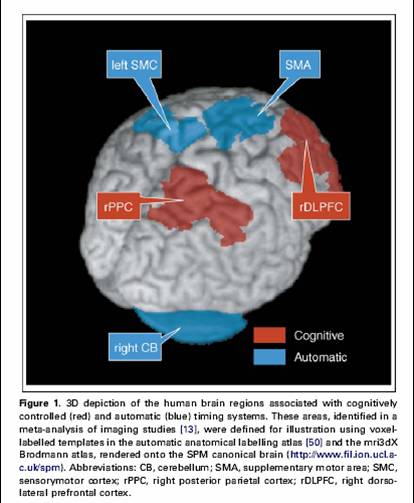
Automatic v controlled cognitive brain clock timing systems: A link with working memory?


[Double click on image to enlarge]

Contemporary research (Buhusi & Meck, 2005; Lewis & Miall, 2006) supports the idea that there are two mental timing circuits that can be dissociated: (1) an automatic timing system that works in the millisecond range, which is used in discrete-event (discontinuous) timing, and involves the cerebellum; and (2) a continuous-event, cognitively controlled timing system that requires attention and involves the basal ganglia and related cortical structures.

The above figure, which is based on a meta-analysis of studies (see Lewis & Miall, 2006), provides neurological evidence for two such systems via the localization of each system in different parts of the brain. What I (as a cognitive psychologist with a primary interest in psychological testing and theories of intelligence-see IQs Corner) find particularly intriguing is the conclusion (as reported in the Lewis & Miall, 2006 article as well as many other articles I've read) that the primary brain region associated with the cognitively controlled timing system is that also primarily associated with working memory--the dorsolateral prefrontal cortex (DLPFC).

  • Buhusi, W. & Meck, C. (Oct, 2005). What makes us tick: Functional and neural mechanism of interval timing. Nature Reviews: Neuroscience, 6, 755-765
  • Lewis, P. & Miall, C (2006). Remembering the time: a continuous clock. Trends in Cognitive Sciences, 10(9), 401-406.


Technorati Tags: , , , , , , , , , , , , , ,,,,,,

Sunday, July 03, 2011

More evidence for brain network involved in controlled attention

A broken theme at the IQ Brain Clock is the hypothesis that the prefrontal cortex(especially the dorsolateral prefrontal), left parietal cortex , cerebellum, and basal ganglia network is key to mental timing, working memory and executive attention. Here is another study providing addition support for the first two cortical areas, with an extension to spatial working memory/attention and motor intention.

Click on images to enlarge


- iPost using BlogPress from my Kevin McGrew's iPad

Saturday, February 05, 2011

Research Byte: Why we sometimes struggle with cognitive self-regulation


I think the following "in press" article is important. Why? Because I have been actively involved in reading research to better understand cognitive performance (working memory and executive attention in particular), the IQ Brain Clock (role of mental timing in human performance), and neuro-technology interventions (e.g., Interactive Metronome) that seem to improve cognitive efficiency. Across these different strands of research I have CONSTANTLY run across a number of common factors. In particular, I am constantly finding the dorsolateral pre-frontal cortex (PFC) as being critical to cognitive efficiency (working memory and cognitive processing speed), which in turn impacts intellectual functioning, especially Gf or fluid reasoning. The same brain area is implicated in mental timing and IM-interventions.

The article below continues to suggest a prominent role of the dlPFC, this time in self-regulation behavior. Of importance, IMHO, is the conclusion (near the end of the article) that this may be a domain-general mechanism. This is important, as it is consistent with my hypothesis why neuro-tech IM and other working memory interventions seem to improve performance across vastly different human performance domains. Clearly the dlPFC, and the functions it regulates (working memory, controlled executive attention, mental timing), is important and focal to understanding a number of related areas of research.


Heatherington & Wagner Cognitive neuroscience of self-regulation failure Review Article. Trends in Cognitive Sciences, In Press, Corrected Proof, Available online 26 January 2011

Abstract

Self-regulatory failure is a core feature of many social and mental health problems. Self-regulation can be undermined by failures to transcend overwhelming temptations, negative moods and resource depletion, and when minor lapses in self-control snowball into self-regulatory collapse. Cognitive neuroscience research suggests that successful self-regulation is dependent on top-down control from the prefrontal cortex over subcortical regions involved in reward and emotion. We highlight recent neuroimaging research on self-regulatory failure, the findings of which support a balance model of self-regulation whereby self-regulatory failure occurs whenever the balance is tipped in favor of subcortical areas, either due to particularly strong impulses or when prefrontal function itself is impaired. Such a model is consistent with recent findings in the cognitive neuroscience of addictive behavior, emotion regulation and decision-making.

Click on image to enlarge for better readability.


Article Outline

The advantages of self-control
Self-regulation failure
Negative moods
Lapse-activated consumption
Cue exposure
Self-regulatory resource depletion
Functional neuroimaging studies of self-regulation
Regulation of appetitive behaviors
Regulation of emotions
Regulation of attitudes and prejudice
Prefrontal–subcortical balance model of self-regulation
Why do people fail at self-regulation?
Concluding remarks
Acknowledgements
References


- iPost using BlogPress from my Kevin McGrew's iPad

Generated by: Tag Generator


Monday, July 26, 2010

Working memory and IQ brain clock training and mechanisms linked?

It is no secret that I believe that there is a significant link between contemporary working memory (and training related studies) and mental timing mechanisms (and training to improve) that can not be ignored.  I keep running across the common neurological mechanisms of the frontal (esp. the dorsolateral PFC) and parietal cortex's, the frontal-parietal loop, the basal ganglia and dopamine.  I have hypothesized about this in a variety of posts (esp. the possibility of a temporal g domain-general mechanism) and have made this link in a couple on-line PPT slide shows.  Klingberg's article below is entirely consistent with these hypotheses (click here for more info on Klingberg's strong program of working memory research).

Klingberg, T. (2010).  Training and plasticity of working memory.  Trends in Cognitive Sciences, 14 (7), 317-324. (click here to view)

Working memory (WM) capacity predicts performance in a wide range of cognitive tasks. Although WM capacity has been viewed as a constant trait, recent studies suggest that it can be improved by adaptive and extended training. This training is associated with changes in brain activity in frontal and parietal cortex and basal ganglia, as well as changes in dopamine receptor density. Transfer of the training effects to non-trained WM tasks is consistent with the notion of training-induced plasticity in a common neural network for WM. The observed training effects suggest that WM training could be used as a remediating intervention for individuals for whom low WM capacity is a limiting factor for academic performance or in everyday life.

Technorati Tags: , , , , , , , , , , , , , , , , , , , , , , , , , , ,

Thursday, June 17, 2010

RE: iPost: Kids with tourettes have superior mental timing?

Now this is a VERY interesting finding worth checking deeper. It would  be very interesting to measure the performance of such children on  synchronized metronome timing interventions.  The results are very consistent in implicating the dorsolateral prefrontal cortex in mental timing.  Story at link below


http://bps-research-digest.blogspot.com/2010/06/tourettes-syndrome-associated-with.html


Sent from KMcGrew iPhone (IQMobile). (If message includes an image-
double click on it to make larger-if hard to see)

Tuesday, December 01, 2009

Research byte: Ga (auditory sound processing) and cognitive development: Auditory scaffolding hypothosis


I ran across this very interest article in one of my favorite journals for short and concise up-to-date summaries of contemporary cognitive research.  Given the apparent role of temporal and serial processing in mental timing behavior (IQ Brain Clock), it reinforces the notion that auditory processing (Ga) is a primary and important cognitive mechanism for intellectual and cognitive growth.....according to these authors, vis-a-vis providing a bootstrap or scaffolding mechanism for the development of critical cognitive functions.

Conway,C.  Pisoni, D., & Kronenberger, W. (2009). The Importance of Sound for Cognitive Sequencing Abilities: The Auditory Scaffolding Hypothesis.  Current Directions in Psychological Science, 18(5), 275-179 (click here to view

ABSTRACT
Sound is inherently a temporal and sequential signal. Experience with sound therefore may help bootstrap— that is, provide a kind of ‘‘scaffolding’’ for—the development of general cognitive abilities related to representing temporal or sequential patterns. Accordingly, the absence of sound early in development may result in disturbances to these sequencing skills. In support of this hypothesis, we present two types of findings. First, normalhearing adults do best on sequencing tasks when the sense of hearing, rather than sight, can be used. Second, recent findings suggest that deaf children have disturbances on exactly these same kinds of tasks that involve learning and manipulation of serial-order information. We suggest that sound provides an ‘‘auditory scaffolding’’ for time and serial-order behavior, possibly mediated through neural connections between the temporal and frontal lobes of the brain. Under conditions of auditory deprivation, auditory scaffolding is absent, resulting in neural reorganization and a disturbance to cognitive sequencing abilities.


Technorati Tags: , , , , , , , , , , , , , , , ,


Tuesday, October 20, 2009

Time Doc Bytes: Two new exciting brain-based brain clock research studies


Two very interesting research studies reported this past week.

The first used a rare procedure (implanting electrodes in Broca's area of the brain) provides useful information on brain mechanisms involved in the speed, timing and sequence of language behaviors.

The second, based on research with primates, is very intriguing as it suggest the use of a "brain stamp" mechanism for keeping time of events.   Interestingly, and consistent with considerable research posted at this blog before, the focus was on certain brain regions/mechanisms (prefrontal cortex; straitum; dopamine), and implications were mentioned for Parkinson's disease treatment.

Technorati Tags: , , , , , , , , , , , ,


Thursday, May 01, 2008

Tic toc brain clock. More on timing and intelligence.

Got it! Tick toc the brain clock. I found a copy of the recent journal article linking rhythmic accuracy and intelligence (that I commented on last week).

If you are a regular reader of the IQ Brain Clock, you can probably guess that this Journal of Neuroscience article by Ullen et al. (2008; abstract below) has me excited! The literature reviewed and results hit on many constructs, hypothesis, ideas, etc. that I've presented at this humble blog re: the potential importance of mental/interval time-keeping (the IQ Brain Clock; temporal processing/g) and general intelligence.

A few sample comments from the authors (and the blogmaster) are featured below:

  • Recent studies suggest that temporal discrimination and judgment tasks may correlate higher with g (general intelligence) than classic reaction time (RT) tasks, tasks that have, for decades, been considered the best available measures of the biological correlates of brain efficiency (see new, destined to be classic, book on the RT paradigm in intelligence research by A. Jensen--Clocking the Mind). "Neural factors influencing accuracy of timing may thus be fundamental to intelligence."
  • Study limitation. I believe the use of a single measure for general intelligence (The Ravens Progressive Matrices), although a common practice, warrants some degree of caution. Some psychometric researchers equate performance on the RPM, which is a well established measure of fluid reasoning/intelligence (Gf), with g. I've read enough research that suggest that the Gf=g argument is not 100% established. So, IMHO, the current study may suggest a link between rhythmic abilities (and temporal processing) and Gf...not necessarily g. I'd like to see a similar study with a g measure comprised of a wide range of Gf-Gc (CHC) abilities, like that used in Rammsayer's temporal g research (which the current study reinforces).
  • It is amazing that a simply isochronous tapping task (subjects listen to 20 auditory metronome clicks and then must continue the same beat, without the metronome, for 45 more beats) correlates with Gf. The authors concluded that "we demonstrate that intelligence is related to millisecond accuracy in isochronous tapping, a simple timing task that does not involve response selection or information processing of the type typically required in the elementary cognitive tasks (Deary, 2001) and in which interval-to-interval variability is primarily controlled by automatic processes."
  • Consistent with prior posts and my IQ Brain Clock powerpoint presentations, it is exciting to find that these researchers confirm the importance of the prefrontal lobes. The authors conclude that "tapping variability and intelligence share neural substrates in the prefrontal white substance."
Up to recently I've never been a student or believer in the idea of a general intelligence (g) domain general cognitive mechanism that may underlie most cognitive/intellectual behavior. The convergence of the mental/interval timing, temporal processing, temporal g, etc. research I've tried to illuminate in this blog is making me more of a believer every day.

Tic toc

Abstract
  • General intelligence is correlated with the mean and variability of reaction time in elementary cognitive tasks, as well as with performance on temporal judgment and discrimination tasks. This suggests a link between the temporal accuracy of neural activity and intelligence. However, it has remained unclear whether this link reflects top-down mechanisms such as attentional control and cognitive strategies or basic neural properties that influence both abilities. Here, we investigated whether millisecond variability in a simple, automatic timing task, isochronous tapping, correlates with intellectual performance and, using voxel-based morphometry, whether these two tasks share neuroanatomical substrates. Stability of tapping and intelligence were correlated and related to regional volume in overlapping right prefrontal white matter regions. These results suggest a bottom-up explanation of the link between temporal stability and intellectual performance, in which more extensive prefrontal connectivity underlies individual differences in both variables.
Technorati Tags: , , , , , , , , , ,

Thursday, April 17, 2008

Executive functions and intellectual performance

I just read an excellent overview of the literature re: the construct of executive functions (EF). The article (by Ardila) is "in press" in Brain and Cognition (an excellent journal). Although I was not personally interested in the later portion of the articles discussion of the evolutionary basis of executive functions, I found everything prior to that section excellent.

The article provides a nice synthesis of the status of the theoretical and empirical research re: the construct of EF. What continues to excite me is the strong link between the prefrontal cortex (the dorsolateral prefrontal lobes in particular) and EF. My reading of the literature, which I've summarized in two of my PPT slide shows (in particular, see "Brain Clock IM 2007 Keynote" under the On-line PPT Slide section of the right side of this blogs home page), suggests a strong link between temporal processing/mental time-keeping (the IQ Brain Clock) and the dorsolateral prefrtonal cortex. This article is consistent with this finding.

The article also serves to remind those of us who are primarily focused on intelligence/cognitive constructs that EF is involved in two broad human behavior systems. One deals more with cognitive functions and the other more motivational/emotional/affective behaviors. I often tend to forget about the later....and I shouldn't, given that these other functions are related to the self-regulatory learning strategies conative domain I have described in a Model of Achievement Competence and Motivation (MACMM).

Article abstract
  • In this paper it is proposed that the prefrontal lobe participates in two closely related but different executive function abilities: (1) ‘‘metacognitive executive functions”: problem solving, planning, concept formation, strategy development and implementation, controlling attention, working memory, and the like; that is, executive functions as they are usually understood in contemporary neuroscience; and (2) ‘‘emotional/ motivational executive functions”: coordinating cognition and emotion/motivation (that is, fulfilling biological needs according to some existing conditions). The first one depends on the dorsolateral prefrontal areas, whereas the second one is associated with orbitofrontal and medial frontal areas. Current tests of executive functions basically tap the first ability (metacognitive). Solving everyday problems (functional application of executive functions), however, mostly requires the second ability (emotional/ motivational); therefore, these tests have limited ecological validity. Contrary to the traditional points of view, recent evidence suggests that the human prefrontal lobe is similar to other primates and hominids. Other primates and hominids may possess the second (emotional executive functions) prefrontal ability,-but not the first (metacognitive executive functions) one. It is argued that metacognitive executive functionsare significantly dependent on culture and cultural instruments. They probably are the result of the development and evolution of some ‘‘conceptualization instruments”; language (and written language as an extension of oral language) may represent the most important one. The second executive function ability (emotional/motivational) probably is the result of a biological evolution shared by other primates.


Technorati Tags: , , , , , , , , , , , , , ,

Saturday, March 17, 2007

Cognitive construct of attention - a review


The most recent Annual Review of Psychology had a nice overview article (by Posner and Rothbart..click here to view) dealing with research on the cognitive construct of attention. I found Figure 2 and Table 1 (above) particularly informative. Below are some key quotes from the article. Given my prior reading and posts regarding the importance of executive attention, I was particularly interested in Posner and Rothbart's suggestion that executive attention may be a domain general learning mechanism that may be trainable. The italics and/or underlining below were added by this blogmaster.
  • In recent years, attention has been one of the fastest growing of all fields within cognitive psychology and cognitive neuroscience.
  • Certainly many, perhaps even most, imaging studies have been concerned with anatomical issues. As Figure 2 illustrates, several functions of attention have been shown to involve specific anatomical areas that carry out important functions.
  • Imaging data have supported the presence of three networks related to different aspects of attention (Fan et al. 2005). These networks carry out the functions of alerting, orienting, and executive attention (Posner & Fan 2007). A summary of the anatomy and chemical modulators involved in the three networks is shown in Table 1. Alerting is defined as achieving and maintaining a state of high sensitivity to incoming stimuli; orienting is the selection of information from sensory input; and executive attention involves mechanisms for monitoring and resolving conflict among thoughts, feelings, and responses.
  • ..we have argued that the executive attention network is involved in self-regulation of positive and negative affect as well as a wide variety of cognitive tasks underlying intelligence (Duncan et al. 2000). This idea suggests an important role for attention in moderating the activity of sensory, cognitive, and emotional systems.
  • There is considerable evidence that the executive attention network is of great importance in the acquisition of school subjects such as literacy (McCandliss et al. 2003) and in a wide variety of other subjects that draw upon general intelligence (Duncan et al.2000).
  • It has been widely believed by psychologists that training involves only specific domains, and that more general training of the mind, for example, by formal disciplines like mathematics or Latin, does not generalize beyond the specific domain trained (Thorndike 1903, Simon 1969). However, attention may be an exception to this idea. Attention involves specific brain mechanisms, as we have seen, but its function is to influence the operation of other brain networks (Posner & Rothbart 2007). Anatomically, the network involving resolution of conflict overlaps with brain areas related to general intelligence (Duncan et al. 2000). Training of attention either explicitly or implicitly is sometimes a part of the school curriculum (Posner&Rothbart 2007), but additional studies are needed to determine exactly how and when attention training can best be accomplished and its long-lasting importance.
  • Executive attention represents a neurodevelopmental process in children and adolescents, the alteration which could affect the propensity for the development of a number of disorders.

Technorati Tags: , , , , , , , , , , , ,

powered by performancing firefox

Thursday, March 15, 2007

Brain clock temporal processing review article

I just finished reading Mauk and Buonomano's 2004 review (Annual Review of Neuroscience) of "The Neural Basis of Temporal Processing." This is a bit of a hard read, but it is a good general overview summary article on contemporary mental time-keeping or temporal processing research and theory. All major mental time-keeping models are discussed, although the authors have a clear preference for the state-dependent distributed "emergent" neural models (vs. the internal clock model). I've posted a link to the article (that includes some yellow highlighting I did while reading the article) in the "key research articles" section of this blog. This is a good article for getting a handle on some of the key terms and theoretical concepts/models. I hope to take the notes I extracted and make some specific posts in the near future. I'm doing this reading largely to try get a handle on this entire domain of research....my learning curve is a bit slow right now.

A key comment in the review is that this field of research is very much in it's formative stage (stage of infancy).

Technorati Tags: , , , , , , , , , , , , ,

powered by performancing firefox

Wednesday, February 14, 2007

What makes us tick? Nice research summary

Previously in this blog I've drawn attention to one of the key contemporary articles dealing with the neural mechanisms of mental/interval time keeping (by Buhusi and Meck). A copy of the complete article is listed under the "Key Research articles" portion of this blog ("What Makes Us Tick?).

Today I ran across a nice bulleted Neuroscience ummary of the article. It can be found by clicking here.

Technorati Tags: , , , , , , , , , ,


powered by performancing firefox

Wednesday, December 13, 2006

Mental time clock - fewer brain areas involved?

In prior posts re: mental/interval time-keeping, I have drawn on key neuroscience research articles regarding the potential brain areas/functions involved in the brain's master clock (this information was summarized in the "Interactive Metronome: Whats happening under the hood" on-line PPT slide show available on the right side of this blog) . This week I ran across a new fMRI study that questions the number and breadth of involvement of some of these key areas of the brain (viz., cerebullum, basal ganglia, frontal-striatal loop, dorsolateral prefrontal cortex, parietal lobe) in mental time-keeping. Below is the article reference and abstract. I believe the article speaks for itself.

As with all science, this is one more bit of information that needs to be added to the extant research knowledge base. The preponderance of research to date suggests the involvement of the areas summarized above, but this new study needs to examined (and hopefully replicated) so that possible adjustments to current thinking can be modified as needed.

I've also placed this article in the the "key research articles" section of this blog.

Livesey, A., Wall, M. Smith, A. (2007). Time perception: Manipulation of task difficulty dissociates clock functions from other cognitive demands Neuropsychologia,45,321–331. (click here to view)

Abstract (italics added by blogmaster)
  • Previous studies suggest the involvement in timing functions of a surprisingly extensive network of human brain regions. But it is likely that while some of these regions play a fundamental role in timing, others are activated by associated task demands such as memory and decisionmaking. In two experiments, time perception (duration discrimination) was studied under two conditions of task difficulty and neural activation was compared using fMRI. Brain activation during duration discrimination was contrasted with activation evoked in a control condition (colour discrimination) that used identical stimuli. In the first experiment, the control task was slightly easier than the time task. Multiple brain areas were activated, in line with previous studies. These included the prefrontal cortex, cerebellum, inferior parietal lobule and striatum. In the second experiment, the control task was made more difficult than the time task. Much of the differential time-related activity seen in the first experiment disappeared and in some regions (inferior parietal cortex, pre-SMA and parts of prefrontal cortex) it reversed in polarity. This suggests that such activity is not specifically concerned with timing functions, but reflects the relative cognitive demands of the two tasks. However, three areas of time-related activation survived the task-difficulty manipulation: (i) a small region at the confluence of the inferior frontal gyrus and the anterior insula, bilaterally, (ii) a small portion of the left supramarginal gyrus and (iii) the putamen. We argue that the extent of the timing “network” has been significantly over-estimated in the past and that only these three relatively small regions can safely be regarded as being directly concerned with duration judgements.
Technorati Tags: , , , , , , , , , , ,

powered by performancing firefox

Friday, December 08, 2006

Exec. Function and Clinical Neuropsych PPT

Chris Chatham, the author of the fantastic Developing Intelligence blog, has made available (in PPT or PDF format) a presentation he put together on clinical neuropsychology and executive function. Below is what Chris says about his presentation. His presentation can be downloaded for free from his site. Kudos to Chris.
  • This presention summarizes the essential findings from three studies on the clinical neuropsychology of executive function. It begins with a preface on the basic differences between cognitive neuroscience and clinical neuropsychology, then delving into the difficulties facing any attempt to use theories of executive dysfunction in clinical neuropsych (this section is based on the Royall et al paper)

  • The second half of the presentation deals with factor analyses of executive dysfunction among patients with traumatic brain injury, and ways in which patients with traumatic brain injury can be assessed and possibly rehabilitated.

Technorati Tags: , , , , , , , ,


powered by performancing firefox

Thursday, October 26, 2006

Mental time keeping and human speech

Earlier today I made an FYI post (with link to article) dealing with the role of the timing function of the auditory brainstem in speech. This reminded me of an article in a recent special issue of Cognitive Brain Research that reviewed recent neuroscience research (lesion and neuroimaging) that investigated the role of timing in human speech.
  • Schirmer, A (2004). Timing speech: a review of lesion and neuroimaging findings. Cognitive Brain Research, 21, 269–287 (click to view)
What I find particularly interesting is the spotlight (in this review article) on the basal ganglia, cerebullum and the left frontal cortex in speech-related timing behavior. Why?

Because the preponderance of mental interval time-keeping research consistently is pointing to the "master internal brain clock" being localized in the same general areas; particularly the basal ganglia, cerebullum, dorsolateral prefrontal cortex, and the frontial-striatal loop (Buhusi & Meck; 2005; Janata & Grafton, 2003; Nobre & O’Reilly, 2004; Peretz & Zatorre, 2005). Schimer concludes that the "BG [basal ganglia] and the cerebellum might perform more general timing operations that feed into other cognitive processes such as the processes specific to speech." In other words, Shimer is arguing for a domain-general, brain-based, mental time-keeper that functions in synchrony with possible domain-specific cognitive mechanisms specific to speech behavior.


Abstract
  • Time is a fundamental dimension of behavior and as such underlies the perception and production of speech. This paper reviews patient and neuroimaging studies that investigated brain structures that support temporal aspects of speech. The left-frontal cortex, the basal ganglia, and the cerebellum represent structures that have been implicated repeatedly. A comparison with the structures involved in the timing of nonspeech events (e.g., tones, lights, finger movements) suggests both commonalities and differences: while the basal ganglia and the cerebellum contribute to the timing of speech and non-speech events, the contribution of left-frontal cortex seems to be specific to speech or rapidly changing acoustic information. Motivated by these commonalities and differences, this paper presents assumptions about the function of basal ganglia, cerebellum, and cortex in the timing of speech.
Technorati Tags: , , , , , , , , , , , , , , , , , , ,

powered by performancing firefox