Time Cells Organize Memory
Yesterday, When I woke up I washed and dressed And while drinking coffee, The telephone rang, And you invited me to the meeting. Memories have specific sequences of events.…

Understanding the human brain clock & related neuroscience
Yesterday, When I woke up I washed and dressed And while drinking coffee, The telephone rang, And you invited me to the meeting. Memories have specific sequences of events.…

From Neurociencia, a Flipboard magazine by igaea
Nobody really believes that the shape of our heads are a window into our personalities anymore. This idea, known as…

Neuroscientist Rogier Kievit discusses the neuroscience of intelligence.

From Twitter, a Flipboard magazine by Jon Lieff MD
Seemingly countless self-help books and seminars tell you to tap into the right side of your brain to stimulate creativity. But forget the…

Neuroplasticty is the way a brain makes lasting alterations of its own circuits when responding to experience. A vast array of mechanisms have been…

From Science and Health, a Flipboard magazine by IBTimes UK
In case of creative thinkers, researchers noted a better connection between 3 crucial parts of the brain.…

The ubiquity of video games in today's society has led to significant interest in their impact on the brain and behavior and in the possibility of harnessing games for good. The present meta-analyses focus on one specific game genre that has been of particular interest to the scientific community—action video games, and cover the period 2000–2015. To assess the long-lasting impact of action video game play on various domains of cognition, we first consider cross-sectional studies that inform us about the cognitive profile of habitual action video game players, and document a positive average effect of about half a standard deviation (g = 0.55). We then turn to long-term intervention studies that inform us about the possibility of causally inducing changes in cognition via playing action video games, and show a smaller average effect of a third of a standard deviation (g = 0.34). Because only intervention studies using other commercially available video game genres as controls were included, this latter result highlights the fact that not all games equally impact cognition. Moderator analyses indicated that action video game play robustly enhances the domains of top-down attention and spatial cognition, with encouraging signs for perception. Publication bias remains, however, a threat with average effects in the published literature estimated to be 30% larger than in the full literature. As a result, we encourage the field to conduct larger cohort studies and more intervention studies, especially those with more than 30 hours of training. (PsycINFO Database Record (c) 2018 APA, all rights reserved)

Richard Haier is a Professor Emeritus at the University of California Irvine and is the author of the Neuroscience of Intelligence…
From BiPolar, Depression & ADHD, a Flipboard magazine by Rob Waldrip
But can people with attention deficit hyperactivity disorder – often referred to as a brain-based disorder – also train their brain to improve? Every…
From Mind, a Flipboard magazine by Devon Briggs
The human brain is malleable – it learns and adapts. Numerous research studies have focused on the impact of action video games on the brain…

The brain considers talking to ourselves in our heads to be very similar to speaking our thoughts out loud. And the…
From Mind the Gap, a Flipboard magazine by Lawrence Villegas
Everybody likes travelling around the world but what if we tell you that now you can travel through human brains as…

From NEUROSCIENCE, a Flipboard magazine by Glossex
People with a higher-than-average intelligence level have brains that are "wired" in a different way, researchers say. A new study suggests that…
The U.S. defense agency that specializes in "out-there" science and technology endeavors is on a quest to bridge the gap between brain and…

From The Guardian, a Flipboard magazine by The Guardian
There are good reasons to be cautious about a new study claiming computer-based training can reduce the risk of…
From Brain, a Flipboard magazine by tommysclee
A recent study has been hailed as a "breakthrough" in dementia prevention, after finding that a brain-training exercise can…
Human beings have an internal clock that enables the subconscious perception and estimation of time periods. A research team under Dr. Roland Thomaschke of…
From THE SCIENCE OF My LIFE, a Flipboard magazine by duskdiver
A memory complaint, also called Subjective Cognitive Decline (SCD), is a subjective disorder that appears to be relatively common,…

From Brain Philosophy, a Flipboard magazine by Sandra Clark
Beyond teaching us more about the structure of the brain, these maps could help unlock some of the…
From Brain/Vision, a Flipboard magazine by CinemaoftheMind
Children with autism show different patterns of connectivity than controls do in brain stem regions associated with balance.…
From Brain/Vision, a Flipboard magazine by CinemaoftheMind
Children with autism show different patterns of connectivity than controls do in brain stem regions associated with balance.…


From Neuro, a Flipboard magazine by Jack
Several studies comparing adult musicians and nonmusicians have…
Proud and excited to announce the 12 groundbreaking startups that will get to pitch their idea and solutions at…


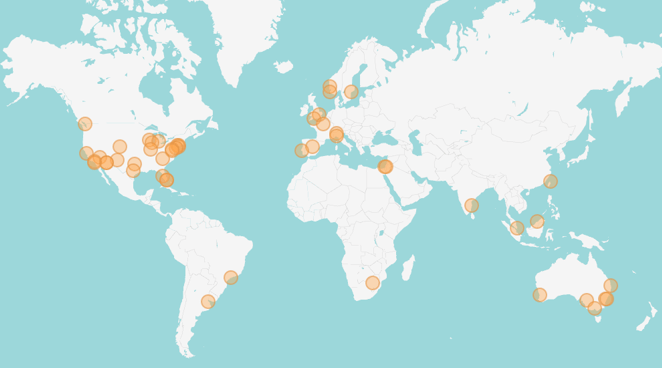
— Registrants for the 2017 SharpBrains Virtual Summit (December 5-7th) as of November 3rd, 2017
Just a quick update on how registration stands for the upcoming 2017 SharpBrains Virtual Summit: Brain Health & Enhancement in the Digital Age (December 5-7th).
We are proud to report that so far 130 experts, pioneers and practitioners are registered to participate.
95 seem to be based in the US and 35 abroad, based on IP address during registration, with the following country breakdown:
__________
Please consider joining us to explore the latest brain science and tech and market trends and to help shape Brain Health & Enhancement in the Digital Age.
For context, organizations represented in past Summits include: AARP, Alegent Health Immanuel Medical Center, Allstate Insurance, Alzheimer's Association, BBC, Bon Secours New York Health System, Brain Injury Association of America, Campbell Soup Company, Greenville Hospital System, Harvard Business Review, HealthComm Inc., Human Dimension Taskforce, US Army, Institute For The Future, Intel, Johnson & Johnson, Los Angeles County Dept of Public Health, McGovern Institute of Neurotechnology, MIT, National Resource Ctr. Osher Lifelong Learning Institutes, Nutrition Science Solutions, One Laptop Per Child, OptumHealth Behavioral Solutions, Piedmont Gardens, PsychologyToday, Procter & Gamble, Robert Wood Johnson Foundation, Stanford University, Sun Microsystems, UC Berkeley, UnitedHealth Group, Winter Park Health Foundation, Workers' Compensation Regulatory Authority, UCSF.
And the backgrounds of previous participants include: Biomedical Engineers, CEOs, Digital Media professionals, Entrepreneurs, Game publishers, Healthcare technologists, Marketing Executives, Medical Students, Neurologists, Neuropsychologists, Non profit board members, Occupational Therapists, Pharmaceutical Executives, Post doctorate researchers, Professors and Researchers, Psychiatrists, Psychologists, Psychotherapists, Scientific Publishers, Social Workers, Speech Pathologists, Talent management/HR, and Wellness professionals.
Looking forward to a great conference!
__________
Learn more & Reserve your Spot HERE
(10%-off promo code for SharpBrains readers: sharp2017)
Almost 10% of the world population suffers dyslexia. Establishing an early diagnosis would allow…

