Wednesday, November 18, 2015
Sharing Time knowledge acquisition in children aged 6 to 11 years and its relationship with numerical skills via BrowZine
Labrell, Florence; Mikaeloff, Yann; Perdry, Hervé; Dellatolas, Georges
Journal of Experimental Child Psychology, Vol. 143 – 2016: 1 - 13
10.1016/j.jecp.2015.10.005
University of Minnesota Users:
http://login.ezproxy.lib.umn.edu/login?url=http://www.sciencedirect.com/science/article/pii/S0022096515002416
Non-University of Minnesota Users: (Full text may not be available)
http://www.sciencedirect.com/science/article/pii/S0022096515002416
Accessed with BrowZine, supported by University of Minnesota.
Tuesday, November 17, 2015
Brain/cognitive training programs and transfer: More support for explanatory domain-general attentional control (AC) mechanism as significant key to effectivness
Abstract
- Objective: General intelligence is important for success in daily life, fueling interest in developing cognitive training as an intervention to improve fluid ability (Gf). A major obstacle to the design of effective cognitive interventions has been the paucity of hypotheses bearing on mechanisms underlying transfer of cognitive training to Gf. Despite the large amounts of money and time currently being expended on cognitive training, there is little scientific agreement on how, or even whether, Gf can be heightened by such training. Method: We review the relevant strands of evidence on cognitive-training-related changes in (a) cortical mechanisms of distraction suppression, and (b) activation of the dorsal attention network (DAN). We hypothesize that training-related increases in control of attention are important for what is termed far transfer of cognitive training to untrained abilities, notably to Gf. Results: We review the evidence that distraction suppression evident in behavior, neuronal firing, scalp electroencephalography, and hemodynamic change is important for protecting target processing during perception and also for protecting targets held in working memory. Importantly, attentional control also appears to be central to performance on Gf assessments. Consistent with this evidence, forms of cognitive training that increase ability to ignore distractions (e.g., working memory training and perceptual training) not only affect the DAN but also affect transfer to Gf. Conclusions: Our hypothesis is supported by existing evidence. However, to advance the field of cognitive training, it is necessary that competing hypotheses on mechanisms of far transfer of cognitive training be advanced and empirically tested. (PsycINFO Database Record (c) 2015 APA, all rights reserved)
Working memory capacity, mind wandering, and creative cognit...
|
| |||||||||||||||||||||||||||||||||||||
Monday, November 16, 2015
Wednesday, November 11, 2015
Article: Brain Rhythms Sync to Musical Beat
Brain Rhythms Sync to Musical Beat
http://www.scientificamerican.com/podcast/episode/brain-rhythms-sync-to-musical-beat/
Related topics: National Academy of Sciences, Stephin Merritt, The Brain
Sent via Flipboard, your personal magazine.
Get it for free to keep up with the news you care about.
Sunday, November 08, 2015
Article: Innovative Digital Medicine: Akili’s Project EVO Shows Promise for Children with ADHD
Innovative Digital Medicine: Akili's Project EVO Shows Promise for Children with ADHD
http://www.innovationexcellence.com/blog/2015/11/02/innovative-digital-medicine-akili-video-game-for-adhd-intervention/#sthash.atuijrja.dpuf
Related topics: Medicine, Game Design, ADHD
Sent via Flipboard, your personal magazine.
Get it for free to keep up with the news you care about.
Wednesday, November 04, 2015
Article: A Brain At Rest? Thoughts and Feelings in the "Resting State" - Neuroskeptic
A Brain At Rest? Thoughts and Feelings in the "Resting State" - Neuroskeptic
http://blogs.discovermagazine.com/neuroskeptic/2015/11/04/brain-rest-thoughts-feelings-in-the-resting-state/#.VjousKI12GQ
Related topics: Life Sciences, Neuroscience, Psychology
Sent via Flipboard, your personal magazine.
Get it for free to keep up with the news you care about.
Saturday, October 31, 2015
Article: A brief history of our desire to peer into the brain
A brief history of our desire to peer into the brain
http://www.bbc.com/future/story/20151028-a-brief-history-of-our-desire-to-peer-into-the-brain
Related topics: Neuroscience, Mind, Museums
Sent via Flipboard, your personal magazine.
Get it for free to keep up with the news you care about.
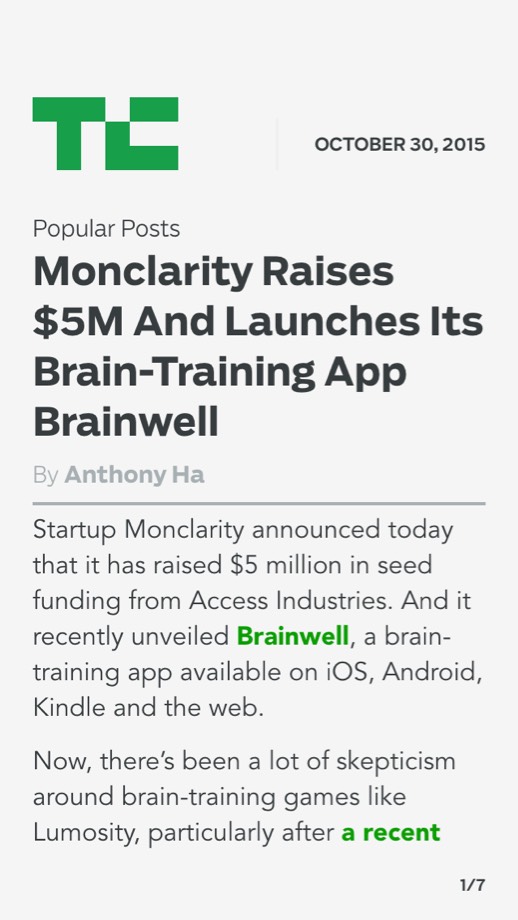
Article: Monclarity Raises $5M And Launches Its Brain-Training App Brainwell
Monclarity Raises $5M And Launches Its Brain-Training App Brainwell
http://techcrunch.com/2015/10/30/brain-and-brain-what-is-brain/
Shared from Technology on Flipboard, your personal magazine.
Get it for free to keep up with the news you care about.
Friday, October 16, 2015
Scientists call for network of “brain observatories” to accelerate neurotechnology research and innovation [feedly]
----
Scientists call for network of "brain observatories" to accelerate neurotechnology research and innovation
// SharpBrains
A national network of neurotechnology centers for the BRAIN Initiative (press release):
"The authors of the original proposal for the Brain Activity Map (BAM) Project, which inspired the White House's BRAIN Initiative, issued today a position statement in Neuron proposing the creation of a national network of neurotechnology centers. These "brain observatories" would enhance and accelerate the BRAIN Initiative by leveraging the success and creativity of individual laboratories to develop novel neurotechnologies.
The authors present evidence of past success of existing national center-scale science efforts such as those sponsored by the Department of Energy (DOE) with the Human Genome Project where the rate of return on investment was both economically impressive and scientifically invaluable.…They raise the question: why are neuroscientists are still expected to work in isolation in the 21st Century?
The BAM authors propose a network of national Neurotechnology Centers as centralized "hubs" to coalesce cross-disciplinary efforts from a spectrum of participants in academic labs, corporate partners and public and private research institutes."
Statement: A National Network of Neurotechnology Centers for the BRAIN Initiative (Neuron)
- Summary: We propose the creation of a national network of neurotechnology centers to enhance and accelerate the BRAIN Initiative and optimally leverage the effort and creativity of individual laboratories involved in it. As "brain observatories," these centers could provide the critical interdisciplinary environment both for realizing ambitious and complex technologies and for providing individual investigators with access to them.
- From the full text: … From the Several center-scale efforts in neuroscience have recently been embarked upon by private research foundations, such as the Allen Institute for Brain Science and the Howard Hughes Institute Janelia Farm campus; in certain respects, these initiatives might serve as potential models. However, while private-sector efforts will no doubt remain important participants in national efforts, they are necessarily limited in scope and focus. They are unlikely to assemble, manage, and sustain the deep and wide efforts needed for nucleating the technological revolution that we believe is possible. In fact, because the neurotechnology centers we advocate will ultimately benefit society at large, we believe they should exist within the public domain and be managed as a national resource. Jump-starting such national centers will require consensus among researchers, federal officials, and private organizations; to achieve this, inspired public leadership will be essential.
----
Shared via my feedly reader
Tuesday, October 13, 2015
Network 'hubs' in the brain attract information, much like airport system
http://www.psypost.org/2015/04/network-hubs-in-the-brain-attract-information-much-like-airport-system-33353
Shared by SumoMe ( http://sumome.com/ )
Monday, October 12, 2015
Article: Progress and Problems in Brain Mapping
Progress and Problems in Brain Mapping
http://jonlieffmd.com/blog/human-brain/progress-and-problems-in-brain-mapping
Related topics: The Brain, Neuroscience, Life Sciences
Sent via Flipboard, your personal magazine.
Get it for free to keep up with the news you care about.
Sunday, October 11, 2015
Article: The Brain's Central Planner
The Brain's Central Planner
http://scitechconnect.elsevier.com/the-brains-central-planner/?sf11921041=1
Related topics: The Brain, Prehistory, Evolution
Sent via Flipboard, your personal magazine.
Get it for free to keep up with the news you care about.
Friday, October 09, 2015
ISIR 2015 Keynote: Roberto Colom
| ||||||||||||||||||||||||||||||||
| |||||||||||||||||||||||||||||||||||||
Thursday, October 08, 2015
Audiovisual integration in musicians
| ||||||||||||||||||||||||||||||||||
| |||||||||||||||||||||||||||||||||||||
Friday, October 02, 2015
Article: A Massive Global Effort Maps How the Brain is Wired
A Massive Global Effort Maps How the Brain is Wired
http://www.scientificamerican.com/article/a-massive-global-effort-maps-how-the-brain-is-wired/
Related topics: The Brain, Scientific Research, Biomechanics
Sent via Flipboard, your personal magazine.
Get it for free to keep up with the news you care about.
Sunday, September 27, 2015
Article: The Brain Reimagined in Mind-Illuminating Portraits
The Brain Reimagined in Mind-Illuminating Portraits
https://www.braindecoder.com/the-brain-shines-in-new-artworks-1365894971.html
Related topics: The Brain, Neuroscience, Life Sciences
Sent via Flipboard, your personal magazine.
Get it for free to keep up with the news you care about.
Friday, September 25, 2015
Sharing From Brain Maps to Cognitive Ontologies: Informatics and the Search for Mental Structure via BrowZine
Poldrack, Russell A.; Yarkoni, Tal
Annual Review of Psychology, Vol. 67 Issue 1 – 2016:
10.1146/annurev-psych-122414-033729
University of Minnesota Users:
http://login.ezproxy.lib.umn.edu/login?url=http://www.annualreviews.org/doi/10.1146/annurev-psych-122414-033729
Non-University of Minnesota Users: (Full text may not be available)
http://www.annualreviews.org/doi/10.1146/annurev-psych-122414-033729
Accessed with BrowZine, supported by University of Minnesota.
Wednesday, September 23, 2015
Research Byte: Children's working memory stability is frequently fluctuating across tasks, time within a day, and across days
Click on image to enlarge for easier reading
This study that is a good reminder to us who engage in cognitive testing. What we may find during 1-1 clinical testing may not generalize 100% to real world. In this study, varying trait stability of working memory during normal school days was found to be significant, with more variability (lack of stability) for some individuals. I think teachers see this all the time. This could also suggest that maybe brain-based working memory training programs should be targeted at those children who show the most time-to-time variability in working memory.
Article: New Agendas for New Goals of the Prefrontal Cortex
New Agendas for New Goals of the Prefrontal Cortex
http://scitechconnect.elsevier.com/new-agendas-prefrontal-cortex/?sf12419160=1
Related topics: The Brain, Life Sciences, Neuroscience
Sent via Flipboard, your personal magazine.
Get it for free to keep up with the news you care about.
Saturday, September 19, 2015
Study: Neonatal MRI scans of preterm children can help predict cognitive and academic problems, and guide early interventions [feedly]
----
Study: Neonatal MRI scans of preterm children can help predict cognitive and academic problems, and guide early interventions
// SharpBrains
Predicting future cognition in preterm children with MRI (Oxford University Press blog):
"In the wake of the development of advanced neonatal intensive medical care, more and more children born preterm manage to beat the previously tough odds…While this is one of the success stories of modern medicine, long-term follow-up of premature-born pediatric cohorts show that…Many children will experience cognitive problems that will impede their performance when they start school…
One question that remains to be answered is the biological underpinnings of the cognitive difficulties experienced by preterm children…the brain alterations causing difficulties in school must be assumed to be already present when the children have gone through the neonatal period, long before they manifest in school difficulties. Our recently published study in Brain aimed to bring advanced analyses of MRI data to address the question of hidden predictors in preterm children…Not only could cognitive ability at five and seven years of age be predicted from the neonatal MRI, the effect also persisted after taking into account all clinical factors during the neonatal period that we previously know affect the prognosis of preterm children. The results illustrate how neonatal MRI of preterm children can be of practical benefit as it opens up a time window for interventions before the children start school."
Study: Neonatal MRI is associated with future cognition and academic achievement in preterm children (Brain). From the summary:
- School-age children born preterm are particularly at risk for low mathematical achievement, associated with reduced working memory and number skills. Early identification of preterm children at risk for future impairments using brain markers might assist in referral for early intervention. This study aimed to examine the use of neonatal magnetic resonance imaging measures derived from automated methods to predict skills important for mathematical achievement (working memory, early mathematical skills) at 5 and 7 years in a cohort of preterm children …Neonatal fractional anisotropy was positively associated with working memory and early mathematics at 5 years…In summary, we identified, in the preterm brain, regions around the insula and putamen using neonatal deformation-based morphometry, and brain microstructural organization using neonatal diffusion tensor imaging, associated with skills important for childhood mathematical achievement. Results contribute to the growing evidence for the clinical utility of neonatal magnetic resonance imaging for early identification of preterm infants at risk for childhood cognitive and academic impairment.
Learn more:
----
Shared via my feedly reader
Wednesday, September 16, 2015
Sharing The attentional cost of receiving a cell phone notification. via BrowZine
Stothart, Cary; Mitchum, Ainsley; Yehnert, Courtney
Journal of Experimental Psychology: Human Perception and Performance, Vol. 41 Issue 4 – 2015: 893 - 897
10.1037/xhp0000100
University of Minnesota Users:
http://login.ezproxy.lib.umn.edu/login?url=http://doi.apa.org/getdoi.cfm?doi=10.1037/xhp0000100
Non-University of Minnesota Users: (Full text may not be available)
http://doi.apa.org/getdoi.cfm?doi=10.1037/xhp0000100
Accessed with BrowZine, supported by University of Minnesota.
Tuesday, September 01, 2015
Article: Monitoring & Enhancing Brain Health in the Pervasive Neurotechnology Era (November 17-19th, 2015)
Monitoring & Enhancing Brain Health in the Pervasive Neurotechnology Era (November 17-19th, 2015)
http://sharpbrains.com/summit-2015/
Related topics: The Brain, Life Sciences, Neuroscience
Sent via Flipboard, your personal magazine.
Get it for free to keep up with the news you care about.
Article: How Does a Gymnast, or Even a Fitness Walker, Keep from Falling?
How Does a Gymnast, or Even a Fitness Walker, Keep from Falling?
http://blogs.scientificamerican.com/talking-back/how-does-a-gymnast-or-even-a-fitness-walker-keep-from-falling/
Related topics: The Brain, Exercise Science, Exercise
Sent via Flipboard, your personal magazine.
Get it for free to keep up with the news you care about.
Tuesday, August 18, 2015
How Your Executive Functioning Impacts Me: Findings From a N...
| ||||||||||||
|
|
|
| |||||
| |||||||||||||||||||||||||||||||||||||
The billion dollar question: Under what conditions can brain...
| ||||||||||||
|
|
|
| |||||
| |||||||||||||||||||||||||||||||||||||