Sharp Brains has a nice explanatory post (Why do you turn down the radio when you're lost?) re: an aspect of executive functioning that most likely plays a role in mental time-keeping and SMT-based interventions...namely, divided attention.
Technorati Tags: psychology, educational psychology, neuropsychology, neuroscience, mental time keeping, interval time, interactive metronome, attention, divided attention, executive function, brain clock, internal brain clock, master brain clock

Understanding the human brain clock & related neuroscience
Saturday, November 11, 2006


Thursday, November 09, 2006
Mental time keeping scholar - Dr. John Wearden

In a prior post I announced the IQ Brain Clock blog "Mental Timing Scholars" link section. I've now expanded this scholar honor roll to three reseachers (Meck, Lewis, and now Wearden). This post is to highlight Dr. John Wearden's program of research.
Below is a statement (lifted from his faculty web page) re: his mental interval time-keeping program of research. He is a scholar whose research this blog will monitor and summarize at it becomes available. What I very much appreciate, and readers of this blog should "check out"...is his list of publications...which includes links to pdf copies of all articles (so you can read and view everything he has done). Kudos to Dr. Wearden.
- For the last 15-20 years I have worked more or less exclusively on the perception of time. A specific area of interest has been the application of scalar timing theory (SET), originally developed as an explanation of timing in animals, to studies of time perception in humans. SET is an internal-clock-based model of timing, but in addition involves short- and long-term memory components, and decision processes. My research has investigated all these areas: studies of “speeding up” and “slowing down” the pacemaker of the clock (both with adults and children), studies of working memory and “reference” memory for duration, and manipulation of decision processes involved in timing. The most recent research involves attempts to control the operation of the putative internal clock, work on all sorts of memory for duration, and attempts to manipulate the “references” that people use when making time judgements. I have been involved in studies of timing in children, elderly people, patients with Parkinson's disease and, most recently, schizophrenia. An additional area of interest is animal timing. Although I do not carry out experiments on animals, I am engaged in computer and mathematical models of animal timing, as well as other theoretical issues. In general, a substantial proportion of my output is theoretical, mainly using computer modelling to test theories derived from SET, but also other areas such as modelling the process of chronometric counting. I have long-standing collaborations with researchers at the University of Liège in Belgium , and the University Blaise-Pascal in Clermont-Ferrand , France , and have recently begun a collaboration with researchers at the Hopital St. Anne in Paris .
- I hope to begin an extensive research programme on timing in the elderly, in particular the question of why distortions of subjective time in everyday life are so frequently mentioned by old people, and what these reports mean. Conventional laboratory studies of timing in the elderly find fairly consistent, albeit small, changes in time perception with age, albeit changes which seem far too slight to account for the subjective reports of older people. In a recent article, I have argued that much previous research on timing in old people (including my own) is “barking up the wrong tree”, and that novel methodologies are needed if old people's time experiences are to be properly understood. Some work in this area can be done with student participants, and preliminary data on some potentially relevant variables has already been collected.
Technorati Tags: psychology, educational psychology, cognition, school psychology, neuropsychology, neuroscience, neurology, intelligence, IQ, interval timing, mental timing, brain timing, master clock, brain clock, IQ Brain Clock.temporal tracking, temporal processing,Interactive Metronome,scalar timing
Teach your brain to stretch time
In my late night web searching I ran across an excellent summary news article that does a decent job of summarizing the broad strokes of contemporary mental time-keeping research. The article "Teach your brain to stretch time" was published at New Scientist.com.
The article highlights the pacemaker-accumulator model of timing and also indicates that another alternative model (coincidence detection model) is gaining status among mental time-keeping researchers. I hope to provide a brief summary of the coincidence detection model sometime soon.
This news type summary article does a good job of summarizing the gist of the major mental time-keeping research. It is worth the read and is a good non-technical article to share with others.
Technorati Tags: psychology, educational psychology, cognition, school psychology, neuropsychology, neuroscience, neurology, intelligence, IQ, interval timing, mental timing, brain timing, master clock, brain clock, IQ Brain Clock.temporal tracking, temporal processing,Interactive Metronome,scalar timing
The article highlights the pacemaker-accumulator model of timing and also indicates that another alternative model (coincidence detection model) is gaining status among mental time-keeping researchers. I hope to provide a brief summary of the coincidence detection model sometime soon.
This news type summary article does a good job of summarizing the gist of the major mental time-keeping research. It is worth the read and is a good non-technical article to share with others.
Technorati Tags: psychology, educational psychology, cognition, school psychology, neuropsychology, neuroscience, neurology, intelligence, IQ, interval timing, mental timing, brain timing, master clock, brain clock, IQ Brain Clock.temporal tracking, temporal processing,Interactive Metronome,scalar timing
Tuesday, November 07, 2006
Mental interval timing interventions - feature on IM
To date, the only intervention I'm aware of, that appears to deal with fine-tunning the brain's master mental/interval timing clock, is Interactive Metronome, a synchronized metronome tapping intervention. [Click here to see potential conflicts of interest - primarily being paid to be an external project evaluation consultant on a study].
For those unfamiliar with the IM method, a brief introductory video can be found at the IM site (click here).
At this time, I'm making a request of readers of this blog. If you know of other brain-based brain-fitness programs that focus on fine-tuning the minds master internal clock, or, indirectly appear to have an impact on the minds internal clock, please drop me a note. I want to find as many interventions relevant to this area of study as possible. Either post a "comment" at this blog or email me at: iap@earthlink.net
Thanks
Technorati Tags: psychology, educational psychology, cognition, school psychology, neuropsychology, neuroscience, neurology, intelligence, IQ, interval timing, mental timing, brain timing, master clock, brain clock, IQ Brain Clock.temporal tracking, temporal processing,Interactive Metronome,scalar timing
For those unfamiliar with the IM method, a brief introductory video can be found at the IM site (click here).
At this time, I'm making a request of readers of this blog. If you know of other brain-based brain-fitness programs that focus on fine-tuning the minds master internal clock, or, indirectly appear to have an impact on the minds internal clock, please drop me a note. I want to find as many interventions relevant to this area of study as possible. Either post a "comment" at this blog or email me at: iap@earthlink.net
Thanks
Technorati Tags: psychology, educational psychology, cognition, school psychology, neuropsychology, neuroscience, neurology, intelligence, IQ, interval timing, mental timing, brain timing, master clock, brain clock, IQ Brain Clock.temporal tracking, temporal processing,Interactive Metronome,scalar timing
IQs Corner Headlines from the mind and brain blogsphere 11-7-06
FYI. Readers of the IQ Brain Clock Blog (this blog) may find my frequent posting of IQs Corner Headlines from the mind and brain blogsphere of interest. Briefly, the headlines I post allow readers to see more of the topics that I select from when monitoring different blogs related to the purpose of IQs Corner. More importantly, the links to the stories are included in the "headlines" and you can rummage around these other blog posts at your leisure. Some of these will interest folks of IQ Brain Clock. Check it out, and if you like it, keep regular tabs on IQs Corner.
Technorati Tags: psychology, educational psychology, cognition, school psychology, neuropsychology, neuroscience, neurology, intelligence, IQ, interval timing, mental timing, brain timing, master clock, brain clock, IQ Brain Clock.temporal tracking, temporal processing,Interactive Metronome,scalar timing
Technorati Tags: psychology, educational psychology, cognition, school psychology, neuropsychology, neuroscience, neurology, intelligence, IQ, interval timing, mental timing, brain timing, master clock, brain clock, IQ Brain Clock.temporal tracking, temporal processing,Interactive Metronome,scalar timing
Sunday, November 05, 2006
Mental timing scholar feature: Dr. Penny Lewis
 In a prior post I announced the IQ Brain Clock blog "Mental Timing Scholars" link section. One of the two (I'm sure there are more...this "honor roll" will be updated) researchers is Dr. Penny Lewis, at the University of Manchester.
Below is a statement (lifted from her faculty web page) re: her mental interval time-keeping program of research. She is a scholar whose research this blog will monitor and summarize at it becomes available.
- "Time measurement is fundamental to almost everything we do: music and speech, for instance, are just time-coded variations in sound, and movements are carefully timed contractions of muscles. We perceive our lives as a flow of events in time, and plan our futures in the same way. If our timing system gets damaged, as it does in patients with Parkinson’s Disease, Schizophrenia, and certain types of brain injury, all of these abilities can be impaired. A fundamental question about time measurement is whether we have just one mental clock or a number of different clocks for timing in this range. I am using fMRI and temporary brain lesions induced using Transcranial Magnetic Stimulation (TMS) to address this question. To date, my findings support the existence of two quite distinct systems for automatic and cognitively controlled timing. Future work will clarify this picture and provide more information about how each system works."
Technorati Tags: psychology, educational psychology, cognition, school psychology, neuropsychology, neuroscience, neurology, intelligence, IQ, interval timing, mental timing, brain timing, master clock, brain clock, IQ Brain Clock.temporal tracking, temporal processing,Interactive Metronome,scalar timing
Saturday, November 04, 2006
New IQ Brain Clock blog features: Blogroll and "scholars"
This evening I've added two new features to the Tick Tock Talk: IQ Brain Clock blog. On the right-hand side of the blog you will find the "blogroll" and "mental timing scholars."
I simply lifted the neuroscience-related links I include at my mother-ship blog (IQs Corner) and placed them here. The "scholars" section simply reflects those researchers I've found via my reading in this area..and they appear to be top-notch researchers in mental time keeping.
At this time I'm asking for help. I'd like folks to send me (either via the blog "comment" feature of this blog; or via my email [iap@earthlink.net]) other blogs to consider adding to the blogroll and nominations (with URL's to web pages if possible) of researchers/scholars who are doing important research in this area.
Thanks.
Technorati Tags: psychology, educational psychology, cognition, school psychology, neuropsychology, neuroscience, neurology, intelligence, IQ, interval timing, mental timing, brain timing, master clock, brain clock, IQ Brain Clock.temporal tracking, temporal processing,Interactive Metronome,scalar timing
I simply lifted the neuroscience-related links I include at my mother-ship blog (IQs Corner) and placed them here. The "scholars" section simply reflects those researchers I've found via my reading in this area..and they appear to be top-notch researchers in mental time keeping.
At this time I'm asking for help. I'd like folks to send me (either via the blog "comment" feature of this blog; or via my email [iap@earthlink.net]) other blogs to consider adding to the blogroll and nominations (with URL's to web pages if possible) of researchers/scholars who are doing important research in this area.
Thanks.
Technorati Tags: psychology, educational psychology, cognition, school psychology, neuropsychology, neuroscience, neurology, intelligence, IQ, interval timing, mental timing, brain timing, master clock, brain clock, IQ Brain Clock.temporal tracking, temporal processing,Interactive Metronome,scalar timing
Synchronized metronome tapping (SMT) and the automatic/controlled timing systems of the brain
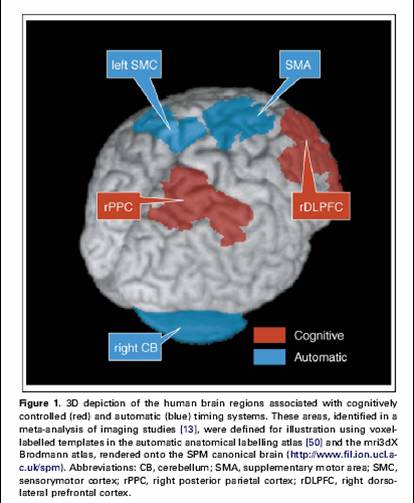
In a prior post, I highlighted a distinction contemporary mental time-keeping researchers make regarding two general types of human timing systems. Briefly, the automatic timing system works in the millisecond range of time, is used in discrete-event (discontinuous) timing, and involves the cerebellum. This contrasts with the continuous-event, cognitively controlled timing system that requires attention and involves the basal ganglia and related cortical structures.
In their article, Lewis and Maill (2006) provide further clarification of how they perceive differences between these two mental timing systems. According to Lewis and Maill, "it is not any single characteristic, but rather a constellation of several characteristics which determines which timing system is recruited in any particular task." The three task characteristics isolated by these researchers are: (a) the duration measured, (b) whether or not the timed intervals were defined by movement and, (c) whether timing was continuous (e.g. an unbroken series of predictable intervals) or intermittent (e.g. broken into discrete measurements by the presence of unpredictable irregular intervals).
Lewis and Maill conclude that "our analysis showed that having any two out of the three characteristics associated with a task type (cognitive or automatic) dramatically increased the probability that the areas associated with that timing system would be recruited. Accordingly, we can think of any task having two or more cognitive attributes (e.g. measuring more than a second, discontinuously, and without relying upon movement) as a ‘cognitively controlled timing task’, and any task with two or more of the opposing characteristics as an ‘automatic timing task’."
How does this apply to understanding the brain structures and functions involved in SMT (synchronized metronome tapping; e.g., Interactive Metronome)? [click here for from info on SMT and IM and my necessary conflict of interest disclosures...just follow the link trails].
Given my understanding (and one personal experience with an SMT intervention), I would hypothesize that SMT interventions most likely tap both the automatic and controlled cognitive timing systems (and related neurological structures and functions). SMT-based interventions typically invovle a motor component (e.g., clapping hands together to the beat), a continuous tone interval, and require responding in terms of milliseconds. These characteristics definetely would be associated with the automatic timing system.
However, although an individual (during SMT training) is trying to synchronoize their tapping in terms of milliseconds, the duration between the continuous tones is more in the range of a second or so. Also, expecially during initial stages of SMT, an individual's working memory [see prior post on the pacemaker accumulator model of mental time-keeping] is partcularly taxed as one monitors the SMT visual and/or auditory feedback provided, makes a decision about whether they are responding "too fast" or "too slow", and then conciouslly implements a correction to their "beat" behavior. These later characteristics are more characteristic of the cognitively controlled timing system.
So...it is my hypothesis that both the automatic and cognitively controlled timing systems of mental or interval time-keeping are inolved with SMT-based interventions. It is possible that both are significantly active during early stages of SMT training and, with improvement and progress over time, the role of the cognitively controlled system decreases and the automatic system is more responsible. These are only hypothesis and need empirical study.
- Lewis, P. & Miall, C (2006). Remembering the time: a continuous clock. Trends in Cognitive Sciences, 10(9), 401-406.
Technorati Tags: psychology, educational psychology, cognition, school psychology, neuropsychology, neuroscience, neurology, intelligence, IQ, interval timing, mental timing, brain timing, master clock, brain clock, IQ Brain Clock.temporal tracking, temporal processing,Interactive Metronome,scalar timing
Blogging as a form of brain fitness training
This is a bit off task for The IQ Brain Clock blog, but, heck....I'm the blog dictator and can do what I want :)
Over on my other blog (IQs Corner) I just posted some interesting information about the potential cognitive/brain enhancements that might result from blogging.
Technorati Tags: psychology, educational psychology, school psychology, neuropsychology, neuroscience, idea production, ideational fluency, ideaphoria, CHC, CHC theory of intelligence, intelligence, IQ, blogging, blog, neuroplasticity, brain fitness, IQs Corner, Idealawg, Eide Neurolearning Blog, brain fitness
powered by performancing firefox
Over on my other blog (IQs Corner) I just posted some interesting information about the potential cognitive/brain enhancements that might result from blogging.
Technorati Tags: psychology, educational psychology, school psychology, neuropsychology, neuroscience, idea production, ideational fluency, ideaphoria, CHC, CHC theory of intelligence, intelligence, IQ, blogging, blog, neuroplasticity, brain fitness, IQs Corner, Idealawg, Eide Neurolearning Blog, brain fitness
powered by performancing firefox
Cognitive Neuroscience and ADD/ADHD - from SharpBrains
Thanks to Sharp Brains for the post summarizing some of the recent developments regarding our understanding of brain structures and functions (role of frontal lobes; executive functioning; etc) and treatment (via brain fitness programs) of ADD/ADHD
SharpBrains continues to be great source for information regarding the use of neurotechology to enhance cognitive functioning.
Technorati Tags: psychology, educational psychology, neuropsychology, neuroscience, neurology, brain, brain fitness, cognition, cognitive, neuroplasticity, intelligence, IQ, ADD, ADHD, executive functioning, frontal lobes, CHADD, Cogmed, Sharp Brains, IQ Brain Clock
SharpBrains continues to be great source for information regarding the use of neurotechology to enhance cognitive functioning.
Technorati Tags: psychology, educational psychology, neuropsychology, neuroscience, neurology, brain, brain fitness, cognition, cognitive, neuroplasticity, intelligence, IQ, ADD, ADHD, executive functioning, frontal lobes, CHADD, Cogmed, Sharp Brains, IQ Brain Clock
powered by performancing firefox
FYI - growth factor for motor neurons
An interesting story over at Science Daily re: a positive report of a growth factor that may stimulate the rapid extension of key motor neurons in the brain.
Technorati Tags: psychology, educational psychology, neuropsychology, neuroscience, neurology, brain, neurons, growth factor, Science Dailey, IQ Brain Clock, neuroplasticity
Technorati Tags: psychology, educational psychology, neuropsychology, neuroscience, neurology, brain, neurons, growth factor, Science Dailey, IQ Brain Clock, neuroplasticity
powered by performancing firefox
Friday, October 27, 2006
Brain fitness program benefits elderly?
Thanks to the Mouse Trap for the FYI about a study that demonstrated a brain plasticity-based program let to significant specific cognitive improvements in elderly
Technorati Tags: psychology, educational psychology, neuropsychology, intelligence, IQ, cognition, cognitive, brain, brain fitness, plasticity, brain plasticity, brain training, IQ Brain Clock
Technorati Tags: psychology, educational psychology, neuropsychology, intelligence, IQ, cognition, cognitive, brain, brain fitness, plasticity, brain plasticity, brain training, IQ Brain Clock
powered by performancing firefox
Working memory for familiar and novel information

Developing Intelligence beat me to the blogsphere with a post regarding a new article in Trends in Cognitive Scienes that explores possible neural mechanisms involved in working memory processing of familiar and novel information. Thanks DI. I really did have this article set aside for some comments.
My contribution will be to post a figure from the article (above) as well as provide a direct link to the article.
Technorati Tags: psychology, educational psychology, neuropsychology, neuroscience, intelligence, IQ, working memory, memory, Gsm, short-term memory
powered by performancing firefox
Thursday, October 26, 2006
Looking for comments, ideas, and feedback: Suggestion box is open
 To date I, as the IQ Brain Clock blog dictator, have been posting information that I think is exciting, informative, etc. I'd like to make this blog useful to a wide variety of professionals and scholars who have an interest in mental time keeping and the application of neuroscience research to cognition and learning.
If anyone has ideas for material I should be paying attention to (articles, researchers, web pages, other blogs, etc.), ideas for posts, self-nominations for guest posts by yourself, etc., please drop me a note in the blog "comment" feature or, email me at iap@earthlink.net.
I'm particularly interested (at this time) in finding neurotechnology-based programs that focus on improving human performance (in any domain) via attempts to increase the efficiency of the master mental interval timing clock.
Technorati Tags: psychology, educational psychology, cognition, school psychology, neuropsychology, neuroscience, neurology, intelligence, IQ, interval timing, mental timing, brain timing, master clock, brain clock, IQ Brain Clock.temporal tracking, temporal processing,Interactive Metronome,scalar timing
Mental time keeping and human speech
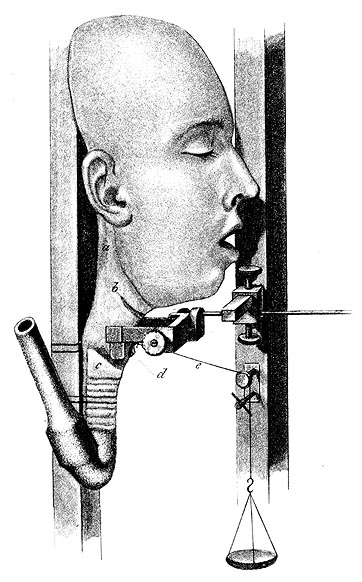 Earlier today I made an FYI post (with link to article) dealing with the role of the timing function of the auditory brainstem in speech. This reminded me of an article in a recent special issue of Cognitive Brain Research that reviewed recent neuroscience research (lesion and neuroimaging) that investigated the role of timing in human speech.
- Schirmer, A (2004). Timing speech: a review of lesion and neuroimaging findings. Cognitive Brain Research, 21, 269–287 (click to view)
Because the preponderance of mental interval time-keeping research consistently is pointing to the "master internal brain clock" being localized in the same general areas; particularly the basal ganglia, cerebullum, dorsolateral prefrontal cortex, and the frontial-striatal loop (Buhusi & Meck; 2005; Janata & Grafton, 2003; Nobre & O’Reilly, 2004; Peretz & Zatorre, 2005). Schimer concludes that the "BG [basal ganglia] and the cerebellum might perform more general timing operations that feed into other cognitive processes such as the processes specific to speech." In other words, Shimer is arguing for a domain-general, brain-based, mental time-keeper that functions in synchrony with possible domain-specific cognitive mechanisms specific to speech behavior.
Abstract
- Time is a fundamental dimension of behavior and as such underlies the perception and production of speech. This paper reviews patient and neuroimaging studies that investigated brain structures that support temporal aspects of speech. The left-frontal cortex, the basal ganglia, and the cerebellum represent structures that have been implicated repeatedly. A comparison with the structures involved in the timing of nonspeech events (e.g., tones, lights, finger movements) suggests both commonalities and differences: while the basal ganglia and the cerebellum contribute to the timing of speech and non-speech events, the contribution of left-frontal cortex seems to be specific to speech or rapidly changing acoustic information. Motivated by these commonalities and differences, this paper presents assumptions about the function of basal ganglia, cerebellum, and cortex in the timing of speech.
powered by performancing firefox
Role of auditory brainstem timing in speech
Thanks to SCLin's neuroscience blog for the tip about an article in the Journal of Neuroscience that implicates the role of auditory brainstem timing and speech. (Click here to view article)
Technorati Tags: psychology, educational psychology, neuropsychology, neuroscience, speech, language, intelligence, IQ, cognition, cognitive, brain clock, mental timing, interval timing, brainsteam, auditory brainstem, mental clock
powered by performancing firefox
Technorati Tags: psychology, educational psychology, neuropsychology, neuroscience, speech, language, intelligence, IQ, cognition, cognitive, brain clock, mental timing, interval timing, brainsteam, auditory brainstem, mental clock
powered by performancing firefox
Wednesday, October 25, 2006
Automatic vs cognitively controlled cognitive timing: Plus working memory link
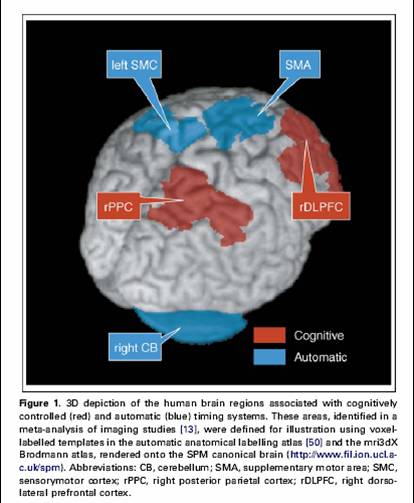
[Double click on image to enlarge]
Contemporary research (Buhusi & Meck, 2005; Lewis & Miall, 2006) supports the idea that there are two mental timing circuits that can be dissociated: (1) an automatic timing system that works in the millisecond range, which is used in discrete-event (discontinuous) timing, and involves the cerebellum; and (2) a continuous-event, cognitively controlled timing system that requires attention and involves the basal ganglia and related cortical structures.The above figure, which is based on a meta-analysis of studies (see Lewis & Miall, 2006), provides neurological evidence for two such systems via the localization of each system in different parts of the brain. What I (as a cognitive psychologist with a primary interest in psychological testing and theories of intelligence-see IQs Corner) find particularly intriguing is the conclusion (as reported in the Lewis & Miall, 2006 article as well as many other articles I've read) that the primary brain region associated with the cognitively controlled timing system is that also primarily associated with working memory--the dorsolateral prefrontal cortex (DLPFC).
More on this potentially important relationship in future posts.
- Buhusi, W. & Meck, C. (Oct, 2005). What makes us tick: Functional and neural mechanism of interval timing. Nature Reviews: Neuroscience, 6, 755-765
- Lewis, P. & Miall, C (2006). Remembering the time: a continuous clock. Trends in Cognitive Sciences, 10(9), 401-406.
Technorati Tags: psychology, educational psychology, cognition, school psychology, neuropsychology, neuroscience, neurology, intelligence, IQ, interval timing, mental timing, brain timing, master clock, brain clock,temporal processing,Interactive Metronome,scalar timing,working memory,prefrontal cortex,Gsm
Introduction to pacemaker-accumulator mental time-keeping model
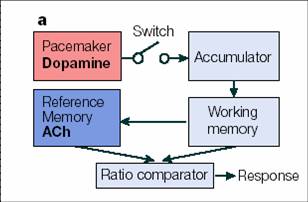
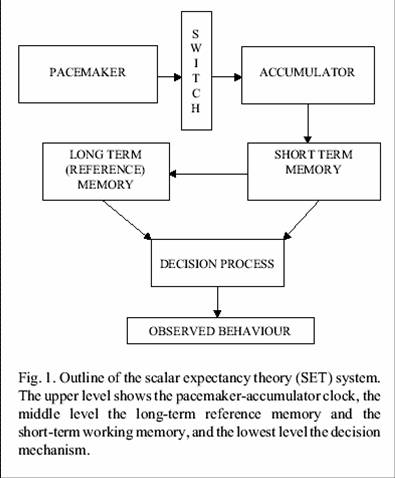 I previously made a couple of tease posts re: the predominant theoretical model of mental interval time-keeping (viz., the pacemaker-accumulator model). It is now time to "buck up" and provide my brief overview. Above is the best figure I've found to date (click here to see the original source article).
Human behavior based on the perception and timing in the range of seconds-to-minutes has traditionally been explained bythe pacemaker–accumulator model. The pacemaker-accumulator model (PAM), which is based on scalar expectancy or timing theory (Church, 1984; Gibbon et al., 1984; Meck, 1983), “is relatively straightforward, and provides powerful explanations of both behavioural and physiological data” (Buhusi & Meck, 2005; p. 755).
Briefly, the PAM model implicates the processing of temporal information via three synchronized modular information processing systems (see Buhusi & Mech, 2005.) The “clock” system consists of a dopaminergic pacemaker that regularly generates or emits neural ticks or pulses that are transferred (via a “gaiting” switch) to the accumulator, which accumulates ticks/pulses (neural counting) that correspond to a specific time interval. The raw representation of the stimulus duration in the accumulator is then transferred to working memory, a component of the PAM “memory” system. The contents of working memory are then compared against a “reference standard” in the long-term (reference) memory, the second component of the PAM memory system. Finally, the “decision” level of the PAM is conceptualized to consist of a comparator that determines an appropriate response based on a decision rule which involves a comparison between the interval duration value present in working memory and the corresponding duration value in reference memory. In other words, a comparison is made between the contents of reference memory (the standard) and working memory (viz., are they “close?”).
Considerable research evidence suggests that the PAM could be conceptualized as domain-general master internal clock central to many complex human behaviors (see Buhusi & Meck, 2005 and Lewis & Miall, 2006). Mental interval time-keeping and temporal processing research has suggested that a higher mental clock rate enables individuals to perform specific sequences of mental operations faster and reduces the probability of occurrence of interfering incidents (i.e., less disinhibition), two conditions that produce superior performance on cognitive tasks as well as more efficient basic information processing skills (Rammsayer & Brandler, in press).
Technorati Tags: psychology, educational psychology, cognition, school psychology, neuropsychology, neuroscience, neurology, intelligence, IQ, interval timing, mental timing, brain timing, master clock, brain clock, IQ Brain Clock.temporal tracking, temporal processing,Interactive Metronome,scalar timing
Tuesday, October 24, 2006
Neuroimaging of interval timing: Special issue of Cognitve Brain Research
I just ran across a special issue of Cognitive Brain Research devoted to "neuroimaging of interval timing.". The editorial introduction reference is listed below, along with a link to the editorial. A copy of the table of contents can also be found by clicking here.
If any readers of The IQ Brain Clock blog would like to examine any of the particular articles, I would willing to provide a copy, in exchange for a guest blog post (i.e., I'll send the article in exchange for a brief blog post about the contents of the article. Contact me via email if this is of interest -- iap@earthlink.net)
Technorati Tags: psychology, educational psychology, cognition, school psychology, neuropsychology, neuroscience, neurology, intelligence, IQ, interval timing, mental timing, brain timing, master clock, brain clock, IQ Brain Clock.temporal tracking, temporal processing,Interactive Metronome,Cognitive Brain Research
If any readers of The IQ Brain Clock blog would like to examine any of the particular articles, I would willing to provide a copy, in exchange for a guest blog post (i.e., I'll send the article in exchange for a brief blog post about the contents of the article. Contact me via email if this is of interest -- iap@earthlink.net)
- Meck, W. & Malapan, C. (2004). Editorial Neuroimaging of interval timing. Cognitive Brain Research, 21,133– 137. (click here to view)
- Exactly how the brain is able to measure the durations of events lasting from seconds to minutes while maintaining time-scale invariance remains largely a mystery. Neuroimaging studies are only now beginning to unravel the nature of interval timing and reveal whether different timing mechanisms are required for the perception and production of sub- and supra-second intervals that can be defined by different stimulus modalities. We here review the impact that neuroimaging studies have had on the field of timing and time perception and outline the major challenges that remain to be addressed before a physiologically realistic theory of interval timing can be established involving cortico-striatalcircuits.
Technorati Tags: psychology, educational psychology, cognition, school psychology, neuropsychology, neuroscience, neurology, intelligence, IQ, interval timing, mental timing, brain timing, master clock, brain clock, IQ Brain Clock.temporal tracking, temporal processing,Interactive Metronome,Cognitive Brain Research
powered by performancing firefox
Sunday, October 22, 2006
Off task - Free hugs
This is WAY off task for this blog.
I ran across one of the more popular videos being viewed on YouTube and it hit a personal chord (Free Hugs Campaign). Don't ask me why. I think the music (by Sick Puppies) resonated to something inside me. Also, given all the partisian political bickering (here in the US) as we approach the mid-term elections and the stuff going on in the world (Iraq, N. Korea, school violence, etc.), sometimes one person can make a difference.
Technorati Tags: psychology, educatonal psychology, neuropsychology, neuroscience, intelligence, IQ, school psychology, education, hugs, love, free hugs, hugs, hugging, YouTube, free hugs campaign, Sick Puppies
I ran across one of the more popular videos being viewed on YouTube and it hit a personal chord (Free Hugs Campaign). Don't ask me why. I think the music (by Sick Puppies) resonated to something inside me. Also, given all the partisian political bickering (here in the US) as we approach the mid-term elections and the stuff going on in the world (Iraq, N. Korea, school violence, etc.), sometimes one person can make a difference.
Technorati Tags: psychology, educatonal psychology, neuropsychology, neuroscience, intelligence, IQ, school psychology, education, hugs, love, free hugs, hugs, hugging, YouTube, free hugs campaign, Sick Puppies
powered by performancing firefox
Friday, October 20, 2006
Application of cognitive neuroscience research to education: Good overview/intro article
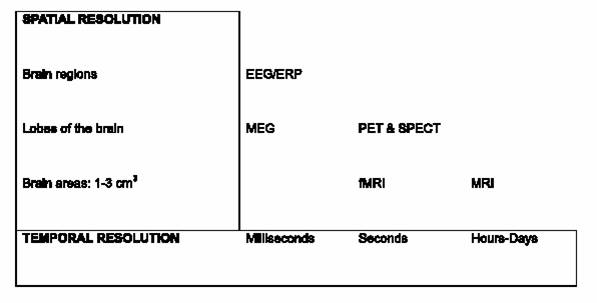 Following up on yesterday's small burst of posts regarding the fact/fiction surrounding the implications of brain-based (i.e., based on neuroscience) for education, I found the following very good overview article. Although not exhaustive or a definitive statement of the state-of-the-art of the neuroscience of education, I think this is a very good introductory overview article. I found the overview of neuroscience methods particulary good. I had not appreciated the differential sensitivity of different brain study methodologies as a function of temporal and spatial sensitivity (see above figure). Readers interested in the application of neuroscience research to the study of severe reading (dyslexia) and math (dyscalculia) disabilities will find the later half of the article interesting, although I believe these disability-related reviews are more illustrative than definitive (does not integrate all relevant neuroscience research findings regarding these forms of learning disabilites)
- Katzir, T & Paré-Blagoev, J. (2006) Applying Cognitive Neuroscience Research to Education: The Case of Literacy. Educational Psychologist, 41(1`), 53,74 (click here to view)
- Neuroscience has provided fascinating glimpses into the brain’s development and function. Despite remarkable progress, brain research has not yet been successfully brought to bear in many fields of educational psychology. In this article, work on literacy serves as a test case for an examination of potential future bridges linking mind, brain, and educational psychology. This article proposes a model for integrating research in the cognitive neurosciences with educational psychology and reviews how neuroscience is providing new data relevant to 3 major controversies in the field of dyslexia. This article also discusses the relevance of these findings for psychoeducational assessment and instruction and suggests innovative venues for interdisciplinary research.
powered by performancing firefox
Neuroscience of learning (brain-based learning): Posts moving to The IQ Brain Clock
FYI. The following post was just made to IQs Corner blog. Long story short....posts related to the neuroscience of learning (esp. in education) will now be made to The IQ Brain Clock blog (what you are now reading)
Technorati Tags: psychology, educational psychology, education, school psychology, learning, brain, brain-based learning, neuropsychology, neuroscience, cognition, cognitive, right brain, left brain, gender diferences
- Yesterday's posts (click here, here) dealing with facts and fictions regarding brain-based learning in education, plus the response of SharpBrains, set me off digging through my electronic library of professional articles...in search of articles on the use of neuroscience in learning in education. I found a number of good overview articles that I will comment and post shortly.
- However, it dawned on me that this line of research is probably more consistent with the focus of my new blog (Tick Tock Talk: The IQ Brain Clock). Thus, this note is to inform regular IQs Corner readers that I'm going to start shifting posts focused on the neuroscience of learning over to The IQ Brain Clock Blog. I will likely also broaden the definition and purpose of that blog.
Technorati Tags: psychology, educational psychology, education, school psychology, learning, brain, brain-based learning, neuropsychology, neuroscience, cognition, cognitive, right brain, left brain, gender diferences
powered by performancing firefox
Thursday, October 19, 2006
Free on-line Metronome
 Thanks to the Download Squad for the FYI regarding a free on-line Metronome.
Technorati Tags: metronome, Interactive Metronome, music, interval timing, mental time keeping, master internal clock, temporal processing, cognition, cognitive, music
powered by performancing firefox
Wednesday, October 18, 2006
Mental time-keeping model "tease" # 2
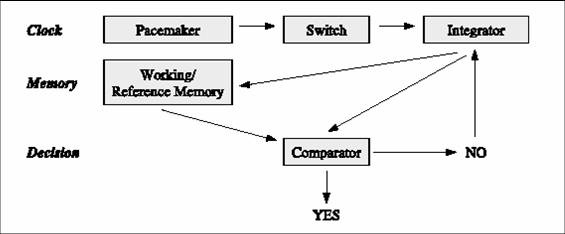
Another blog tease :)...sorry. (click here to see tease post #1)
The above figure is another variation of the most prominent model of mental time keeping, namely....the pacemaker-accumulator model of timing based on scalar expectancy/timing theory. As in my prior tease post, I hope to describe the basics of this model in a series of blog posts...I just need to find the "time."
Technorati Tags: psychology, educational psychology, cognition, school psychology, neuropsychology, neuroscience, neurology, intelligence, IQ, interval timing, mental timing, brain timing, master clock, brain clock, IQ Brain Clock.temporal tracking, temporal processing,Interactive Metronome
Book review of Jensen's "Clocking the Mind"
Since posting information about Aruthur Jensen's new book (Clocking the Mind: Mental Chronometery of Individual Differences) yesterday, I did some sleuthing via the intelligence grapeview. I'm pleased to report, that a credible source (I've always wanted to say that....I love politics) indicates that a book review (by a top notch scholar in the field of intelligence) is in the works for the journal Intelligence. When I know...you shall know. I will post information as soon as I see it.
Technorati Tags: psychology, educational psychology, neuropsychology, neuroscience, cognition, cogntive, intelligence, IQ, g, general intelligence, reaction time, temporal processing, temporal g, mental clock, mental time keeping, interval time, brain clock, Aurthur Jensen, mental chronometry, individual differences, IQ Brain Clock, IQs Corner
Technorati Tags: psychology, educational psychology, neuropsychology, neuroscience, cognition, cogntive, intelligence, IQ, g, general intelligence, reaction time, temporal processing, temporal g, mental clock, mental time keeping, interval time, brain clock, Aurthur Jensen, mental chronometry, individual differences, IQ Brain Clock, IQs Corner
powered by performancing firefox
Tuesday, October 17, 2006
Arthur Jensen's "Clocking the mind" book
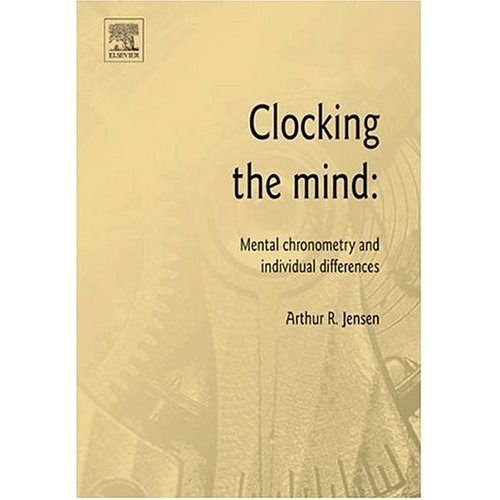
Thanks to an annonymous commenter for reminding me of the publication of Arthur Jensen's new book: Clocking the Mind: Mental Chronometry and Individual Differences.
As mentioned in a prior post (click here), Jensen is "the" name associated with the use of reaction time measures in the search for the essence of g (general intelligence). Although my prior post was in reference to an "in press" article that suggested that measures of temporal processing (vs. reaction time) may represent a temporal g ability that may be equal to or better than Jensen's reaction time paradigm, there is little doubt that Jensen's treatise will be relevant to understanding mental or interval time keeping. I'm anxious to see if Jensen draws any links to temporal processing and elementary timing tasks.
I placed my order for the book this evening. I also conducted a search for any professional reviews of the book, but could find none. If any readers become aware of any professional reviews of this book, please notify me.
Below is the description for the book provided by the publisher (I lifted this from Amazon.com)
Mental Chronometry (MC) comprises a variety of techniques for measuring the speed with which the brain processes information.
First developed in mid-1800, MC was subsequently eclipsed by more complex and practically useful types of psychometric tests stemming from Alfred Binet. This class of mental tests, however, has no true metric relating the test scores to any specific properties of the brain per se. The scores merely represent an ordinal scale, only ranking individuals according to their overall performance on a variety of complex mental tasks. The resulting scores represent no more than ranks rather than being a true metrical scale of any specific dimension of brain function. Such an ordinal scale, which merely ranks individuals in some defined population, possesses no true scale properties, possessing neither a true zero or equal intervals throughout the scale. This deficiency obstructs the development of a true natural science of mental ability. The present burgeoning interest in understanding individual differences in mental abilities in terms of the natural sciences, biology and the brain sciences in particular, demands direct measures that functionally link brain and behavior. One such natural ratio scale is time itself - the time it takes the brain to perform some elementary cognitive task, measured in milliseconds.
After more than 25 years researching MC, Jensen here presents results on an absolute scale showing times for intake of visual and auditory information, for accessing short-term and long-term memory, and other cognitive skills, as a function of age, at yearly intervals from 3 to 80 years. The possible uses of MC in neurological diagnosis and the monitoring of drug effects on cognition, the chronometric study of special time-sensitive talents such as musical performance, and presents a theory of general intelligence, or g, as a function of the rate of oscillation of neural action potentials as measured by chronometric methods. Finally, Jensen urges the world-wide standardization of chronometric methods as necessary for advancing MC as a crucial branch of biopsychological science.
*Provides a different scale to report Mental Chronometry (MC) findings
*Argues for the global adoption of an absolute scale as opposed to the traditional ordinal scale
*An important contribution to MC researchers and psychologists and neuroscientists
Technorati Tags: psychology, educational psychology, neuropsychology, neuroscience, cognition, cogntive, intelligence, IQ, g, general intelligence, reaction time, temporal processing, temporal g, mental clock, mental time keeping, interval time, brain clock, Aurthur Jensen, mental chronometry, individual differences, IQ Brain Clock, IQs Corner
powered by performancing firefox
Is ADHD related to a poor internal mental clock?
 I just ran across a 2004 study that examined prospective (reproducing a 30 second time interval) and retrospective (how long did a task take?) time judgements in children with reading disorders and ADHD (RD and ADHD groups).
Although prior research with ADHD subjects has implicated deficient mental/interval time-keeping (at the milisecond level--see introduction/review of lit in actual article--see below) as a potentail causal mechanism for ADHD, the current study attempted to determine if ADHD subjects, consistent with Barkley's ADHD impaired behavioral inhibition conceptualization (which articulates four primary self-regulation subsystems--working memory and sense of time, internalization of speech, affect regulation, and "reconstitution" or the formation of novel, complex behavioral sequences), differed from RD subjects in more "everday" time perception/judgments.
With regard to the focus of Tick Tock Talk: The IQ Brain Clock blog, the most interesting finding was a difference between RD and ADHD subjects in retrospective time estimation. As stated by the authors:
- The most unusual and interesting finding of the study was discovering the retrospective exaggeration of ADHD children when judging how long the CCPT had taken. When asked “how long did that take?” of the CCPT, ADHD children gave more extreme estimates (“Oh! That took 3 hours!”). This finding underscores the temporal distortion problems found in ADHD (West et al., 2000). Childrens’ time estimations become less accurate with increasing duration of the time interval to be perceived, and distortion decreases with age (Zakay, 1992). Barkley’s theory emphasizes that ADHD childrens’ time judgements will be developmentally delayed relative to agemates.
- McGee et al. (2004). Time Perception: Does it Distinguish ADHD and RD Children in a Clinical Sample? Journal of Abnormal Child Psychology, Vol. 32, No. 5, October 2004, pp. 481–490 (click here to view)
Technorati Tags: psychology, educational psychology, school psychology, special education.learning disabilities, neuropsychology, neuroscience, ADHD, ADD, Barkley, interval timing, mental clock, master time clock, brain clock, reading disability, cognitive, cognition, intelligence, IQ, temporal processing, time judgements, time perception
powered by performancing firefox
Types of elementary timing or temporal processing experiences
According the Rammsayer and Brandler (2006, in press), a major controversy in the field of human timing is whether psychological time is governed by a unitary (domain-general) timing mechanism, separate (domain-specific) mechanisms, and/or whether a domain-general internal mental clock can explain the subset of distinct elementary temporal/timing experiences.
What are the major classes of elementary timing experiences that a master internal mental clock theory/model would need to explain? According the Rammsay and Brandler, they are:
Technorati Tags: psychology, educational psychology, cognition, school psychology, neuropsychology, neuroscience, neurology, intelligence, IQ, interval timing, mental timing, brain timing, master clock, brain clock, temporal processing, rhythum perception, temporal order judgements, IQ Brain Clock
What are the major classes of elementary timing experiences that a master internal mental clock theory/model would need to explain? According the Rammsay and Brandler, they are:
- Interval timing: Is often explained by the general assumption of a hypothetical internal clock based on neural counting. The neural pacemaker generates pulses or ticks with the number of pulses corresponding to a physical time interval that is recorded by an accumulator. The number of pulses counted during a given time interval is the internal representation of this interval.
- Rhythm perception: The subjective grouping of objectively separate events or discrimination processes in serial temporal patterns.
- Temporal-order judgment (TOJ): Refers to the question of how much time must intervene between the onsets of two different stimuli for their order to be perceived correctly.
- Simultaneity and successiveness: Concerned with the size of the temporal interval between two sensory events that is required for them to be perceived as two separate events (successiveness) rather than fused as one event (simultaneity)
Technorati Tags: psychology, educational psychology, cognition, school psychology, neuropsychology, neuroscience, neurology, intelligence, IQ, interval timing, mental timing, brain timing, master clock, brain clock, temporal processing, rhythum perception, temporal order judgements, IQ Brain Clock
Monday, October 16, 2006
Mental time keeping model: A sneak preview of "comming attractions"
 This is a preview post.
The figure on the left is a simple visual representation (from Buhusi and Mecck, 2005 article in Nature Reviews: Neuroscience) of the most prominent model of mental time keeping..namely....the pacemaker-accumulator model of timing based on scalar expectancy/timing theory (boy...is that a mouthful). Shortly, in a series of forthcomming posts, I will explain the basics of the pacemaker-accumulator model for an underlying internal (brain-based) mental/interval time clock. This will then be followed by posts devoted to some recent alternative models.
Technorati Tags: psychology, educational psychology, cognition, school psychology, neuropsychology, neuroscience, neurology, intelligence, IQ, interval timing, mental timing, brain timing, master clock, brain clock, IQ Brain Clock.temporal tracking, temporal processing,Interactive Metronome
Synchronized metronome tapping (SMT): WD-40 for the brain clock?
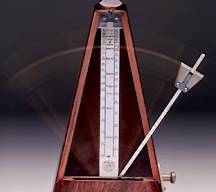 Can a person's internal master mental clock be improved? Can the temporal resolution, as reflected by a higher "clock rate," be improved vis-a-vis some form of intervention?
Enter.....one possibility...namely...synchronized metronome tapping (SMT). I won't repeat my prior original post re: the possible efficacy of SMT here (as operationalized by Interactive Metronome-IM), which also includes a necessary potential conflict of interest (click here to visit this post @ IQs Corner).
The purpose of this post is to make readers of this neophyte blog aware of where my interest in internal mental or interval time keeping started...as an external consultant to an SMT intervention study. More importantly, I want readers to know that this blog (Tick Tock Talk: The IQ Brain Clock) is NOT a blog for IM. My consultant statistical work for the IM studies simply started me down my current interest path in this area of cognitive functioning. Also, the current post should alert readers to the fact that the scope of the IQ Brain Clock blog will be to deal not only with mental/interval time-keeping theory and research, but also interventions that may improve cognitive performance via this brain-based mechanism.
Technorati Tags: psychology, educational psychology, cognition, school psychology, neuropsychology, neuroscience, neurology, intelligence, IQ, interval timing, mental timing, brain timing, master clock, brain clock, IQ Brain Clock.temporal tracking, temporal processing,Interactive Metronome
Subscribe to:
Posts (Atom)